The non-Nader factor: Back in May of this year, Politizine put together an extensive state by state polling analysis countering claims by Democratic front groups attacking the 2004 candidacy of Ralph Nader ["Anti-Nader study falls flat"]. What the analysis showed was that these groups were using flawed data – national preference polling – to come to the conclusion that Nader was harming Sen. John Kerry’s presidential effort. However, by examining individual state polls, those that determine the election of the president, Nader has little to no impact on the race. The analysis also showed that registered Democrats supporting the reelection of President George W. Bush were potentially a bigger problem for Kerry.
Six weeks and many more state polls later, the conclusion remains the same: Nader has little to no impact on Kerry’s campaign. In some polls, Nader actually helps Kerry gain better position against Bush.
Between Jan. 1 and July 9, 209 polls from 43 states of have been conducted. In most states, because of the demographics, the presidential race is essentially over.
In polls taken from Alabama, Arizona, Colorado, Indiana, Louisiana, Missouri, Montana, Nevada, North Carolina, Oklahoma, South Dakota, and Utah, Kerry loses with or without Nader in the polls [Note: The polls from North Carolina were held before Sen. John Edwards was chosen to be Kerry’s running mate]. Nader has not been included in polls taken from Arkansas, Georgia, Kansas, Kentucky, Mississippi, South Carolina, Tennessee, Texas, and Virginia [Note: The only poll from Virginia by Rasmussen Reports was within the margin of error but historically, this has been a safe Republican state]. There have been no polls taken in Alaska, Idaho, Nebraska, North Dakota, and Wyoming, but all the states are considered to be safe Bush states. Winning these states will award 207 Electoral College votes to Bush.
In almost all the polls taken from California, Connecticut, Illinois, Iowa, Maine, Maryland, Massachusetts, Minnesota, New Jersey, New York, Rhode Island, Vermont, and Washington, Kerry wins the state with or without Nader on the ballot. [Note: In one poll Fairleigh Dickinson from New Jersey in early April, Nader's appearance in the poll shifted the state from Kerry to Bush. However, countering this anomaly are six other polls showing Kerry with leads in an otherwise safe Democratic state]. There have been no polls in Delaware, the District of Columbia, and Hawaii, safe Kerry states. Winning these states will award 200 Electoral College votes to Kerry.
Nader’s positive impact
In some states, Nader’s candidacy has a positive influence on Kerry’s poll positions despite the relentless attacks against the independent candidate.
In a June 5-8 Los Angeles Times poll in Ohio, Nader takes more votes from Bush than Kerry, by a three-to-one ratio. It is enough Bush votes to help Kerry win the state by a wider margin than without Nader included in the poll. Without Nader: Kerry 46, Bush 45. With Nader: Kerry 45, Bush 42.
In a March 25-29 Keystone Poll from Pennsylvania Nader earned more Republican than Democrat votes by a 4-to-3 margin.
In a March 22-23 West Virginia ARG poll Nader’s appearance in the poll helped improve Kerry’s position in the state. Nader lures enough registered Democrat voters who planned to vote for Bush – a two-to-one margin – to help Kerry tie Bush in the state. With Nader: 46-46. Without Nader: Bush 47, Kerry 46. In this poll, Bush received a massive 22 percent of the registered Democrat vote.
In a March 15-18 ARG New Hampshire poll Nader garnered the support of 9 percent of Republicans compared to 4 percent of Democrats, a more than two-to-one margin and virtual repeat of what occurred in 2000, with Bush leading in the state with or without Nader [According to CNN exit polls, Nader received 2 percent of the Republican vote and 1 percent of the Democrat vote in 2000. Check out Debunking the Myth for more data on the 2000 results: ["Debunking the Myth"] ].
In 16 other polls from Ohio, New Hampshire, and West Virginia, Kerry and Bush switch off leads with no Nader impact.
Where Nader could be a factor
In 12 of 209 state polls – or 5.7 percent of all state polling done so far in the campaign - Nader could potentially be a factor. However, other data within these polls reveal bigger problems for Kerry than Nader’s candidacy.
In Florida there have been 13 polls, with leads flipping back and forth between Bush and Kerry. Kerry has taken slight leads in recent polls. In most, polling agencies have included two versions: One with and one without Nader. In three polls, Nader’s appearance cancels out a Kerry lead – but does not deliver a Bush win, a literal replay of 2000.
In a June 23-27 Quinnipiac University poll, Kerry posted a 46 to 44 lead. But with Nader in the poll, the numbers shift to a 43-43 tie, with 5 percent for Nader.
An American Research Group [ARG] poll from May 15-17 shows Bush leading 47-46, with Nader receiving 3 percent. Without Nader, the results are 47-47.
An ARG poll from April 18-20 showed similar results: Bush with 46, Kerry at 45, and Nader again receiving 3 percent. Without Nader, the results were 46-46.
But by looking deeper into the Florida polls, problems that have nothing to do with Nader arise.
In the Quinnipiac poll, five times as many Democrats plan to vote for Bush than Nader. Nader’s candidacy also cuts into Bush’s Democrat vote totals, dropping from 12 percent in a two-way race to 10 percent in a three-way race. In the May ARG poll, Bush receives more than three times the Democrat vote that Nader does: 11 to 3 percent. In the June ARG poll showing a Kerry lead, Bush receives 11 times the Democrat vote as Nader, 11 to 1 percent. In that poll, Nader received 1 percent of the Republican vote, earning equally from both sides.
This is a repeat of 2000 when a tiny percentage of Democrats, 1 percent, voted for Nader but many more voted for Bush: 13 percent and a virtual tie in the state.
Sixteen Michigan polls show similar results as Florida, with back and forth leads, regardless of whether Nader is included or not. Most polls have Kerry in the lead in the state. However, in two of those polls, Nader’s appearance on the ballot hypothetically delivers the state to Bush.
In a FoxNews/Opinion Dynamics June 22-23 poll, Kerry has a 44-43 lead. But when Nader is included, the poll flips to a Bush 44-42 lead.
In a Detroit News June 24-28 poll, Bush received 44 to Kerry’s 43 with Nader getting 5 percent.
However, neither of these polls released more specific data from the poll like voter registration designation or data without Nader included in the polling, so no assumption can be made about whether Nader voters would automatically go to Kerry.
But in an ARG poll from July 9, which showed a Kerry lead [50-43-2], Nader earned equally from Republicans and Democrats: 1 percent, while Bush took 7 percent of the Democrat vote.
New Mexico is one place where Nader’s candidacy could be a factor.
In a March 30-April 1 ARG poll, Bush had 46 to Kerry’s 45, with Nader getting 3 percent of the vote. Without Nader, the results would again be a tie: 47-47.
However, Nader took equally from both registered Republicans and Democrats, 2 percent, while Bush received a whopping 20 percent of registered Democrats in the state – a 10 to 1 margin over Nader. Again, in this poll, registered Democrats – and not Nader – are keeping Kerry from potentially winning the state.
In a more recent ARG poll from the state, released on July 9, Kerry had the lead, 49 to 42, with Nader earning 3 percent. Kerry’s lead is secure despite 13 percent of Democrats voting for Bush and 3 percent voting for Nader.
In Oregon, there have been eight polls with two showing Nader potentially influencing the outcome.
In a May 3-5 ARG poll, Bush and Kerry were tied at 45, with Nader clocking in with 5 percent. Without Nader, the result would be Kerry 48, Bush 46. In this poll, 6 percent of Democrats were planning on voting for Bush, with 7 percent voting for Nader.
A Rasmussen Reports poll released on April 25 showed Bush and Kerry tied with 43 and Nader receiving 8 percent. Without Nader, Kerry received 46 with Bush getting 45, and 6 percent said they would vote for "some other candidate." So even with only two choices, the bulk of Nader’s support inflexibly stayed with their candidate. This polling data shines light on the mistaken premise that Nader’s candidacy "costs" Kerry the election. Again, many of Nader's supporters are not going to vote for Kerry under any circumstances so he gains nothing from a two-candidate race.
However, four other polls from Oregon showed Kerry beating Bush even with Nader on the ballot. And two other polls – one in March and one in May – showed Bush beating Kerry in Oregon with no Nader candidacy at all.
In Pennsylvania, there have been 15 polls taken, with Bush and Kerry in a tug of war. However, only two polls show any Nader impact.
A March 9-15 Quinnipiac poll showed Bush with 44, Kerry at 40, and Nader with 7 percent. Without Nader, Kerry takes the lead with 45 to Bush's 44 percent. In the polling data, Nader earned the support of 4 percent of registered Republicans and 6 percent registered Democrats. Democrats supporting Bush came in at 14 percent.
In an April 16-25 Pew Charitable Trusts poll, Bush and Kerry were tied with 42 percent. Nader received 5 percent. The poll did not ask voters how they would vote if Nader were not on the ballot. Yet in this poll, Bush received 12 percent of the vote from registered Democrats – four times as many Democrat votes as Nader received. Another 10 percent of Democrats were undecided or supporting other candidates. So a full 22 percent of Democrats in Pennsylvania were supporting Bush, another candidate other than Nader, or were undecided, while only 3 percent were supporting Nader.
In Wisconsin, there have been eight polls with two showing potential Nader impact.
In one, a June 3-8 Los Angeles Times poll, Bush and Kerry are tied 44-44. But when Nader is thrown into the mix, Kerry loses 2 percent, with Bush leading 44 to 42.
In another poll, conducted by the University of Wisconsin Survey Center, Bush leads 46 to Kerry’s 42 with Nader getting 5 percent.
Like the Michigan polls, these did not offer a "without Nader" option or any specific registration data, so no impact can be properly vetted. The UWSC poll did state that 90 percent of Republicans were backing Bush and 85 percent of Democrats were voting for Kerry. Kerry led among independent voters but no numbers were given. In two other polls from Wisconsin, Bush led Kerry with no impact by Nader, similar to results from Oregon.
There are four months until Election Day but the conclusion is clear: Nader is a non-factor at this point in the presidential race. Registered Democrats voting for Bush potentially could cost Kerry the presidency. As well, Green Party candidate David Cobb, who is on 23 ballot lines and has changed his mind about a "safe-state" approach, is more of a potential threat to Kerry than Nader who is only on 10 ballot lines. Lastly, as of July 9, Kerry had an Electoral College lead over Bush: 286 to 252, with other Web sites which track EC votes showing higher numbers for Kerry. In other words, at this point in the campaign, Kerry would win the presidency with or without Nader in the race.
Saturday, July 10, 2004


Thursday, July 8, 2004
Edwards gives Dems hope for November
Presumptive Democratic nominee Mass. Sen. John Kerry made a dynamic vice presidential choice Tuesday morning which should shift his sagging presidential campaign into overdrive.
Kerry chose North Carolina Sen. John Edwards as his running mate, calling him a man who "understands and defends the values of America" and "whose life has prepared him for leadership, and whose character brings him to exercise it," according to the Associated Press. The choice is a good one for Kerry and puts the Democrats in an even better position to take back the White House in November.
Throughout the primary process, Edwards was often the second choice candidate of voters. New Hampshire primary voters, who also cast votes for vice president in a non-binding referendum, cast more than 16,600 votes for Edwards. The high number of VP votes in the state inspired the Democratic insiders and the establishment media to spin the virtues of a Kerry/Edwards ticket. This spin, unfortunately, helped to derail Edwards' effort. Even though he said on a number of occasions that he wouldn't be Kerry's running mate, the insiders and the media got their wish.
And this isn't such a bad thing. Edwards has the Clintonesque Southern charm and personality without all the questionable ethics, morals and glad-handling. He isn't a career politician, having spent many years as a trial lawyer, taking on powerful interests and winning judgments for clients who had nowhere else to turn.
Edwards also has a moving life story to tell the undecided voters of America. The son of a mill worker and a postal clerk, Edwards was the first one in his family to go to college. He clearly understands what it is like to live amongst the lower middle class and knows what it means to work hard to earn what you have. His campaign theme - "Two Americas," one for the privileged and the other for the rest of us - was believable because he had been there. These values, or acknowledgement of such values, are important to the sea of red states between Pennsylvania and California which President George W. Bush won in 2000. When juxtaposed with Kerry and his Ivy League, privileged background, the decision to pick Edwards becomes even clearer.
On issues, both Kerry and Edwards are similar, approaching policy from the more centrist side of the party, despite criticism to the contrary. Both foolishly supported bad Bush policies like the invasion for Iraq resolution, the USA PATRIOT Act, and the unfunded federal mandate, No Child Left Behind. Both also supported Permanent Most Favored Nation trade status with China during Clinton's presidency, although Edwards actively campaigned against bad trade deals in the primaries. All of these votes in any other election would potentially hurt them with swing and liberal voters.
There is a good chance that Edwards will overshadow Kerry in the charisma, performance, and message departments, something Kerry probably thought a little bit about. The Republicans are clearly worried - starting their attacks 15 minutes after Kerry made the announcement - ridiculing Edwards' work as a lawyer and Kerry's comments that Edwards didn't have enough experience.
There is also the risk of having two senators on the ticket together. Only a couple of times in American history have two senators been able to win the presidency together. Although, the last time two senators competing for the nomination were on the ticket together, they won. In 1960, another JFK, John Kennedy, chose Texas Sen. Lyndon Johnson to be on the ticket and the two slipped by then-Vice President Richard Nixon and Henry Cabot Lodge Jr., another Mass. senator, in a squeaker of a contest.
This November, the election will be another close one.
With the unpopular war raging on and the economy sputtering, most Democrats and independents seem energized with the prospect of changing direction. For months the angry mantra has been, "anyone but Bush," or ABB. But despite this anger, Kerry has been unable to gain ground on the incumbent. Most of the blame for this can be put on Kerry's spotty political record and flip-flopping on numerous issues.
Both Bush and Kerry are essentially in a dead-heat, with minor third party and independent candidates earning small fractions of the vote. The election, the experts say, will come down to a handful of states. But, if Kerry can hold onto the states Vice President Al Gore won in 2000 and possibly pick up Edwards' home state of North Carolina, Bush will lose the election, with or without the state of Florida.
In the end, that is probably why John Edwards was picked and it was a good choice.
Thursday, July 1, 2004
Summer music doldrums
There was some pretty big news in the music world last week when the very popular Lollapalooza tour for this summer scrapped the entire tour just a few days after tickets went on sale.
The announcement came as a surprise because this year's tour looked like one of the stronger lineups in the last few years, even if the bands scheduled to play were not multi-platinum artists. Morrissey, alt-rockers The Flaming Lips, the art noise band Sonic Youth, and the delightful Polyphonic Spree were all scheduled to play during the 16-city tour. The tour also planned to have a second stage - powered entirely on solar energy - and MoveOn.org was sponsoring a voter registration drive.
Everyone in the music business was shocked by the cancellation which made national news. But, after a little analysis, it isn't that surprising that this tour - and others - have been cancelled. The music business is going through some serious changes and most have nothing to do with the file sharing controversy.
The most obvious culprit is a bad economy which is taking a toll on middle class folks who might take in a concert or two during the summer. If you think about it, the recent rise in gas prices weekly are about the cost of a concert ticket.
Other priorities in life also change the way the buying public spends its money. Most of the bands slated for Lollapalooza were "Generation X" bands. As we all know, we X-ers are getting older, buying homes, and raising families. Sure, we still might still hope to see a band or two, but the summers where we are out all week drinking and seeing bands are long behind us.
Another problem is the ticket price itself which some industry experts say has doubled over the last eight years. Recent Madonna tickets were priced as high as $300. Who is going to pay that? You really have to be a "material girl" to afford those tickets. The Lollapalooza tickets, however, seemed reasonably priced, around $30 for an all day show. It also doesn't help that a handful of companies now controls all of the ticket sales and concert promotions for the entire country, charging exorbitant fees and surcharges.
Personally, I have sworn off the big stadium concerts and my reasons go beyond the high ticket prices. Some readers may recall a column I wrote about seeing The Who at the Tweeter Center two years ago and how disturbing it was waiting in line for so long, being herded around like cattle and then frisked like I was a terrorist or something. Sorry, I'll wait for the live concert DVD, pay less money, and enjoy the concert repeatedly on my very loud stereo.
But the biggest problem of all is the music business itself and how wretched it has become. In some ways - I can't believe I am saying this, I sound like an old-timer - I miss the good old days of rock 'n' roll when a song became part of your life at the first moment you heard it. I long for the day when musical artists cared more about their art and less about their financial portfolios. In some ways, it isn't the artist's fault. There have always been crappy bands, signed by accountants masquerading as music lovers. A lot of these record company execs even ripped off artists - and continue to do so - with bad recording contracts that offer fewer rights than migrant workers have. Most artists make their money from touring and T-shirt sales. With tours tanking in the marketplace one has to wonder what some of these people are going to do to put food on the table.
Then, there is radio, which has been in a steady decline both in listenership and quality.
Radio has also been so formatted that very hard to find something fresh and new. Sure, college and community radio stations still challenge the listener. But their signals can be so small that unless you live right on top of the station, you can't pick it up. It is hard to imagine that just two decades ago the modern rock format was born out of the boredom of what has now become classic rock. Most of the bands were groundbreaking and some went on to become very popular.
But along the way, record companies wrecked this music too, by bombarding the listener with mediocre copycat bands with similar styles to those who made the "new wave." Instead of putting in the time and effort to find unique bands, record labels just turned on the cookie-cutter machine and everything started to sound the same. As one artist put it, a band like The Doors would never get signed in a million years because of their originality.
Over the last few years, alternative switched gears and basically became re-treaded metal - driving listeners away in droves. At the same time, Top 40 radio stations no longer air pop songs, preferring to pummel their audiences with grunts, samples, and screeching disguised as music.
Then, there are the pathetic stunts musicians pull to keep themselves in the limelight. Some are just plain silly, like lesbian kissing scenes on national television. Others are downright embarrassing.
Take INXS, one of my favorite bands, which now has a new reality TV series recently picked up by CBS. The band will try out aspiring singers, ala "American Idol," with the finalists living in Hollywood together until a winner is chosen. The winner then gets to go on tour with the band next year. It's pretty sad that a group of good musicians has to stoop this low just to make a comeback. Somewhere, their mate, the late singer Michael Hutchence, an amazing performer and songwriter who cared about his craft, is spinning in his grave.
Something has to give and hopefully, changes can be made. A good start would be musicians worrying less about the business aspect of the industry and embracing the art and joy of music again. That was originally the point, wasn't it? Record labels could also help by nurturing an artist instead of worrying about the quarterly spreadsheets. With the state of the music business now, nothing can hurt.
Thursday, June 24, 2004
Markey eyes U.S. Senate
Anyone who doesn't think that the Massachusetts political landscape will be turned upside in the wake of Sen. John Kerry being elected president of the United States should think again. Kerry hasn't even won and already a number of Democrats are prepping to run for the presumed open seat.
While mingling with Democratic supporters at Saturday night's Winchester Area Democracy in Action event, Rep. Ed Markey, D-Mass., said he will be a candidate for the open seat if Kerry wins. Markey's confirmation wasn't much of a surprise. Some of his supporters have already begun talking up his candidacy and fund-raising letters promoting the special election have reportedly been sent out to potential donors. Markey considered running for the seat in 1984 against Kerry.
But Markey isn't the only member of the state's delegation rumored to be eyeing Kerry's seat.
Rep. Marty Meehan, Rep. Stephen Lynch, Rep. Bill Delahunt, and Rep. Barney Frank are all rumored to be ramping up their campaign committees for an early 2005 special election primary. Former 2002 gubernatorial candidate Robert Reich has also been mentioned as a possible candidate.
And why not run? A special election to fill Kerry's seat is essentially a free pass - no one running will have to relinquish his elected post during the campaign. The race would probably be short and nasty, with many millions of dollars thrown around and divergent Democrat Party interests going at each other.
Lynch would represent pro-life voters and those few lunch bucket Reagan Democrats left in the state while getting good numbers from conservative suburban voters. Frank and Reich would get the bulk of their support from the liberal intellectual enclaves, like Cambridge and Amherst, and could effectively cancel each other out in a tight, low turnout primary. Meehan's base is in the Merrimack Valley but he would pick up centrist votes from certain sectors of the high technology community, who tend to be independent swing voters. Ditto Delahunt whose congressional district - a bastion of moderate and conservative voters since redistricting - has seen spurts of growth.
So where would Markey's statewide support come from? And will his slippery positions on some issues and centrist stance allow him to compete for fickle primary votes in a race with the likes of Frank or Lynch?
Markey's remarks on Saturday had all the makings of a campaign stump speech and show why he will be competitive against anyone [Markey does have a Republican opponent, Ken Chase, and an independent opponent, former Democrat Jim Hall - so he is in campaign mode]. The incumbent verbally lashed out at the Republicans currently in control of D.C. and at President Bush for lying about the invasion of Iraq. But he conveniently disregarded his own vote for the invasion. Markey attacked Attorney General John Ashcroft's secrecy yet failed to mention his own support for the Constitutional-challenging PATRIOT Act and other anti-terrorism legislation. Markey complained that Republicans were passing bills in the dead of night and faulted the media for not covering the discretions. Yet, at the same time, he ignored his own role in weakening the media with the passage of the 1996 Telecommunications Bill which allowed a handful of corporations to gobble up all the radio and TV stations, effectively limiting the news coverage.
The throngs of cheering concerned voters at the event didn't seem to notice - or mind - the duplicity. Instead, they enjoyed the political invectives, rightfully angered by the state of the nation.
But listening to Markey complain - while ignoring his role in enabling the problems - was disheartening at best, frightening at worst. And one has to wonder how it will sell on the statewide political stage.
At the same time, Republicans are frantically trying to squelch the special election legislation.
And why shouldn't they? As the law stands now, Romney gets to select Kerry's successor. This law has been in effect since the time when senators were selected by the Legislature and not elected by the people. Some suggest Romney would nominate himself. Others say he could tap Lt. Gov. Kerry Murphy Healy. Former Suffolk D.A. Ralph Martin's and Convention Board chairwoman Gloria Larson's names have also been floated, with Turnpike Authority Board member Christy Mihos saying he would consider running in a special election.
However, are the Democrats overstepping their bounds by even suggesting a special election? Yes, holding onto Kerry's senate seat is extremely important. But the last time the Democrats pulled a ruse like this it backfired.
Earlier this year when the state senate set up a special election to be held on the Democrat's presidential primary day, more voters than expected voted. Some were so angry that they swung to the right and elected a very conservative Republican in otherwise safe Democratic territory. Do Democrats want to repeat this political mistake with a U.S. Senate seat?
Knowing the Democratically-controlled Legislature like we do, I doubt they will pass up the opportunity to do what is in the best interests of their party. Plus, if one of the congressional candidates wins, there will be another special election to fill the congressional vacancy. Who better to run for that seat than state reps and senators waiting for the chance to move up and out?
Combine all of this with Green-Rainbow and Libertarian candidates, candidates scrambling to get 10,000 qualifying signatures in a couple of weeks, and one thing is for sure: A special election for Kerry's seat will be a free-for-all - and every political junkie's dream.
Monday, June 14, 2004
Goodbye, for now:
As of this moment, I am suspending publication of Politizine until further notice. I have decided to spend what precious personal time I have working on other projects. However, I do want to thank the thousands of people who have viewed this site over the years and the hundreds who have sent emails of support, news links, and political thoughts. I have great hope for the world because of all of you out here in online land. Thank you all so much - it was a lot of fun. And don't forget to vote!
Tony
Sunday, June 13, 2004
Buchanan promotes Nader:
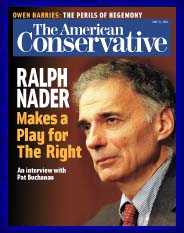
The cover of the 2004 campaign? Ralph Nader makes a play for conservatives.
Conservative commentator and former presidential candidate Pat Buchanan lobs a softball interview to Ralph Nader in the latest edition of The American Conservative Magazine: ["Ralph Nader: Conservatively Speaking"]. This is pretty amazing stuff and clearly proves the case Nader has been making: He can appeal to both conservatives pissed off at President George W. Bush and liberals who are just not going to vote for John Kerry. Combine this with the efforts of conservatives across the country to get Nader on the ballot in states and donate money to his campaign, and Nader's strategy seems to be working. With Kerry's current Electoral College lead over Bush in most surveys and we will have a new nation by November! Conservative-Naderites - a new political designation? Maybe after all.
U.S. Senator from N.H., hmm ...:
It really sucks to be Democrat N.H. state Sen. Burt Cohen right now.
For the last 18 months, Cohen has been gunning for Republican Sen. Judd Gregg. And why not? Sure, Gregg isn't as bad as most Republicans - but he is still pretty bad. With Kerry looking good here, maybe Cohen could pull off a miracle. Cohen had some pretty good radio ads but didn't seem to have as powerful a message as other Democrats. While he was quick to criticize Republicans, he was tentative on solutions to the issues - which was a problem. But somebody over at the campaign was pilfering campaign funds: ["Sources: Cohen Campaign Funds May Have Been Stolen"]. The fledging PoliticsNH site broke the story first: ["Cohen drops U.S. Senate bid one day before filing period ends"] while word spread around the Web about what was happening.
However, what a tempting situation. Apparently in N.H., registered party members don't have to collect signatures, all they have to do is sign up for the race and they are on the ballot. How easy is that? But just when all hope is lost, the Democrats have a true champion who signed up to run: Granny D!: ["Granny D and two others file for U.S. Senate"]. As the song goes, Go Granny go Granny go Granny go! You have my vote for sure.
In other political news ...:
U.S. Rep. Mike Capuano, D-MA-8, escaped a real close one after former Ambassador Charles Stith decided not to challenge him as an independent this fall: ["Stith decides against a run for Congress"]. And here is my old bud Paul Simmons - finally getting into the papers - by shooting his mouth off in the Boston Phoenix: ["STITH VERSUS CAPUANO"].
Ouch. While Simmons is probably correct - Stith would lose - he would hardly be road kill, one of Simmons' fave expressions. It would have been a difficult race. Stith was planning on running as an independent - a very difficult task, especially with the arrogant media, who would probably ignore his campaign. However, Stith could easily lay the ground work for 2006, when Capuano is most assuredly going to run for governor against Mitt Romney. And let's be honest: While there is all kinds of talk about "diversity" in Massachusetts, they always manage to find a way not to actually implement diversity. Twelve white males representing them in the Senate and Congress. What an example. There are more black Republicans in elected office in most states then there is in Massachusetts. While Capuano is an okay rep., a Stith campaign would have been a good thing for the state and the black community.
"You say times are tough ..."
Who says ex-rock and rollers can't run for public office? Here is one of my faves, Peter Garrett, running for a Labor Party seat in Australia: ["Ex-Midnight Oil Singer Runs for Office"]. There is hope in the world.
Sunday polls:
Illinois: Kerry 52, Bush 39 [Survey USA].
Michigan: Kerry 45, Bush 43, Nader 3 [EPIC/MRA].
Missouri: Bush 48, Kerry 37, Nader 5 [L.A. Times].
New Hampshire: Bush 46, Kerry 46, Nader 2 [American Research Group, without Nader both Bush and Kerry have 47].
Ohio: Kerry 45, Bush 42, Nader 4 [L.A. Times, without Nader it's Kerry 46, Bush 45. Nader takes more votes from Bush than Kerry].
Pennsylvania: Kerry 47, Bush 46 [Survey USA].
Wisconsin: Bush 44, Bush 42, Nader 4 [L.A. Times, without Nader Kerry and Bush are tied with 44].

The cover of the 2004 campaign? Ralph Nader makes a play for conservatives.
Conservative commentator and former presidential candidate Pat Buchanan lobs a softball interview to Ralph Nader in the latest edition of The American Conservative Magazine: ["Ralph Nader: Conservatively Speaking"]. This is pretty amazing stuff and clearly proves the case Nader has been making: He can appeal to both conservatives pissed off at President George W. Bush and liberals who are just not going to vote for John Kerry. Combine this with the efforts of conservatives across the country to get Nader on the ballot in states and donate money to his campaign, and Nader's strategy seems to be working. With Kerry's current Electoral College lead over Bush in most surveys and we will have a new nation by November! Conservative-Naderites - a new political designation? Maybe after all.
U.S. Senator from N.H., hmm ...:
It really sucks to be Democrat N.H. state Sen. Burt Cohen right now.
For the last 18 months, Cohen has been gunning for Republican Sen. Judd Gregg. And why not? Sure, Gregg isn't as bad as most Republicans - but he is still pretty bad. With Kerry looking good here, maybe Cohen could pull off a miracle. Cohen had some pretty good radio ads but didn't seem to have as powerful a message as other Democrats. While he was quick to criticize Republicans, he was tentative on solutions to the issues - which was a problem. But somebody over at the campaign was pilfering campaign funds: ["Sources: Cohen Campaign Funds May Have Been Stolen"]. The fledging PoliticsNH site broke the story first: ["Cohen drops U.S. Senate bid one day before filing period ends"] while word spread around the Web about what was happening.
However, what a tempting situation. Apparently in N.H., registered party members don't have to collect signatures, all they have to do is sign up for the race and they are on the ballot. How easy is that? But just when all hope is lost, the Democrats have a true champion who signed up to run: Granny D!: ["Granny D and two others file for U.S. Senate"]. As the song goes, Go Granny go Granny go Granny go! You have my vote for sure.
In other political news ...:
U.S. Rep. Mike Capuano, D-MA-8, escaped a real close one after former Ambassador Charles Stith decided not to challenge him as an independent this fall: ["Stith decides against a run for Congress"]. And here is my old bud Paul Simmons - finally getting into the papers - by shooting his mouth off in the Boston Phoenix: ["STITH VERSUS CAPUANO"].
"Stith would be road kill," Simmons says. "Capuano is arguably the best field politician currently in Massachusetts, as he proved in the 1998 race. I wonder if this isn’t some sort of trial balloon, because Charlie Stith never struck me as being politically stupid — and it would be stupid to the point of masochism for him to run."
Ouch. While Simmons is probably correct - Stith would lose - he would hardly be road kill, one of Simmons' fave expressions. It would have been a difficult race. Stith was planning on running as an independent - a very difficult task, especially with the arrogant media, who would probably ignore his campaign. However, Stith could easily lay the ground work for 2006, when Capuano is most assuredly going to run for governor against Mitt Romney. And let's be honest: While there is all kinds of talk about "diversity" in Massachusetts, they always manage to find a way not to actually implement diversity. Twelve white males representing them in the Senate and Congress. What an example. There are more black Republicans in elected office in most states then there is in Massachusetts. While Capuano is an okay rep., a Stith campaign would have been a good thing for the state and the black community.
"You say times are tough ..."
Who says ex-rock and rollers can't run for public office? Here is one of my faves, Peter Garrett, running for a Labor Party seat in Australia: ["Ex-Midnight Oil Singer Runs for Office"]. There is hope in the world.
Sunday polls:
Illinois: Kerry 52, Bush 39 [Survey USA].
Michigan: Kerry 45, Bush 43, Nader 3 [EPIC/MRA].
Missouri: Bush 48, Kerry 37, Nader 5 [L.A. Times].
New Hampshire: Bush 46, Kerry 46, Nader 2 [American Research Group, without Nader both Bush and Kerry have 47].
Ohio: Kerry 45, Bush 42, Nader 4 [L.A. Times, without Nader it's Kerry 46, Bush 45. Nader takes more votes from Bush than Kerry].
Pennsylvania: Kerry 47, Bush 46 [Survey USA].
Wisconsin: Bush 44, Bush 42, Nader 4 [L.A. Times, without Nader Kerry and Bush are tied with 44].
Wednesday, June 9, 2004
Montana primary:
Democrat:
Kerry - 58,973 - 67.9 percent - 14 delegates.
Kucinich - 9,109 - 10.5 percent.
Edwards - 8,059 - 9.3 percent.
No Preference - 6,172 - 7.1 percent.
Clark - 3,837 - 4.4 percent.
LaRouche - 740 - 0.9 percent.
Republican:
Bush - 93,502 - 95.2 percent.
No Preference - 4,707 - 4.8 percent.
New Jersey:
Democrat:
Kerry - 191,816 - 92.1 percent - 106 delegates.
Kucinich - 9,074 - 4.4 percent.
LaRouche - 4,528 - 2.2 percent.
George Ballard - 2,758 - 1.3 percent.
Republican:
Bush - 211,218 - 100 percent - 52 delegates.
Sunday, June 6, 2004
Sunday headlines ... and questions:
I am going to be busy today so instead of posting the usual weekend rant, here are some headlines for everyone to peruse:
What is going on in Bush's mind?: ["Bush's Erratic Behavior Worries White House Aides"]. Holy sh*t:
Very interesting. There is also this, a pretty good overview of Bush's flip-flops by consultant Dan Payne: ["'Steadfast' Bush's amazing flip-flops"].
Why are liberals worried about Kerry?: Here's why: ["Liberal activists lukewarm on Kerry"]. I meant to post this earlier in the week but I have been busy. Simply, the wrong Democrat is the nominee.
What's going on with Nader?: Nader's press coverage hasn't been bad considering this time four years ago there was practically nothing. Here is a pretty good piece by William Safire: ["Who's a 'spoiler,' and who's not?"]. Worrying about Kerry's energy policy is a legitimate issue these days, with gas prices where they are and no one calling Kerry on his positions: ["Nader skeptical about Kerry on energy"]. Though Nader doesn't mention it, people forget that Kerry was advocating new nuclear power plants in early 2001. But then, there is this: ["Candidates Risk 'Glum' Label for Criticism"]. Sure, this is a "news article" but is also soaked with opinion. The point shouldn't be lost however: Candidates opposing a popular incumbent need to get a bit more positive and allow the surrogates to be negative. Other articles include this one, about efforts to get Nader on the ballot in Mass.: ["Nader supporters crash graduations: Backers want enough signatures to put candidate on ballot"] and this one from New Jersey ["Nader's aim on a viable third party"].
Why isn't this guy mopping up floors somewhere?: ["Rome on $12,000 a Month: The Return of Cardinal Bernard Law"]. So, this is what the Pope thinks should be done to people who don't protect the most innocent among us? The holy father goes on and on about the unborn. Yet, when priests were raping boys, over and over again, for years and years, and Law did nothing but attack those who were being raped, the Pope rewards the man. This is a disgrace.
Sunday polls:
Alabama: Bush 57, Kerry 36, Other 4, Not sure 4 [Rasmussen].
California: Kerry 49, Bush 41, Other 5, Not sure 5 [Rasmussen].
Connecticut: Kerry 46, Bush 36, Nader 8 [Qunnipiac, Without Nader, Kerry gains 4 points, Bush gains 2 points].
Georgia: Bush 51, Kerry 39, Other 5, Not sure 5 [Rasmussen].
Georgia: Bush 49, Kerry 32 [Insider Advantage].
Illinois: Kerry 54, Bush 38, Other 2, Not sure 6 [Rasmussen].
Illinois: Kerry 53, Bush 37, Nader 4 [Market Shares Corp.].
Louisiana: Bush 48, Kerry 42 [Marketing Research Institute].
Maine: Kerry 54, Bush 35, Other 3, Not sure 7 [Rasmussen].
Michigan: Kerry 47, Bush 43 [Survey USA].
Minnesota: Kerry 48, Bush 43, Other 4, Not sure 5 [Rasmussen].
Missouri: Bush 44, Kerry 43, Other 5, Not sure 8 [Rasmussen].
New Jersey: Kerry 51, Bush 39, Other 4, Not sure 6 [Rasmussen].
New York: Kerry 57, Bush 34, Other 4, Not sure 5 [Rasmussen].
North Carolina: Bush 48, Kerry 44, Other 3, Not sure 5 [Rasmussen].
Ohio: Bush 46, Kerry 44, Other 5, Not sure 6 [Rasmussen].
Oregon: Bush 46, Kerry 45, Other 6, Not sure 3 [Rasmussen].
Pennsylvania: Bush 45, Kerry 44 [Rasmussen].
South Carolina: Bush 49, Kerry 39, Other 3, Not sure 8 [Rasmussen].
Texas: Bush 55, Kerry 38, Other 3, Not sure 4 [Rasmussen].
Virgina: Bush 47, Kerry 45, Other 3, Not sure 5 [Rasmussen].
Election Projection has the race Kerry 337, Bush 201: [http://www.electionprojection.com/elections2004.html].
Samboni now has it at Kerry 312, Bush 226: [http://www.geocities.com/samboni1342/state_polls.htm].
David Wissing has it at Bush 307, Kerry 231: [http://www.davidwissing.com/bushkerrystate2004.html].
MyDD Blog has it Kerry 316, Bush 222: [http://www.mydd.com/special/president].
Rasmussen comments on why they aren't including Nader in their polls here: ["Why We're Not Including Ralph Nader"]. Here is an interesting quote: "These polls have caused some to conclude that Nader will once again play the role of spoiler for the Democratic contender. We respectfully disagree."
I am going to be busy today so instead of posting the usual weekend rant, here are some headlines for everyone to peruse:
What is going on in Bush's mind?: ["Bush's Erratic Behavior Worries White House Aides"]. Holy sh*t:
"President George W. Bush's increasingly erratic behavior and wide mood swings has the halls of the West Wing buzzing lately as aides privately express growing concern over their leader's state of mind. In meetings with top aides and administration officials, the President goes from quoting the Bible in one breath to obscene tantrums against the media, Democrats and others that he classifies as 'enemies of the state.'"
Very interesting. There is also this, a pretty good overview of Bush's flip-flops by consultant Dan Payne: ["'Steadfast' Bush's amazing flip-flops"].
Why are liberals worried about Kerry?: Here's why: ["Liberal activists lukewarm on Kerry"]. I meant to post this earlier in the week but I have been busy. Simply, the wrong Democrat is the nominee.
What's going on with Nader?: Nader's press coverage hasn't been bad considering this time four years ago there was practically nothing. Here is a pretty good piece by William Safire: ["Who's a 'spoiler,' and who's not?"]. Worrying about Kerry's energy policy is a legitimate issue these days, with gas prices where they are and no one calling Kerry on his positions: ["Nader skeptical about Kerry on energy"]. Though Nader doesn't mention it, people forget that Kerry was advocating new nuclear power plants in early 2001. But then, there is this: ["Candidates Risk 'Glum' Label for Criticism"]. Sure, this is a "news article" but is also soaked with opinion. The point shouldn't be lost however: Candidates opposing a popular incumbent need to get a bit more positive and allow the surrogates to be negative. Other articles include this one, about efforts to get Nader on the ballot in Mass.: ["Nader supporters crash graduations: Backers want enough signatures to put candidate on ballot"] and this one from New Jersey ["Nader's aim on a viable third party"].
Why isn't this guy mopping up floors somewhere?: ["Rome on $12,000 a Month: The Return of Cardinal Bernard Law"]. So, this is what the Pope thinks should be done to people who don't protect the most innocent among us? The holy father goes on and on about the unborn. Yet, when priests were raping boys, over and over again, for years and years, and Law did nothing but attack those who were being raped, the Pope rewards the man. This is a disgrace.
Sunday polls:
Alabama: Bush 57, Kerry 36, Other 4, Not sure 4 [Rasmussen].
California: Kerry 49, Bush 41, Other 5, Not sure 5 [Rasmussen].
Connecticut: Kerry 46, Bush 36, Nader 8 [Qunnipiac, Without Nader, Kerry gains 4 points, Bush gains 2 points].
Georgia: Bush 51, Kerry 39, Other 5, Not sure 5 [Rasmussen].
Georgia: Bush 49, Kerry 32 [Insider Advantage].
Illinois: Kerry 54, Bush 38, Other 2, Not sure 6 [Rasmussen].
Illinois: Kerry 53, Bush 37, Nader 4 [Market Shares Corp.].
Louisiana: Bush 48, Kerry 42 [Marketing Research Institute].
Maine: Kerry 54, Bush 35, Other 3, Not sure 7 [Rasmussen].
Michigan: Kerry 47, Bush 43 [Survey USA].
Minnesota: Kerry 48, Bush 43, Other 4, Not sure 5 [Rasmussen].
Missouri: Bush 44, Kerry 43, Other 5, Not sure 8 [Rasmussen].
New Jersey: Kerry 51, Bush 39, Other 4, Not sure 6 [Rasmussen].
New York: Kerry 57, Bush 34, Other 4, Not sure 5 [Rasmussen].
North Carolina: Bush 48, Kerry 44, Other 3, Not sure 5 [Rasmussen].
Ohio: Bush 46, Kerry 44, Other 5, Not sure 6 [Rasmussen].
Oregon: Bush 46, Kerry 45, Other 6, Not sure 3 [Rasmussen].
Pennsylvania: Bush 45, Kerry 44 [Rasmussen].
South Carolina: Bush 49, Kerry 39, Other 3, Not sure 8 [Rasmussen].
Texas: Bush 55, Kerry 38, Other 3, Not sure 4 [Rasmussen].
Virgina: Bush 47, Kerry 45, Other 3, Not sure 5 [Rasmussen].
Election Projection has the race Kerry 337, Bush 201: [http://www.electionprojection.com/elections2004.html].
Samboni now has it at Kerry 312, Bush 226: [http://www.geocities.com/samboni1342/state_polls.htm].
David Wissing has it at Bush 307, Kerry 231: [http://www.davidwissing.com/bushkerrystate2004.html].
MyDD Blog has it Kerry 316, Bush 222: [http://www.mydd.com/special/president].
Rasmussen comments on why they aren't including Nader in their polls here: ["Why We're Not Including Ralph Nader"]. Here is an interesting quote: "These polls have caused some to conclude that Nader will once again play the role of spoiler for the Democratic contender. We respectfully disagree."
Saturday, June 5, 2004
Nearly half Nader voters would vote for Bush!
Thanks to Kevin for sending me some of the raw data from this ABC News/Washington Post Poll which shows almost half of Nader's support coming from Bush. I did a google and found the link: ["White House 2004: General Election"]. The poll talked to 1,005 adults over May 20-23.
When asked who they were supporting, the results were Bush 46, Kerry 46, Nader 4, None/Wouldn't vote 2, No Opinion 1.
However, when Nader and undecided voters were asked, "If Nader does not run or is not on the ballot, for whom would you vote: Bush or Kerry?" Bush got 47 percent to Kerry's 49 percent. In April, the results were Bush 49, Kerry 48.
So nearly half of Nader voters in May and over half of Nader voters in April planned to vote for Bush if Nader wasn't a choice. Again, more polling evidence that shows that Nader is hurting Bush just as much as Kerry and goes to the heart of what Nader has been saying about his 2004 campaign.
R.I.P. Reagan:
Ronald Reagan, the 40th president of the United States, died earlier this afternoon. Since I try to make a habit of not speaking ill of the dead, I won't say anything about his passing. I feel for his family and wish them condolences.
Friday, June 4, 2004
Alabama:
From June 1, Democrat:
Kerry - 162,958 - 75 percent - 44 delegates.
Uncommitted - 37,986 - 17.5 percent - 6 delegates.
Kucinich - 9,043 - 4.2 percent.
LaRouche - 7,241 - 3.3 percent.
Republican:
Bush - 186,926 - 93 percent - 45 delegates.
Uncommitted - 13,971 - 7 percent.
New Mexico:
Republican:
Bush - 47,341 - 21 percent.
South Dakota:
Kerry - 69,454 - 82.3 percent - 14 delegates.
Uncommitted - 5,104 - 6.0 percent - 6 delegates.
Dean - 4,837 - 5.7 percent.
LaRouche - 2,942 - 3.5 percent.
Kucinich - 2,043 - 2.4 percent.
Monday, May 31, 2004
SPECIAL REPORT: Anti-Nader study falls flat
Deeper analysis shows registered Democrats voting for Bush a larger threat than Nader; massive Kerry lead
A press release sent out last week by DontVoteRalph.net claiming Ralph Nader’s independent candidacy is impacting John Kerry’s presidential campaign in a negative way is founded on flawed analysis of national preference polls. It also ignores the fact that Kerry’s inability to hold registered Democrats in certain swing states has a more detrimental effect on his campaign than Nader does. Studying individual state polls reveals that Nader has negative, neutral and positive impacts on the Kerry campaign, with Kerry currently beating Bush by anywhere from 136 to 116 Electoral College votes – the votes that actually determine who becomes the president.
In the study, located at http://www.dontvoteralph.net/pollwatch.htm, the group performed a Google.com news search on May 13 and consulted the PollingReport.com site, eventually finding 37 national polls taken since Nader announced his candidacy. In their news release of May 26, 32 of those polls showed "that Nader directly helps Bush." Four reportedly showed no impact and one by FoxNews showed a 1 percent tilt towards Kerry.
"This study shreds the assertion by the Nader campaign that they will help beat Bush," stated John Pearce, Executive Director of Progressive Unity, in the press release. "Facts are facts, and these findings are overwhelming: Nader is directly helping Bush."
But is Nader really helping Bush? Are these the "facts"?
Faulty use of national polls
The first flaw of DontVoteRalph.net’s analysis is the use of national preference polls to determine the outcome of the presidential election. National polls are meaningless in electing the president. The president is elected by prevailing in each individual state and winning every state’s Electoral College votes. Whether Nader is earning 1, 2, 5 or whatever percent of the support in a national preference poll is pointless because the result has no bearing on the individual state voting. Since DontVoteRalph.net didn't analyze state polling data thoroughly, there is not one shred of proof that Nader "costs" Kerry anything.
The second flaw in this analysis of the national preference poll is the perception that somehow every single voter supporting Nader would automatically go to Kerry if Nader were not running for president. This is a completely false assumption. In 2000 – when Nader garnered a large section of left-leaning voters – only 45 percent said they would have voted for the Democratic nominee Al Gore had Nader not been in the race, according to the Voter News Service, the most extensive national polling consortium. Twenty-seven percent of Nader voters would have gone to Republican George W. Bush and the rest said they would not have voted at all. So, if less than half of Nader voters in 2000 would vote for the Democrat, why would anyone assume that 100 percent would vote for Kerry four years later? DontVoteRalph.net foolishly forwards this assumption in its analysis. As we have all heard time and time again, most liberal, progressive, and Democrat voters are taking an "anybody but Bush" stance. Kerry has already gained tens of thousands of Nader's 2000 votes and is in a better position to beat Bush than Gore was. There are still stubborn Nader supporters out there and there are thousands of Green-Rainbow and Socialists party members who will probably support their nominees. These voters aren't planning to vote for Kerry under any circumstances. So the Nader candidacy doesn’t help Bush or "cost" Kerry anything.
Individual state polls
On their site, DontVoteRalph.net states they did look at some state polls and they claim "the results were even more striking … show[ing] Nader flipping New Jersey and Pennsylvania from Kerry to Bush, and causing an 8% surge for Bush among the large Arab-American vote in four critical swing states." But is it really "striking" or "helping Bush"? Maybe; maybe not. David Wissing of The Hedgehog Report [http://www.davidwissing.com/bushkerrystate2004.html] is one of a handful of netizens who has been tracking state polling data for over six months. Unlike other Web sites that track polls, Wissing posts the Nader numbers – and the outcome without Nader – when available. The site has 59 polls in which Nader was included from 30 different states. In over 50 of those polls, Nader had no influence on the outcome, with other polls showing negative, neutral, or positive results for the Kerry campaign.
Nader: Negative, neutral, positive
In analyzing all the individual state data, Nader’s campaign does have some bearing on Kerry’s position in a few states.
On the negative side, in at least three states that Gore won in 2000, Nader could potentially influence the outcome of the election.
In a Fairleigh Dickinson April 3-10 poll in New Jersey, the results were Bush 48, Kerry 44, and Nader 5. But without Nader, Kerry benefits with 48 percent and Bush gets 47. However, countering this are four other polls from New Jersey done after the Fairleigh Dickinson poll which show Kerry beating Bush with or without Nader on the ballot.
In Oregon, a state Gore barely won in 2000, two polls show Nader potentially influencing the outcome. In a May 3-5 American Research Group [ARG] poll, Bush and Kerry were tied at 45, with Nader clocking in with 5 percent. Without Nader, the result would be Kerry 48, Bush 46. A Rasmussen Reports poll released on April 25 showed Bush and Kerry tied with 43 and Nader receiving 8 percent. Without Nader, Kerry received 46 with Bush getting 45, and 6 percent said they would vote for "some other candidate." So even with only two choices, the bulk of Nader’s support inflexibly stayed with their candidate. This polling data shines light on the mistaken premise that Nader’s candidacy "costs" Kerry the election. Again, many of Nader's supporters are not going to vote for Kerry under any circumstances so he gains nothing from a two-candidate race. Like in New Jersey, three other polls from Oregon showed Kerry beating Bush even with Nader on the ballot. But two recent polls - one in March and one in May - showed Bush beating Kerry in Oregon with no Nader candidacy at all. Again, more evidence that shows a potential loss for Kerry, without Nader, in the state.
Lastly, in Pennsylvania, a March 9-15 Quinnipiac poll showed Bush with 44, Kerry at 40, and Nader with 7 percent. However, without Nader, Kerry takes the lead with 45 to Bush's 44 percent. In the polling data, Nader earned the support of 4 percent of registered Republicans and 6 percent registered Democrats. Democrats supporting Bush came in at 14 percent.
However, another Pennsylvania poll shows Nader taking more Republican than Democrat votes by a 4 to 3 margin. In an April 16-25 Pew Charitable Trusts poll, Bush and Kerry were tied with 42 percent. Nader received 5 percent. The poll did not ask voters how they would vote if Nader were not on the ballot. Yet in this poll, Bush received 12 percent of the vote from registered Democrats – four times as many Democratic votes as Nader received. Another 10 percent of Democrats were undecided or supporting other candidates. So a full 22 percent of Democrats in Pennsylvania were supporting Bush, another candidate other than Nader, or were undecided, while only 3 percent were supporting Nader. Again, the Democratic base voting for Bush or another candidate costs Kerry the state. Kerry and Bush have been in a tug-of-war for the lead in other Pennsylvania polls, with most recent ones showing Kerry leading even with Nader on the ballot.
On the neutral side, recent polls from Florida show a replay of 2000 with essentially a tied race. An ARG poll from May 15-17 shows Bush leading 47 to Kerry’s 46 and Nader with 3. Without Nader, the results are a tie: Bush 47, Kerry 47. So while Nader "costs" Kerry 1 percent of the vote in this poll, the addition of Nader doesn’t guarantee a Kerry win in the state. An ARG poll from April 18-20 showed similar results: Bush at 46, Kerry with 45, and Nader in at 3. But without Nader, the results are again a tie: Bush 47, Kerry 47. So there is still no Kerry win in the state without Nader but some affect. However, look at some of the data buried in the May poll: Nader received 3 percent of registered Democrats [1 percent of the Republican vote] while Bush gets 11 percent of registered Democrats. This is almost a repeat of 2000 when 1 percent of Democrats voted for Nader and 13 percent voted for Bush, swinging the election to Bush. Clearly, in Florida, the Democratic nominee’s inability to hold his own base is more of a detriment to his candidacy than Nader.
In New Mexico, another state Gore barely won in 2000, the Nader candidacy has mixed results. In a March 30-April 1 ARG poll, Bush had 46, Kerry had 45, and Nader came in with 3 percent. Without Nader, the results would again be a tie, with Bush and Kerry getting 47 percent. However, Nader took equally from both registered Republicans and Democrats, 2 percent, while Bush received a whopping 20 percent of registered Democrats in the state – a 10 to 1 margin over Nader. Again, in this poll, registered Democrats – not Nader – are keeping Kerry from winning in New Mexico by voting for Bush.
On the positive side, in at least one poll from Ohio, Nader takes enough Republican votes to help Kerry win the state. In a late-March poll from West Virginia, Nader takes more Democrat votes by a two-to-one margin but the results affect Bush’s position in the state, not Kerry's. In that poll, Bush received a massive 22 percent of the Democrat vote. In many other states, Nader takes almost equally from both major party candidates, without changing the state outcomes. In a New Hampshire poll released in March by ARG, Nader garnered the support of 9 percent of Republicans compared to 4 percent of Democrats, a two to one margin and virtual repeat of what occurred in 2000, with Bush leading in the state with or without Nader.
Kerry's Electoral College vote lead
Different Web sites tracking state by state polls and compiling possible Electoral College results show Kerry with huge leads over Bush even with Nader in the race. Election Projection [http://www.electionprojection.com/elections2004.html] has the race at Kerry 337, Bush 201. Samboni1342, another Web site posting numbers, now has it Kerry 327, Bush 211 [http://www.geocities.com/samboni1342/state_polls.htm]. On Saturday, May 29, Wissing posted Kerry 289, Bush 249 results on his site, listed above. However, on Sunday, his results had shifted to Bush 296, Kerry 248 with new polls showing Bush leads in Ohio and other states but no Nader effect.
Conclusion: The anti-Nader site analysis is flawed
After looking at all the polling analysis that is available to date, there is no definitive evidence that shows Nader harming Kerry in any way. There is the potential for Nader to harm Kerry if the Democrat follows a similar path that Gore followed in 2000 and loses his clear lead at this point in the election. As well, the selection of a conservative or free trade vice presidential candidate by Kerry could alienate potential support for his cause and shift votes to Nader, similar to the support which shifted from Gore after his selection of Sen. Joseph Lieberman for the VP spot. However, the deeper data in some of the state polls goes to the heart of what Nader has stated in his 2004 campaign – and goes against statements and analysis forwarded by DontVoteRalph.net. In some swing states, Nader is taking more votes from registered Republicans than Democrats. In many others, Kerry's inability to keep the Democratic base from casting votes for Bush will cost him the election just as these voters cost Gore the election in 2000. A Kerry loss would be more a result of failing to keep his base from fleeing to Bush than Nader.
In the future, anti-Nader sites like DontVoteRalph.net should ignore national preference polling and perform a more expansive and accurate analysis of state polls before coming to suspect conclusions like they did on May 26. They should also spend less time attempting to deny the Constitutional rights of Nader to run for office and those people who want a third choice in 2004.
Kerry supporters should also spend more time trying to get Kerry elected and encouraging the candidate to pick a populist, fair trader for the vice presidential nomination, in order to earn the votes of Nader supporters instead of trying to scare them with flawed, baseless analysis.
Sunday, May 30, 2004
Sunday polls - Kerry's big lead:
The problems in Iraq and the sputtering economy are clearly damaging Bush's reelection campaign.
Alabama: Bush 54, Kerry 32, Nader 3 [Capital Survey Research Center].
Arizona: Bush 43, Kerry 38, Nader 2, Undecided 17 [Arizona State/KAET-TV].
Arkansa: Bush 49, Kerry 45, Nader 0 [Zogby].
California: Kerry 51, Bush 39, Nader 6 [Field Poll].
Florida: Kerry 49, Bush 48, Nader 1 [Zogby].
Indiana: Bush 54, Kerry 38, Nader 8 [Indianapolis Star/WTHR].
Iowa: Kerry 46, Bush 43, Nader 2 [Research 2000].
Iowa: Kerry 48, Bush 45, Nader/Undecided 8 [Survey USA].
Kentucky: Bush 49, Kerry 43 [Garin-Hart-Yank Research Group].
Louisiana: Bush 48, Kerry 29, Nader 0 [Multi-Quest].
Michigan: Kerry 50, Bush 41, Nader 0 [Zogby].
Minnesota: Kerry 51, Bush 42, Nader [Zogby].
Missouri: Kerry 47, Bush 44, Nader 0 [Zogby].
Montana: Bush 53, Kerry 33, Nader 8 [Mason-Dixon].
Nevada: Kerry 47, Bush 43, Nader 0 [Zogby].
Ohio: Bush 47, Kerry 41, Nader 3, Undecided 9 [Mason-Dixon]
Ohio: Kerry 49, Bush 45, Nader 0 [Zogby].
Pennsylvania: Kerry 44, Bush 41, Nader 6 [Quinnipiac].
Washington: Kerry 53, Bush 44, Nader 0 [Zogby].
West Virginia: Bush 48, Kerry 46, Nader 0 [Zogby].
Wisconsin: Kerry 52, Bush 43, Nader 0 [Zogby].
Election Projection has the race Kerry 337, Bush 201. Last week, they had Kerry 327, Bush 211: ["Election Projection"].
Samboni now has it at Kerry 307, Bush 231. Last week it was: Kerry 289, Bush 243, Undecided 6. Two weeks ago he had Bush 266, Kerry 258, Undecided 54: http://www.geocities.com/samboni1342/state_polls.htm.
David Wissing has it at Bush 296, Kerry 248. On Saturday he had it: Kerry 289, Bush 249. Last week he had it: Bush 276, Kerry 262. Two weeks ago he had Bush 280, Kerry 256: http://www.davidwissing.com/bushkerrystate2004.html.
Saturday, May 29, 2004
Quick headlines
I meant to post the correction notice which the New York Times published earlier this week about the paper's Iraq coverage ["Correction: The New York Times on Iraq coverage"] but I just didn't get around to it. As we all know, no one is perfect. Correction notices are published in all newspapers responsible enough to admit when they've published a mistake [Are you listening, Boston Globe?]. But how about this - an amazing overview of how reporter Judith Miller was duped over and over and over again by those advocating regime change in Iraq: ["How Chalabi and the White House held the front page"]. Here is a really great section which should frighten anyone who questions the NYT supposed liberal bias:
Do you think the NYT should have written a correction or offered payments to those who have been adversely affected by their coverage? Where do those people go to get their lives back? Where do the soldiers go to get their limbs back?
BTW, Miller is still employed at the Times.
More NYT errors: Can you imagine a better time to release a book about the huge mistakes over at the NYT? I doubt "Democracy Now'" Amy Goodman did: ["Fatal Error: The Lies of Our Times"].
Thank heaven, for the ACLU ... The protectors of civil rights have released more information on its legal challenge against the PATRIOT Act and the Justice Dept's obsession with ISPs: ["'John Doe' Revealed as Secret Client in Censored ACLU Patriot Act Case"].
Big dreamers?: Kerry hasn't even won yet but some "armchair strategists" are looking towards the future: ["Kerry's Cabinet? Here goes"]. Edwards as VP? Gephardt at Labor? McCain at Defense? Sounds reasonable.
Here is another more humorous point of view: ["Pros and Cons"].
And almost the entire congressional delegation is salivating at the chance to move up: ["SENATE RE-SEATING ARRANGEMENTS"].
What a bloodbath this one is going to be. Although, it depends.
As the law stands now, Gov. Romney gets to choose Kerry's replacement. Former DA Ralph Martin, a liberal black Republican, has been floated as a possible candidate. However, there is a bill in both houses of the Legislature which would change the law and instead, call for a special election sometime after the 2005 inauguration.
I've heard that Meehan [along with AG Tom Reilly] was looking at a gubernatorial race against Romney in 2006. So is Capuano. I doubt Delahunt is going anywhere fast. That leaves Frank, Lynch, Markey, and whoever else wants to jump in. Markey is a terrible campaigner, Lynch is pro-life, and Frank is too much of a leftist for most. However, Frank [or Meehan, if he were to run] probably has the edge. I agree with a lot of the analysis of Reilly's piece: In a large field, Lynch could pull off a tight win, similar to what he did in the 9th CD special election in 2001 after the death of Joe Moakley. If Lynch won, look for a whole slew of voters to abandon him for a pro-choice Republican or a Green Party candidate - although it is doubtful that they would be able to beat Lynch [This almost happened in the final part of the special election in 2001. Lynch was challenged by Socialist Worker's Party candidate Brock Satter, Conservative Party candidate Susan C. Gallagher-Long, and pro-choice Republican state Sen. Joanne Sprague, who got 37-plus percent of the vote in a district where only 11 percent were registered Republicans. There was speculation that Sprague could pull of a surprise victory. But in the end, Lynch was able to keep the Democrats in line and the media virtually ignored the final leg of the race].
However, if Kerry wins, it will all be so interesting ...
Plus, there is this: ["Kerry to spend $17m on ads in June"]. $17 million? Damn. In places like Virginia? Wow. Kerry is clearly showing some confidence with this move.
Nader's N.H. visit: Ralph Nader was in New Hampshire earlier this week stumping for volunteers and support. It is interesting to look at the different versions of just one press conference: ["Nader says he gets more votes from Republicans"] ["Nader says he's in it for the principle"] ["Nader has plan to get GIs out of Iraq"]. The AP Story was also published on the Globe's Web site. It is also interesting that the state Democratic Party held a conference call with former Nader supporters who are now planning on voting for Kerry. Do they do that when Bush, a Libertarian, or Green Party candidate come to town? Do reporters bother to cover such a conference call? Nader will speak to the National Press Club on June 3. Also, the Greens are debating the Nader factor too: ["Green Party debates picking own candidate or endorsing Nader"].
Update: I missed this nhpolitics post about the press conference, with their own spin: ["Nader draws more media than supporters in NH trip"].
"The White House had a perfect deal with Miller," [one CIA analyst] said. "Chalabi is providing the Bush people with the information they need to support their political objectives, and he is supplying the same material to Judy Miller. Chalabi tips her on something and then she goes to the White House, which has already heard the same thing from Chalabi, and she gets it corroborated. She also got the Pentagon to confirm things for her, which made sense, since they were working so closely with Chalabi. Too bad Judy didn't spend a little more time talking to those of us who had information that contradicted almost everything Chalabi said.Ten-thousand-plus dead Iraqis and 800-plus dead Americans later ...
Do you think the NYT should have written a correction or offered payments to those who have been adversely affected by their coverage? Where do those people go to get their lives back? Where do the soldiers go to get their limbs back?
BTW, Miller is still employed at the Times.
More NYT errors: Can you imagine a better time to release a book about the huge mistakes over at the NYT? I doubt "Democracy Now'" Amy Goodman did: ["Fatal Error: The Lies of Our Times"].
Thank heaven, for the ACLU ... The protectors of civil rights have released more information on its legal challenge against the PATRIOT Act and the Justice Dept's obsession with ISPs: ["'John Doe' Revealed as Secret Client in Censored ACLU Patriot Act Case"].
Big dreamers?: Kerry hasn't even won yet but some "armchair strategists" are looking towards the future: ["Kerry's Cabinet? Here goes"]. Edwards as VP? Gephardt at Labor? McCain at Defense? Sounds reasonable.
Here is another more humorous point of view: ["Pros and Cons"].
And almost the entire congressional delegation is salivating at the chance to move up: ["SENATE RE-SEATING ARRANGEMENTS"].
What a bloodbath this one is going to be. Although, it depends.
As the law stands now, Gov. Romney gets to choose Kerry's replacement. Former DA Ralph Martin, a liberal black Republican, has been floated as a possible candidate. However, there is a bill in both houses of the Legislature which would change the law and instead, call for a special election sometime after the 2005 inauguration.
I've heard that Meehan [along with AG Tom Reilly] was looking at a gubernatorial race against Romney in 2006. So is Capuano. I doubt Delahunt is going anywhere fast. That leaves Frank, Lynch, Markey, and whoever else wants to jump in. Markey is a terrible campaigner, Lynch is pro-life, and Frank is too much of a leftist for most. However, Frank [or Meehan, if he were to run] probably has the edge. I agree with a lot of the analysis of Reilly's piece: In a large field, Lynch could pull off a tight win, similar to what he did in the 9th CD special election in 2001 after the death of Joe Moakley. If Lynch won, look for a whole slew of voters to abandon him for a pro-choice Republican or a Green Party candidate - although it is doubtful that they would be able to beat Lynch [This almost happened in the final part of the special election in 2001. Lynch was challenged by Socialist Worker's Party candidate Brock Satter, Conservative Party candidate Susan C. Gallagher-Long, and pro-choice Republican state Sen. Joanne Sprague, who got 37-plus percent of the vote in a district where only 11 percent were registered Republicans. There was speculation that Sprague could pull of a surprise victory. But in the end, Lynch was able to keep the Democrats in line and the media virtually ignored the final leg of the race].
However, if Kerry wins, it will all be so interesting ...
Plus, there is this: ["Kerry to spend $17m on ads in June"]. $17 million? Damn. In places like Virginia? Wow. Kerry is clearly showing some confidence with this move.
Nader's N.H. visit: Ralph Nader was in New Hampshire earlier this week stumping for volunteers and support. It is interesting to look at the different versions of just one press conference: ["Nader says he gets more votes from Republicans"] ["Nader says he's in it for the principle"] ["Nader has plan to get GIs out of Iraq"]. The AP Story was also published on the Globe's Web site. It is also interesting that the state Democratic Party held a conference call with former Nader supporters who are now planning on voting for Kerry. Do they do that when Bush, a Libertarian, or Green Party candidate come to town? Do reporters bother to cover such a conference call? Nader will speak to the National Press Club on June 3. Also, the Greens are debating the Nader factor too: ["Green Party debates picking own candidate or endorsing Nader"].
Update: I missed this nhpolitics post about the press conference, with their own spin: ["Nader draws more media than supporters in NH trip"].
Thursday, May 27, 2004
The Kerry campaign comes to its senses:
It looks like smarter heads have prevailed over at the Kerry campaign: ["Sen. Flip-Flop does it again!: Now Kerry will accept nomination in Hub"]. As I said earlier, while strategic, it was stupid for Kerry to even think about delaying his nomination: ["Kerry's starting to get foolish"]. Especially after local and federal taxpayers are spending tens of millions of dollars on "the party" and the Boston metropolitan region will be disrupted because of the convention.
In the Herald story, Rep. Meehan makes a good point: The DNC can spend some money during the five week period where Kerry believes he will be at a disadvantage. After all, it is the DNC's fault: They chose to hold their convention in July so they wouldn't have to compete for air time with the Summer Olympics. The GOP moved their convention to be closer to the Sept. 11 terrorist attack anniversary - a reprehensible move to exploit the deaths of thousands of people for political reasons.
In the above post, I also noted some other strategic moves Kerry could make. On one of the WBZ talk shows Monday, a caller mentioned that Kerry [or any Democrat] could file legislation to tweak the FEC law which requires candidates to spend no money other than the $75 million in public financing after accepting the party's nomination. The change in the legislation could be based on not when a candidate accepts the nomination, but a specific date, like Sept. 1 or the day after both candidates have officially accepted their party's nomination. It was a good point by the caller. A larger point is that this has never been a problem in the past. Both parties over the last 30 years have adhered to the rules as currently written. So why was Kerry complaining in the first place?
A needed distraction?

Zogby points to sweeping Kerry leads in swing states.
One of the reasons this whole Kerry/convention thing is such a distraction might be this graph released by pollster John Zogby in a recent edition of the Wall Street Journal. Zogby, you may recall, recently came out with a prediction that Kerry would win. He got lambasted all over the Web for saying such things so early. So in response, Zogby released some of his numbers which led to his conclusions. And no wonder Bush and the Republicans are freaking out - these Kerry numbers are frighteningly high! Granted, it is really early in the process - and Gore had a huge lead in late-September 2000 before losing the election in a squeaker. The same could happen to Kerry. However, if this holds up, Kerry will shatter Bush in the election, Nader or no Nader. With a populist or progressive vice presidential choice, Kerry should be able to hold this lead. If he picks a conservative Democrat or the climate in Iraq gets worse, Nader could be more of a factor than he is right now. If Nader picks Jesse Ventura for his VP slot - look out!
Serious reforms are needed:
What has become clear from all of this Kerry/convention nonsense is that the conventions no longer matter in the scheme of things and there needs to be serious discussion about reforming the entire process, including proposing Constitutional amendments to alter the way our political process works.
In reality, the conventions only exist so that a bunch of political insiders get free meals, drinks, and gifts - often funded by large corporations. All the real work of the presidential process goes into winning the primaries. By shifting the primary process from winning delegates to say, winning points for each state, you wouldn't need conventions at all. Essentially, the candidate with the most points wins. As well, candidates could combine their points, creating joint tickets, to knock off a front-runner. How fun would that be? John Edwards and Howard Dean could have formed a joint ticket early into the Kerry surge and cut him off at the pass. In my opinion, an Edwards-Dean ticket would've been a much stronger ticket for the Democrats than Kerry.
Advocates will say the convention helps iron out a party's platform. But the platforms of both parties are essentially bogus. None of the candidates follow the platform when elected and most of the planks in the platforms don't matter to the bulk of the American people. Sure, it is all interesting to us political junkies. But it really doesn't matter to most people.
Like a university graduation or a state party convention, the national party conventions could be held over a day [maybe two if needed] during a weekend in a large stadium with news clip highlights of the speeches compiled on Sunday night during prime time on the three major networks. You could still keep the delegate process in place with this change and people could still come to Boston, or any other city, for a weekend of boozing and bickering on the corporate dole. The minor parties manage to do it in a day; why can't the other parties get it done in a day? As well, equal coverage should also be granted to the minor third parties - like Libertarians, Greens, and Conservative parties - something that does not occur right now. In fact, none of the minor parties get any money from the federal government to run their conventions or fund their candidates, so why should the big two get funds? Let them have a potluck picnic lunch in a cornfield like the Greens do!
Ideally, the conventions should be held in June. The summer months would make up the bulk of the campaign season. The general Election Day could be held on a Saturday in late September, from 7 a.m. to 6 p.m. The weather is still pleasant for most of the nation in late September and switching the day to Saturday would encourage voting turnout and allow people who work on Tuesdays to be more participatory. Those people would don't want to vote on Saturday for religious reasons would be allowed to cast absentee ballots.
The election dates we currently live with were written hundreds of years ago during an agrarian society based on farming the land, blacksmithing steel, blowing glass, and scripting the news by ink and quill. The general election is scheduled in November because it was the end of the farming season. Most Americans had already taken care of the harvest and had time to go down to the pub and elect the citizen legislature.
Times have changed drastically - shouldn't our political process adapt to the changes? Some will contend that most people are thinking about their vacations during the summer. But the reverse argument is true: Political candidates would have to work harder for votes. They would have to do more than just broadcast endless television ads which scare people into voting a specific way. Is this such a bad thing?
With these changes, some sort of instant run-off voting system should also be implemented to allow voters to rate their choices by preference. This would eliminate the "spoiler" arguments and empower voters with second and third choices. After the polls close in states over a period of time, based on the daily time shifts, the task of compiling the votes would occur. While this process might take longer than the current system, the entire election could be wrapped up by Sunday morning or afternoon and be broadcast thoroughly on the networks Sunday night or daily newspapers on Monday morning. The inauguration could also be shifted, maybe to sometime before the holidays or it could be left in January.
Whatever happens in this election, it is clear that changes need to be made. The system we have isn't working. It is denigrating and devious. And it would be nice to see some more serious discussion about the issue.
This is real girl power:

Panty protests to pickle party.
You gotta love this prank waiting for Republicans at their NYC convention: ["Women Plan 'Pom Pom' Protest"]. The group's site - with all kinds of other panty slogans - is located here: ["http://www.axisofeve.org/"].
Nichols guilty: But are we closer to the truth?:
Oklahoma City bomber Terry Nichols was quickly found guilty yesterday in the deaths of over 160 in the Murrah Federal Building bombing: ["Oklahoma Bomber Nichols Convicted of Murder, Faces Death Penalty"]. This doesn't really come as a surprise. However, did Nichols get a fair trial? One has to wonder after reading this:
And this passage:
Why? Why was Nichols' legal team not allowed to put on a vigorous defense? While I am not a lawyer, this seems like a window for an appeal.
In the end, Nichols will get fried - just like Timothy McVeigh did. And despite my opposition to the death penalty, I can understand why some people want him to fry. However, it would be more constructive if the American people could get to the truth about what really happened and who was involved. Unfortunately, we will probably never know.
It looks like smarter heads have prevailed over at the Kerry campaign: ["Sen. Flip-Flop does it again!: Now Kerry will accept nomination in Hub"]. As I said earlier, while strategic, it was stupid for Kerry to even think about delaying his nomination: ["Kerry's starting to get foolish"]. Especially after local and federal taxpayers are spending tens of millions of dollars on "the party" and the Boston metropolitan region will be disrupted because of the convention.
In the Herald story, Rep. Meehan makes a good point: The DNC can spend some money during the five week period where Kerry believes he will be at a disadvantage. After all, it is the DNC's fault: They chose to hold their convention in July so they wouldn't have to compete for air time with the Summer Olympics. The GOP moved their convention to be closer to the Sept. 11 terrorist attack anniversary - a reprehensible move to exploit the deaths of thousands of people for political reasons.
In the above post, I also noted some other strategic moves Kerry could make. On one of the WBZ talk shows Monday, a caller mentioned that Kerry [or any Democrat] could file legislation to tweak the FEC law which requires candidates to spend no money other than the $75 million in public financing after accepting the party's nomination. The change in the legislation could be based on not when a candidate accepts the nomination, but a specific date, like Sept. 1 or the day after both candidates have officially accepted their party's nomination. It was a good point by the caller. A larger point is that this has never been a problem in the past. Both parties over the last 30 years have adhered to the rules as currently written. So why was Kerry complaining in the first place?
A needed distraction?

Zogby points to sweeping Kerry leads in swing states.
One of the reasons this whole Kerry/convention thing is such a distraction might be this graph released by pollster John Zogby in a recent edition of the Wall Street Journal. Zogby, you may recall, recently came out with a prediction that Kerry would win. He got lambasted all over the Web for saying such things so early. So in response, Zogby released some of his numbers which led to his conclusions. And no wonder Bush and the Republicans are freaking out - these Kerry numbers are frighteningly high! Granted, it is really early in the process - and Gore had a huge lead in late-September 2000 before losing the election in a squeaker. The same could happen to Kerry. However, if this holds up, Kerry will shatter Bush in the election, Nader or no Nader. With a populist or progressive vice presidential choice, Kerry should be able to hold this lead. If he picks a conservative Democrat or the climate in Iraq gets worse, Nader could be more of a factor than he is right now. If Nader picks Jesse Ventura for his VP slot - look out!
Serious reforms are needed:
What has become clear from all of this Kerry/convention nonsense is that the conventions no longer matter in the scheme of things and there needs to be serious discussion about reforming the entire process, including proposing Constitutional amendments to alter the way our political process works.
In reality, the conventions only exist so that a bunch of political insiders get free meals, drinks, and gifts - often funded by large corporations. All the real work of the presidential process goes into winning the primaries. By shifting the primary process from winning delegates to say, winning points for each state, you wouldn't need conventions at all. Essentially, the candidate with the most points wins. As well, candidates could combine their points, creating joint tickets, to knock off a front-runner. How fun would that be? John Edwards and Howard Dean could have formed a joint ticket early into the Kerry surge and cut him off at the pass. In my opinion, an Edwards-Dean ticket would've been a much stronger ticket for the Democrats than Kerry.
Advocates will say the convention helps iron out a party's platform. But the platforms of both parties are essentially bogus. None of the candidates follow the platform when elected and most of the planks in the platforms don't matter to the bulk of the American people. Sure, it is all interesting to us political junkies. But it really doesn't matter to most people.
Like a university graduation or a state party convention, the national party conventions could be held over a day [maybe two if needed] during a weekend in a large stadium with news clip highlights of the speeches compiled on Sunday night during prime time on the three major networks. You could still keep the delegate process in place with this change and people could still come to Boston, or any other city, for a weekend of boozing and bickering on the corporate dole. The minor parties manage to do it in a day; why can't the other parties get it done in a day? As well, equal coverage should also be granted to the minor third parties - like Libertarians, Greens, and Conservative parties - something that does not occur right now. In fact, none of the minor parties get any money from the federal government to run their conventions or fund their candidates, so why should the big two get funds? Let them have a potluck picnic lunch in a cornfield like the Greens do!
Ideally, the conventions should be held in June. The summer months would make up the bulk of the campaign season. The general Election Day could be held on a Saturday in late September, from 7 a.m. to 6 p.m. The weather is still pleasant for most of the nation in late September and switching the day to Saturday would encourage voting turnout and allow people who work on Tuesdays to be more participatory. Those people would don't want to vote on Saturday for religious reasons would be allowed to cast absentee ballots.
The election dates we currently live with were written hundreds of years ago during an agrarian society based on farming the land, blacksmithing steel, blowing glass, and scripting the news by ink and quill. The general election is scheduled in November because it was the end of the farming season. Most Americans had already taken care of the harvest and had time to go down to the pub and elect the citizen legislature.
Times have changed drastically - shouldn't our political process adapt to the changes? Some will contend that most people are thinking about their vacations during the summer. But the reverse argument is true: Political candidates would have to work harder for votes. They would have to do more than just broadcast endless television ads which scare people into voting a specific way. Is this such a bad thing?
With these changes, some sort of instant run-off voting system should also be implemented to allow voters to rate their choices by preference. This would eliminate the "spoiler" arguments and empower voters with second and third choices. After the polls close in states over a period of time, based on the daily time shifts, the task of compiling the votes would occur. While this process might take longer than the current system, the entire election could be wrapped up by Sunday morning or afternoon and be broadcast thoroughly on the networks Sunday night or daily newspapers on Monday morning. The inauguration could also be shifted, maybe to sometime before the holidays or it could be left in January.
Whatever happens in this election, it is clear that changes need to be made. The system we have isn't working. It is denigrating and devious. And it would be nice to see some more serious discussion about the issue.
This is real girl power:

Panty protests to pickle party.
You gotta love this prank waiting for Republicans at their NYC convention: ["Women Plan 'Pom Pom' Protest"]. The group's site - with all kinds of other panty slogans - is located here: ["http://www.axisofeve.org/"].
Nichols guilty: But are we closer to the truth?:
Oklahoma City bomber Terry Nichols was quickly found guilty yesterday in the deaths of over 160 in the Murrah Federal Building bombing: ["Oklahoma Bomber Nichols Convicted of Murder, Faces Death Penalty"]. This doesn't really come as a surprise. However, did Nichols get a fair trial? One has to wonder after reading this:
The defense contended that others helped McVeigh carry out the bombing and that Nichols was the fall guy for a wider conspiracy. Witnesses testified that they saw McVeigh with others, including a stocky, dark-haired man depicted in an FBI sketch and known only as John Doe No. 2, in the weeks before the bombing. Authorities later concluded that the mystery man was an Army private who had nothing to do with the bombing.
And this passage:
Defense lawyers had planned on bringing up evidence that a shadowy group of conspirators, including members a white supremacist gang, helped McVeigh with the bombing. But Judge Steven Taylor refused to allow that evidence, saying the defense never showed that such people made any overt acts to further the bomb plot.
Why? Why was Nichols' legal team not allowed to put on a vigorous defense? While I am not a lawyer, this seems like a window for an appeal.
In the end, Nichols will get fried - just like Timothy McVeigh did. And despite my opposition to the death penalty, I can understand why some people want him to fry. However, it would be more constructive if the American people could get to the truth about what really happened and who was involved. Unfortunately, we will probably never know.
Wednesday, May 26, 2004

Subscribe to:
Posts (Atom)