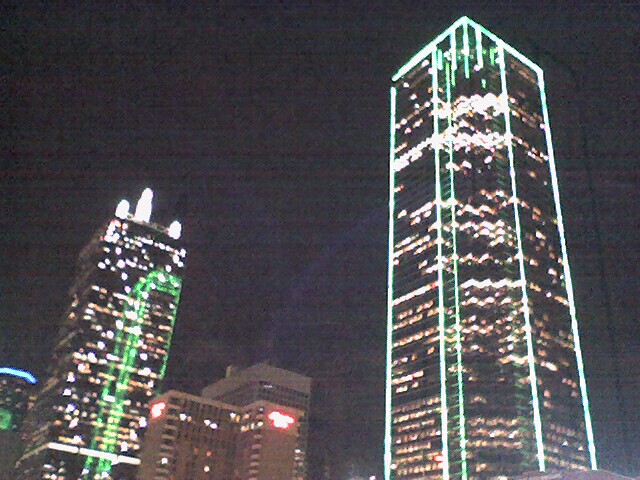
The view outside the fab YO Texas Steakhouse in Dallas. The building on the right is the Bank of America bulding. I thought I would post this so everyone with Bank of America cards can see what their interest payments built. Note how cool the green neon looks in the opposite building. Again, taken with the spotty camera on the Treo 650.
Between airliners roaring over my head – it must have been last night’s wind affecting flight patterns – and people getting out of their rooms early and draggin’ their luggage over the cement hallway [clunk, clunk, clunk …], I didn’t get enough sleep last night and woke a little later than I wanted to.
I had hoped to get to the NAB FCC Breakfast by 7:30 a.m. Instead, I arrived a little after 8 a.m. to a bunch of folks standing at the entrance, eating their breakfasts or just drinking coffee, because there were not enough chairs. So, when in Rome …
It was an interesting conversation between Commissioners Jonathan Adelstein and Robert McDowell with host Bruce Reese [sp], talking about everything from indecency laws, regulation, or actually lack of it, the roll out of digital radio, low-powered licenses, and FM translators for AM stations who go dark or power down in the evening.
Interestingly, they both kinda agreed that the indecency fines may have gone too far the other way and may be stifling free speech. There was some talk about how the digital radio format was an experimental thing and that was why the FCC was taking so long to make the digital arrangements permanent. They also stated that they were waiting to see if broadcasters were taking advantage of the multicasts to become more local.
Sidebar: As most of us know, broadcasters haven’t been doing that. They have been doing the opposite – throwing syndicated or satellite stuff on the air with little or no local content, according to some of the trades. Broadcasters seem more concerned with using the new multicast signals as ways of raising new revenue and not necessarily concerned with content or localism, despite all the NAB rah-rahing about the subject.
Reece was also affable and humorous and the breakfast of standard buffet fare was pretty good.
After the breakfast, I attended the first session of the morning, Small Market Operators, Big Market Thinkers, featuring a pretty good give and take from three Midwest owner/operators of clusters of small market stations.
The moderator, Chuck DuCoty, of NRG Media in Iowa, did a really good job of moving the conversation around and allowing people in the audience to chime in with questions about what operators were doing. This keeps the thing a bit less top-down more than other sessions, which isn’t an easy thing to do without passing a mic around.
Joe Schwartz, the president and CEO of Cherry Creek Radio in Colorado, called it an exciting time to be in radio despite all the “gloom and doom” from the big owners and their shareholders. He also said that he didn’t think the HD Radio, PPM – a new electronic metering system expected to be unveiled by Arbitrons in 2010 – or Wall Street meant anything to the small market broadcaster.
Sue Goldstein, who handles the marketing/sales for Jackson Radio Works of Michigan, a company she owns with her husband, agreed with much of what Schwartz said. She noted that her company worked with customers one-on-one to help them solve problems and find solutions.
“We don’t worry about the ratings,” she said, but added that they embrace new technologies as much as they can without spending big bucks. “It’s all what we make it.”
Gary Buchanan, the president and COO of Three Eagles Broadcasting, which owns 47 stations in the Midwest, noted that small market radio “can still have fun … We don’t try to save our way to prosperity” taking a jab at some of the big boys who are complaining about profit pressures.
They all agreed about the importance of retaining and recruiting people locally on a regular basis and making sure that sales people were trained properly. There was some discussion about inventory and what to do about filling it or keeping it under control and also about cost per point and pricing.
Schwartz said his station didn’t look at the pricing structure at other radio stations.
“Giving away spots is not the business you want,” he said.
Rather, radio stations should go after newspaper ads where “the real money” is. He noted that newspapers raise their prices every single year, sometimes twice a year, and radio does a far better job getting the price the client deserves.
Goldstein also said it was important to look at the market as a whole. While her company owns the only commercial station in her town, it gets bombed by other radio stations outside of the market. However, it doesn’t affect them. She said they worry about cable ads, although the high costs of television production keep things inline.
Buchanan said it was important to pay close attention to local advertisers, noting that one of his sales managers refused ads from a large big-box store which is opening up stores everywhere across the nation and putting locals out of business [He was probably talking about Wal-Mart but didn’t mention the company by name]. He said those companies will press radio stations to give them rates of 10 cents on the dollar. He said their company also does calendar promotions and other things with packaging and promotions.
They all talked about car giveaway promotions and other things stations have seen that have worked. Schwartz said the station puts together an agriculture event which raises $200,000 each year in revenue. He also stressed selling long-term contracts because radio repetition and the frequency of ad runs were the way to success in radio. He said most companies should consider 28 spots per week over 52-weeks and the advertiser will get results.
The keynote speech by David Rehr, president and CEO of NAB, and Ken Schmidt, a former spokesman and marketing man for Harley-Davidson, was surprisingly sparsely attended It was interesting to say the least though.
Rehr went on this near rant about forcing the FCC to take on the satellite companies for their illegal signal transponders in cars and their push to offer services to terrestrial radio. He noted that radio’s demise had been predicted before with the invention of the LP, 8-track, cassette, TV, and CDs, and yet, radio was still around.
Rehr also went off with a laundry list of things which the NAB was doing to assist broadcasters. He emphasized “localism” a number of times, noting that radio is a person’s most immediate resource. He stated that it was important for radio to embrace technology and stop the RIAA, the recording industry’s lobbying arm, from passing a performance broadcast tax on radio stations. One got the feeling that it was a fire and brimstone speech and not really one on “the state of the industry” as it was promoted to be. He said that NAB would be “going on the offensive” and would be transferred into an aggressive advocate for radio.
“The future goes to those who take risks,” he said. “The others, will be left behind.”
Schmidt was a pretty cool guy but he knew it was a rough crowd when his jokes starting falling flat right out of the box.
“There are a lot of suits out there,” he cracked.
By the third joke, he threw up his hands and gave up and started to talk about how he helped turn Harley-Davidson around by creating brand loyalty, offering customization, and getting out into the hustings to see what motorcycle enthusiasts wanted in a Harley. It wasn’t an easy task. But the company kept trying and trying until the company reached the position it is in today.
He said the company worked to find the emotional, human side in its customers and ignored catch phrases like “quality” and “customer satisfaction.”
“People are tuning it out,” he said. “[We have to] stop doing business the way we’re expected.”
He also said it was important to listen to your customers and adjust accordingly since a company really isn’t who it says it is; a company is what the market says it is. He also said it was important to show passion in what you do.
I then attended a session called “Radio and The Consumer’s Mind: How Radio Works” which was headed up by Mary Bennett of RAB and James Peacock, a consultant helping RAB put together these studies about how effective radio advertising are and some other things which are being gathered up through extensive polling. The whole discussion was pretty fascinating with a lot of data about how effective certain types of advertising is and whether or not people tune out to certain types of ads.
The studies will take things from four different angles: Relevance and emotion, Internet synergy, Creating images, Engagement, and then they will figure out ways of utilizing all the information to make radio work better for clients.
Most of the information is clearly geared to big ad agencies who will advertise with big radio companies and those same big radio companies are footing the bill for the study. But there should be some trickling down of the information for mom and pop shops trying to get more business.
The study will be unveiled next week in NYC and when it is, I may come back and do a more thorough write-up about it because I’m intrigued by these things.
They did, however, release a sneak peak at some results. They found that: Radio is more personally and emotionally connected to consumers than TV, Internet, or newspapers; Radio ads remain more personally relevant to consumers, who expect radio ads to be “speaking to them”; Radio ads are better tolerated than ads on TV or the Internet; Advertising on the Internet has very high negatives; All of which suggests that radio listeners are especially receptive to advertising.
Pretty interesting to say the least.
The State of Talk Radio was another session I attended but it wasn’t much different than previous ones I have attended or seen on C-Span. Note to Michael Harrison: Will you please pipe down and let your panelists speak a bit? Jeesh.
I also attended a short meeting of the Small Market Broadcasters Caucus and listened to a presentation about HD Radio and an update about AM stations getting FM transponders.
I skipped the Marconi Awards dinner this year and saved the $100 ticket. After seeing all the big corporate radio stations nominated for awards, another silly morning zoo host lined up as the emcee, and a house band made up of radio executives who could play instruments, I decided to pass. I don’t think I missed anything but I will find out tomorrow.
Rumor around the convention in mild chit-chat before most of the sessions was that ticket sales for the event were really bad and that was why NAB introducers kept pimping the fact that there were still dinner tickets available before each session on Thursday. I don’t know if this is true or not, just guessing.
Instead, I enjoyed a huge New York ribeye steak at the YO Texas Steakhouse downtown and took a stroll over to Deep Elum, where I once played some shows while in a rock band back in the late 1980s. It is all developed and yuppified now but still a nice place to look around.


