DNC Coverage
For whatever reason, our pal Kristina from the Wicked Words blog hasn't been posting any DNC stuff to us. More than likely, she is having too good a time on the floor of the Fleet and at parties ...
However, not surprisingly, the Boston Phoenix has some dynamite coverage from almost every angle imaginable: ["DNC Coverage Index"] . Media Log's Dan Kennedy makes a pretty important point here about the lack of time reporters have to read all the other stuff being written about the convention: ["No-Reading Zone"] . Although, thank God for technology - how would the rest of us be able to hear about all the great stuff going on?
Lastly, the Boston Herald has been publishing an impressive front section of DNC coverage with big tabloid pictures, hilarious headlines, and their stellar columnists working over time: ["DNC 2004 coverage"]
Wednesday, July 28, 2004


Friday, July 23, 2004
'OutFoxed' film misfires
At house parties in Winchester and all across the nation last week, concerned voters watched Robert Greenwald's new political documentary, "OutFoxed: Rupert Murdoch's war on journalism," a film which targets the cozy relationship between Murdoch and the Republican Party.
Unfortunately, the film doesn't tell the whole story.
The film concentrates its criticism on the FoxNews Channel, Murdoch's flashy news channel, claiming the network is an organ grinder for the GOP. Through internal memos, disgruntled former employees and repetitive clips, the case against FoxNews seems overwhelming, questioning the channel's trademarked "Fair & Balanced" slogan. In the presidential race, Greenwald points to coverage where Sen. John Kerry is disparaged as a flip-flopper while President George W. Bush is consistently commended for showing leadership via live shots of speeches most every day.
However, the film completely ignores the fact that most of FoxNews is opinion-based programming - not news. It also overlooks the role of elected Democrats in what our national media has become, placing all the blame on Republicans through subtle hints and careful editing.
For example, it is strange to watch the comments of former FoxNews contributor Jeff Cohen, who in the past has worked with Fairness and Accuracy in Reporting [FAIR]. Cohen has been a consistent critic of both political parties and of corporate influence in the media. In one of his comments, Cohen attacks radio and TV station consolidation yet is silent about the bipartisan 1996 Telecom Bill which allowed this consolidation to occur. He mentions Clear Channel, which owns about 1,200 stations and cuts anti-war artists from its playlists, but never says a word about the hundreds of Democrats who voted to allow this company to buy the radio stations. Did clips of Cohen's criticism about Democrats end up on the cutting room floor?
Chellie Pingree, a former state Senator from Maine, complains in the documentary about the Fairness Doctrine, rescinded during "the Reagan Administration," again, a shot at Republicans. But Pingree disregards the fact that rescinding the Fairness Doctrine was a bipartisan proposal even though small broadcasters and news editors were urging them not to change the law. The Democrats supported the law because at the time they thought they would have control over the media instead of the Republicans. Thought wrong, didn't they?
In some of the creative editing, Sean Hannity, one of Fox's hosts, is shown repeatedly announcing the number of days left until Bush wins the election. Any regular viewer knows that on alternating days, liberal host Alan Colmes announces the number of days left until Kerry is elected, yet those clips are not presented.
One disgruntled employee claims that she only recognized the name of one prominent Democrat hired as a FoxNews contributor. But again, any regular viewer to the channel will see such liberal heavyweights as 1984 VP nominee Geraldine Ferraro, almost-NYC Mayor Mark Green, Newsweek's Eleanor Clift, and consultant Donna Brazile.
The documentary also shows a lack of understanding about the news media in general.
Memos by John Moody, the news chief at FoxNews, offering conservative comments on the state of the nation are used to insinuate that his opinion influenced what was broadcast. While this might be true at Fox, it is true at other stations too. FAIR has done numerous studies showing how corporate opinions on business, culture, and politics influence media coverage. One of the most blatant examples was NBC doing a piece on how safe nuclear power plants were - with no opposing view. NBC is owned by General Electric, a major manufacturer of nuclear power plant components. We all know what happened at "60 Minutes" when they tried to do a story about the cigarette business which was accurately portrayed in the movie "The Insider."
Unfortunately, the film doesn't tell the whole story.
The film concentrates its criticism on the FoxNews Channel, Murdoch's flashy news channel, claiming the network is an organ grinder for the GOP. Through internal memos, disgruntled former employees and repetitive clips, the case against FoxNews seems overwhelming, questioning the channel's trademarked "Fair & Balanced" slogan. In the presidential race, Greenwald points to coverage where Sen. John Kerry is disparaged as a flip-flopper while President George W. Bush is consistently commended for showing leadership via live shots of speeches most every day.
However, the film completely ignores the fact that most of FoxNews is opinion-based programming - not news. It also overlooks the role of elected Democrats in what our national media has become, placing all the blame on Republicans through subtle hints and careful editing.
For example, it is strange to watch the comments of former FoxNews contributor Jeff Cohen, who in the past has worked with Fairness and Accuracy in Reporting [FAIR]. Cohen has been a consistent critic of both political parties and of corporate influence in the media. In one of his comments, Cohen attacks radio and TV station consolidation yet is silent about the bipartisan 1996 Telecom Bill which allowed this consolidation to occur. He mentions Clear Channel, which owns about 1,200 stations and cuts anti-war artists from its playlists, but never says a word about the hundreds of Democrats who voted to allow this company to buy the radio stations. Did clips of Cohen's criticism about Democrats end up on the cutting room floor?
Chellie Pingree, a former state Senator from Maine, complains in the documentary about the Fairness Doctrine, rescinded during "the Reagan Administration," again, a shot at Republicans. But Pingree disregards the fact that rescinding the Fairness Doctrine was a bipartisan proposal even though small broadcasters and news editors were urging them not to change the law. The Democrats supported the law because at the time they thought they would have control over the media instead of the Republicans. Thought wrong, didn't they?
In some of the creative editing, Sean Hannity, one of Fox's hosts, is shown repeatedly announcing the number of days left until Bush wins the election. Any regular viewer knows that on alternating days, liberal host Alan Colmes announces the number of days left until Kerry is elected, yet those clips are not presented.
One disgruntled employee claims that she only recognized the name of one prominent Democrat hired as a FoxNews contributor. But again, any regular viewer to the channel will see such liberal heavyweights as 1984 VP nominee Geraldine Ferraro, almost-NYC Mayor Mark Green, Newsweek's Eleanor Clift, and consultant Donna Brazile.
The documentary also shows a lack of understanding about the news media in general.
Memos by John Moody, the news chief at FoxNews, offering conservative comments on the state of the nation are used to insinuate that his opinion influenced what was broadcast. While this might be true at Fox, it is true at other stations too. FAIR has done numerous studies showing how corporate opinions on business, culture, and politics influence media coverage. One of the most blatant examples was NBC doing a piece on how safe nuclear power plants were - with no opposing view. NBC is owned by General Electric, a major manufacturer of nuclear power plant components. We all know what happened at "60 Minutes" when they tried to do a story about the cigarette business which was accurately portrayed in the movie "The Insider."
In other words, FoxNews isn't an anomaly and the network's leanings have never been questioned. They didn't hire James Carville to run the network; they hired Roger Ailes. And how influential are they? At the height of the Iraqi invasion, only 4 million people were watching FoxNews or less than 2 percent of the population of the country. The shows most complained about in the film, like "The O'Reilly Factor," barely have 1 million viewers on any given night.
The documentary also doesn't understand why FoxNews is so popular. The network is fast-paced, combative, and yeah, entertaining. It fills a void for those unhappy with the old-styled TV news programs. And despite the protestations by liberals, much of the country is moderate to conservative and they want news that reflects their views or doesn't detract from their views. In the past, TV news coverage on the other networks was perceived to be out of step with the views of many American people.
The larger problem is the fact that many of the nation's voices - especially on the progressive side - are silenced because of the expensive nature of running a news operation. By continuing to support deregulation, Democrats hurt their own cause. "OutFoxed" makes some good points but Greenwald should have presented a fairer and more balanced film.
In the end, those worried about FoxNews can simply change the channel or shut the TV off.
In the end, those worried about FoxNews can simply change the channel or shut the TV off.
Thursday, July 15, 2004
Let Mitt make Senate appointment
This column originally appeared in The Winchester Star.
The battle raging on Beacon Hill over what happens to John Kerry's U.S. Senate seat in the wake of a presidential victory is getting just a bit ridiculous.
The latest eruption has to do with a proposal forwarded by Gov. Mitt Romney on Sunday which would allow him to make an appointment to fill the seat at the time of Kerry's inauguration - with approval from Senate president or House speaker - until a special election can be held sometime in the spring of 2005.
Under the amendment, Romney would submit names for a temporary appointment to House Speaker Tom Finneran and Senate President Robert Travaglini. One of the two of them would approve one of the recommended names within three days or Romney would be free to appoint whomever he wished. Both Finneran and Travaglini balked at the idea calling it "unconstitutional."
Why Romney would want to give any power over the selection to Finneran is frankly beyond belief. But at least the governor is trying to come to a comprise which will guarantee the state has representation for the months that the seat is vacant.
Currently, Romney has the legal right to appoint a senatorial successor who would hold the seat until the next federal election cycle in November 2006. The 17th Amendment to the Constitution, ratified in 1913, grants Romney the right to make the appointment. But it also grants the Legislature the right to set a special election. The last two times a governor appointed a successor, Democrats have held the corner office. In 1985, just before being sworn in, Gov. Mike Dukakis appointed Kerry to the seat he had won a couple of months before. In 1960, a month after being elected president, John F. Kennedy resigned from his seat and lame duck Gov. Foster Furcolo appointed a family friend of Kennedy's, Ben Smith, to the Senate. Two years later, Ted Kennedy ran for the seat and was elected. Republicans - who were in a stronger political position in the state at the time - said little about the appointments. This, despite the fact that in 1960 John Volpe had just beaten Furcolo in the election and would come into office a few weeks before Kennedy's inauguration.
However, those were different political times.
The Democratically-controlled Legislature recently rammed through a bill to hold a special election within 160 days of a Senate vacancy and stripped Romney of his ability to make the appointment. Legislative leaders said the bill was about allowing "the people" to decide while at the same time eliminating "the people's" representation in the Senate. By approving this bill, the Legislature also limited the special election candidates to those who can raise huge sums of money in the shortest amount of time for a special election. Only two candidates - Rep. Ed Markey and Rep. Marty Meehan - have declared their intentions to run for the seat. Both have raised over $1 million for the race and hold good positions in polling data, according to a Boston Herald report last week. The governor has yet to sign the special election bill.
Personally, I understand the fear some Democrats have in the appointment of a Republican - even a temporary Republican - in the wake of a Kerry victory. But why the anxiety? Kerry will be the president so the Democrats won't have to worry about what happens because he will have veto power over anything that will come out of a Republican-controlled Senate, right?
Maybe. Maybe not.
Up until President George W. Bush authorized the invasion of Iraq, Democrats have been acting pretty much like Republicans for a long time. Sure, they talked a good game. But legislation-wise, look out. Most of the Massachusetts delegation voted for the invasion. They voted for the Constitution-shredding PATRIOT Act. They voted for the No Child Left Behind legislation and then refused to fund it. When Clinton was president, the Democrats were even worse, passing all kinds of bad legislation including eight planks of the GOP's Contract with America. With Democrats like these, who is really worried about Romney's appointment?
Actually, it is kind of amazing that the Democrats - the people who are always lecturing the rest of us about the hallowed nature of democracy, inclusion, diversity, and other worthy virtues - are doing everything they can to keep millions of residents from having their second voice in the Senate for more than five months. And the fact that they have set up a special election which will pretty much limit the candidates to the all-white, all-male, contributor-connected insiders is even worse.
Clearly, in the wake of a presidential victory by Kerry, the citizens of our state should not be without democratic representation just because partisans don't like that a Republican is making the appointment. Romney should be allowed to appoint a successor - it is the best thing for the people of Massachusetts.
The battle raging on Beacon Hill over what happens to John Kerry's U.S. Senate seat in the wake of a presidential victory is getting just a bit ridiculous.
The latest eruption has to do with a proposal forwarded by Gov. Mitt Romney on Sunday which would allow him to make an appointment to fill the seat at the time of Kerry's inauguration - with approval from Senate president or House speaker - until a special election can be held sometime in the spring of 2005.
Under the amendment, Romney would submit names for a temporary appointment to House Speaker Tom Finneran and Senate President Robert Travaglini. One of the two of them would approve one of the recommended names within three days or Romney would be free to appoint whomever he wished. Both Finneran and Travaglini balked at the idea calling it "unconstitutional."
Why Romney would want to give any power over the selection to Finneran is frankly beyond belief. But at least the governor is trying to come to a comprise which will guarantee the state has representation for the months that the seat is vacant.
Currently, Romney has the legal right to appoint a senatorial successor who would hold the seat until the next federal election cycle in November 2006. The 17th Amendment to the Constitution, ratified in 1913, grants Romney the right to make the appointment. But it also grants the Legislature the right to set a special election. The last two times a governor appointed a successor, Democrats have held the corner office. In 1985, just before being sworn in, Gov. Mike Dukakis appointed Kerry to the seat he had won a couple of months before. In 1960, a month after being elected president, John F. Kennedy resigned from his seat and lame duck Gov. Foster Furcolo appointed a family friend of Kennedy's, Ben Smith, to the Senate. Two years later, Ted Kennedy ran for the seat and was elected. Republicans - who were in a stronger political position in the state at the time - said little about the appointments. This, despite the fact that in 1960 John Volpe had just beaten Furcolo in the election and would come into office a few weeks before Kennedy's inauguration.
However, those were different political times.
The Democratically-controlled Legislature recently rammed through a bill to hold a special election within 160 days of a Senate vacancy and stripped Romney of his ability to make the appointment. Legislative leaders said the bill was about allowing "the people" to decide while at the same time eliminating "the people's" representation in the Senate. By approving this bill, the Legislature also limited the special election candidates to those who can raise huge sums of money in the shortest amount of time for a special election. Only two candidates - Rep. Ed Markey and Rep. Marty Meehan - have declared their intentions to run for the seat. Both have raised over $1 million for the race and hold good positions in polling data, according to a Boston Herald report last week. The governor has yet to sign the special election bill.
Personally, I understand the fear some Democrats have in the appointment of a Republican - even a temporary Republican - in the wake of a Kerry victory. But why the anxiety? Kerry will be the president so the Democrats won't have to worry about what happens because he will have veto power over anything that will come out of a Republican-controlled Senate, right?
Maybe. Maybe not.
Up until President George W. Bush authorized the invasion of Iraq, Democrats have been acting pretty much like Republicans for a long time. Sure, they talked a good game. But legislation-wise, look out. Most of the Massachusetts delegation voted for the invasion. They voted for the Constitution-shredding PATRIOT Act. They voted for the No Child Left Behind legislation and then refused to fund it. When Clinton was president, the Democrats were even worse, passing all kinds of bad legislation including eight planks of the GOP's Contract with America. With Democrats like these, who is really worried about Romney's appointment?
Actually, it is kind of amazing that the Democrats - the people who are always lecturing the rest of us about the hallowed nature of democracy, inclusion, diversity, and other worthy virtues - are doing everything they can to keep millions of residents from having their second voice in the Senate for more than five months. And the fact that they have set up a special election which will pretty much limit the candidates to the all-white, all-male, contributor-connected insiders is even worse.
Clearly, in the wake of a presidential victory by Kerry, the citizens of our state should not be without democratic representation just because partisans don't like that a Republican is making the appointment. Romney should be allowed to appoint a successor - it is the best thing for the people of Massachusetts.
Saturday, July 10, 2004
The non-Nader factor: Back in May of this year, Politizine put together an extensive state by state polling analysis countering claims by Democratic front groups attacking the 2004 candidacy of Ralph Nader ["Anti-Nader study falls flat"]. What the analysis showed was that these groups were using flawed data – national preference polling – to come to the conclusion that Nader was harming Sen. John Kerry’s presidential effort. However, by examining individual state polls, those that determine the election of the president, Nader has little to no impact on the race. The analysis also showed that registered Democrats supporting the reelection of President George W. Bush were potentially a bigger problem for Kerry.
Six weeks and many more state polls later, the conclusion remains the same: Nader has little to no impact on Kerry’s campaign. In some polls, Nader actually helps Kerry gain better position against Bush.
Between Jan. 1 and July 9, 209 polls from 43 states of have been conducted. In most states, because of the demographics, the presidential race is essentially over.
In polls taken from Alabama, Arizona, Colorado, Indiana, Louisiana, Missouri, Montana, Nevada, North Carolina, Oklahoma, South Dakota, and Utah, Kerry loses with or without Nader in the polls [Note: The polls from North Carolina were held before Sen. John Edwards was chosen to be Kerry’s running mate]. Nader has not been included in polls taken from Arkansas, Georgia, Kansas, Kentucky, Mississippi, South Carolina, Tennessee, Texas, and Virginia [Note: The only poll from Virginia by Rasmussen Reports was within the margin of error but historically, this has been a safe Republican state]. There have been no polls taken in Alaska, Idaho, Nebraska, North Dakota, and Wyoming, but all the states are considered to be safe Bush states. Winning these states will award 207 Electoral College votes to Bush.
In almost all the polls taken from California, Connecticut, Illinois, Iowa, Maine, Maryland, Massachusetts, Minnesota, New Jersey, New York, Rhode Island, Vermont, and Washington, Kerry wins the state with or without Nader on the ballot. [Note: In one poll Fairleigh Dickinson from New Jersey in early April, Nader's appearance in the poll shifted the state from Kerry to Bush. However, countering this anomaly are six other polls showing Kerry with leads in an otherwise safe Democratic state]. There have been no polls in Delaware, the District of Columbia, and Hawaii, safe Kerry states. Winning these states will award 200 Electoral College votes to Kerry.
Nader’s positive impact
In some states, Nader’s candidacy has a positive influence on Kerry’s poll positions despite the relentless attacks against the independent candidate.
In a June 5-8 Los Angeles Times poll in Ohio, Nader takes more votes from Bush than Kerry, by a three-to-one ratio. It is enough Bush votes to help Kerry win the state by a wider margin than without Nader included in the poll. Without Nader: Kerry 46, Bush 45. With Nader: Kerry 45, Bush 42.
In a March 25-29 Keystone Poll from Pennsylvania Nader earned more Republican than Democrat votes by a 4-to-3 margin.
In a March 22-23 West Virginia ARG poll Nader’s appearance in the poll helped improve Kerry’s position in the state. Nader lures enough registered Democrat voters who planned to vote for Bush – a two-to-one margin – to help Kerry tie Bush in the state. With Nader: 46-46. Without Nader: Bush 47, Kerry 46. In this poll, Bush received a massive 22 percent of the registered Democrat vote.
In a March 15-18 ARG New Hampshire poll Nader garnered the support of 9 percent of Republicans compared to 4 percent of Democrats, a more than two-to-one margin and virtual repeat of what occurred in 2000, with Bush leading in the state with or without Nader [According to CNN exit polls, Nader received 2 percent of the Republican vote and 1 percent of the Democrat vote in 2000. Check out Debunking the Myth for more data on the 2000 results: ["Debunking the Myth"] ].
In 16 other polls from Ohio, New Hampshire, and West Virginia, Kerry and Bush switch off leads with no Nader impact.
Where Nader could be a factor
In 12 of 209 state polls – or 5.7 percent of all state polling done so far in the campaign - Nader could potentially be a factor. However, other data within these polls reveal bigger problems for Kerry than Nader’s candidacy.
In Florida there have been 13 polls, with leads flipping back and forth between Bush and Kerry. Kerry has taken slight leads in recent polls. In most, polling agencies have included two versions: One with and one without Nader. In three polls, Nader’s appearance cancels out a Kerry lead – but does not deliver a Bush win, a literal replay of 2000.
In a June 23-27 Quinnipiac University poll, Kerry posted a 46 to 44 lead. But with Nader in the poll, the numbers shift to a 43-43 tie, with 5 percent for Nader.
An American Research Group [ARG] poll from May 15-17 shows Bush leading 47-46, with Nader receiving 3 percent. Without Nader, the results are 47-47.
An ARG poll from April 18-20 showed similar results: Bush with 46, Kerry at 45, and Nader again receiving 3 percent. Without Nader, the results were 46-46.
But by looking deeper into the Florida polls, problems that have nothing to do with Nader arise.
In the Quinnipiac poll, five times as many Democrats plan to vote for Bush than Nader. Nader’s candidacy also cuts into Bush’s Democrat vote totals, dropping from 12 percent in a two-way race to 10 percent in a three-way race. In the May ARG poll, Bush receives more than three times the Democrat vote that Nader does: 11 to 3 percent. In the June ARG poll showing a Kerry lead, Bush receives 11 times the Democrat vote as Nader, 11 to 1 percent. In that poll, Nader received 1 percent of the Republican vote, earning equally from both sides.
This is a repeat of 2000 when a tiny percentage of Democrats, 1 percent, voted for Nader but many more voted for Bush: 13 percent and a virtual tie in the state.
Sixteen Michigan polls show similar results as Florida, with back and forth leads, regardless of whether Nader is included or not. Most polls have Kerry in the lead in the state. However, in two of those polls, Nader’s appearance on the ballot hypothetically delivers the state to Bush.
In a FoxNews/Opinion Dynamics June 22-23 poll, Kerry has a 44-43 lead. But when Nader is included, the poll flips to a Bush 44-42 lead.
In a Detroit News June 24-28 poll, Bush received 44 to Kerry’s 43 with Nader getting 5 percent.
However, neither of these polls released more specific data from the poll like voter registration designation or data without Nader included in the polling, so no assumption can be made about whether Nader voters would automatically go to Kerry.
But in an ARG poll from July 9, which showed a Kerry lead [50-43-2], Nader earned equally from Republicans and Democrats: 1 percent, while Bush took 7 percent of the Democrat vote.
New Mexico is one place where Nader’s candidacy could be a factor.
In a March 30-April 1 ARG poll, Bush had 46 to Kerry’s 45, with Nader getting 3 percent of the vote. Without Nader, the results would again be a tie: 47-47.
However, Nader took equally from both registered Republicans and Democrats, 2 percent, while Bush received a whopping 20 percent of registered Democrats in the state – a 10 to 1 margin over Nader. Again, in this poll, registered Democrats – and not Nader – are keeping Kerry from potentially winning the state.
In a more recent ARG poll from the state, released on July 9, Kerry had the lead, 49 to 42, with Nader earning 3 percent. Kerry’s lead is secure despite 13 percent of Democrats voting for Bush and 3 percent voting for Nader.
In Oregon, there have been eight polls with two showing Nader potentially influencing the outcome.
In a May 3-5 ARG poll, Bush and Kerry were tied at 45, with Nader clocking in with 5 percent. Without Nader, the result would be Kerry 48, Bush 46. In this poll, 6 percent of Democrats were planning on voting for Bush, with 7 percent voting for Nader.
A Rasmussen Reports poll released on April 25 showed Bush and Kerry tied with 43 and Nader receiving 8 percent. Without Nader, Kerry received 46 with Bush getting 45, and 6 percent said they would vote for "some other candidate." So even with only two choices, the bulk of Nader’s support inflexibly stayed with their candidate. This polling data shines light on the mistaken premise that Nader’s candidacy "costs" Kerry the election. Again, many of Nader's supporters are not going to vote for Kerry under any circumstances so he gains nothing from a two-candidate race.
However, four other polls from Oregon showed Kerry beating Bush even with Nader on the ballot. And two other polls – one in March and one in May – showed Bush beating Kerry in Oregon with no Nader candidacy at all.
In Pennsylvania, there have been 15 polls taken, with Bush and Kerry in a tug of war. However, only two polls show any Nader impact.
A March 9-15 Quinnipiac poll showed Bush with 44, Kerry at 40, and Nader with 7 percent. Without Nader, Kerry takes the lead with 45 to Bush's 44 percent. In the polling data, Nader earned the support of 4 percent of registered Republicans and 6 percent registered Democrats. Democrats supporting Bush came in at 14 percent.
In an April 16-25 Pew Charitable Trusts poll, Bush and Kerry were tied with 42 percent. Nader received 5 percent. The poll did not ask voters how they would vote if Nader were not on the ballot. Yet in this poll, Bush received 12 percent of the vote from registered Democrats – four times as many Democrat votes as Nader received. Another 10 percent of Democrats were undecided or supporting other candidates. So a full 22 percent of Democrats in Pennsylvania were supporting Bush, another candidate other than Nader, or were undecided, while only 3 percent were supporting Nader.
In Wisconsin, there have been eight polls with two showing potential Nader impact.
In one, a June 3-8 Los Angeles Times poll, Bush and Kerry are tied 44-44. But when Nader is thrown into the mix, Kerry loses 2 percent, with Bush leading 44 to 42.
In another poll, conducted by the University of Wisconsin Survey Center, Bush leads 46 to Kerry’s 42 with Nader getting 5 percent.
Like the Michigan polls, these did not offer a "without Nader" option or any specific registration data, so no impact can be properly vetted. The UWSC poll did state that 90 percent of Republicans were backing Bush and 85 percent of Democrats were voting for Kerry. Kerry led among independent voters but no numbers were given. In two other polls from Wisconsin, Bush led Kerry with no impact by Nader, similar to results from Oregon.
There are four months until Election Day but the conclusion is clear: Nader is a non-factor at this point in the presidential race. Registered Democrats voting for Bush potentially could cost Kerry the presidency. As well, Green Party candidate David Cobb, who is on 23 ballot lines and has changed his mind about a "safe-state" approach, is more of a potential threat to Kerry than Nader who is only on 10 ballot lines. Lastly, as of July 9, Kerry had an Electoral College lead over Bush: 286 to 252, with other Web sites which track EC votes showing higher numbers for Kerry. In other words, at this point in the campaign, Kerry would win the presidency with or without Nader in the race.
Six weeks and many more state polls later, the conclusion remains the same: Nader has little to no impact on Kerry’s campaign. In some polls, Nader actually helps Kerry gain better position against Bush.
Between Jan. 1 and July 9, 209 polls from 43 states of have been conducted. In most states, because of the demographics, the presidential race is essentially over.
In polls taken from Alabama, Arizona, Colorado, Indiana, Louisiana, Missouri, Montana, Nevada, North Carolina, Oklahoma, South Dakota, and Utah, Kerry loses with or without Nader in the polls [Note: The polls from North Carolina were held before Sen. John Edwards was chosen to be Kerry’s running mate]. Nader has not been included in polls taken from Arkansas, Georgia, Kansas, Kentucky, Mississippi, South Carolina, Tennessee, Texas, and Virginia [Note: The only poll from Virginia by Rasmussen Reports was within the margin of error but historically, this has been a safe Republican state]. There have been no polls taken in Alaska, Idaho, Nebraska, North Dakota, and Wyoming, but all the states are considered to be safe Bush states. Winning these states will award 207 Electoral College votes to Bush.
In almost all the polls taken from California, Connecticut, Illinois, Iowa, Maine, Maryland, Massachusetts, Minnesota, New Jersey, New York, Rhode Island, Vermont, and Washington, Kerry wins the state with or without Nader on the ballot. [Note: In one poll Fairleigh Dickinson from New Jersey in early April, Nader's appearance in the poll shifted the state from Kerry to Bush. However, countering this anomaly are six other polls showing Kerry with leads in an otherwise safe Democratic state]. There have been no polls in Delaware, the District of Columbia, and Hawaii, safe Kerry states. Winning these states will award 200 Electoral College votes to Kerry.
Nader’s positive impact
In some states, Nader’s candidacy has a positive influence on Kerry’s poll positions despite the relentless attacks against the independent candidate.
In a June 5-8 Los Angeles Times poll in Ohio, Nader takes more votes from Bush than Kerry, by a three-to-one ratio. It is enough Bush votes to help Kerry win the state by a wider margin than without Nader included in the poll. Without Nader: Kerry 46, Bush 45. With Nader: Kerry 45, Bush 42.
In a March 25-29 Keystone Poll from Pennsylvania Nader earned more Republican than Democrat votes by a 4-to-3 margin.
In a March 22-23 West Virginia ARG poll Nader’s appearance in the poll helped improve Kerry’s position in the state. Nader lures enough registered Democrat voters who planned to vote for Bush – a two-to-one margin – to help Kerry tie Bush in the state. With Nader: 46-46. Without Nader: Bush 47, Kerry 46. In this poll, Bush received a massive 22 percent of the registered Democrat vote.
In a March 15-18 ARG New Hampshire poll Nader garnered the support of 9 percent of Republicans compared to 4 percent of Democrats, a more than two-to-one margin and virtual repeat of what occurred in 2000, with Bush leading in the state with or without Nader [According to CNN exit polls, Nader received 2 percent of the Republican vote and 1 percent of the Democrat vote in 2000. Check out Debunking the Myth for more data on the 2000 results: ["Debunking the Myth"] ].
In 16 other polls from Ohio, New Hampshire, and West Virginia, Kerry and Bush switch off leads with no Nader impact.
Where Nader could be a factor
In 12 of 209 state polls – or 5.7 percent of all state polling done so far in the campaign - Nader could potentially be a factor. However, other data within these polls reveal bigger problems for Kerry than Nader’s candidacy.
In Florida there have been 13 polls, with leads flipping back and forth between Bush and Kerry. Kerry has taken slight leads in recent polls. In most, polling agencies have included two versions: One with and one without Nader. In three polls, Nader’s appearance cancels out a Kerry lead – but does not deliver a Bush win, a literal replay of 2000.
In a June 23-27 Quinnipiac University poll, Kerry posted a 46 to 44 lead. But with Nader in the poll, the numbers shift to a 43-43 tie, with 5 percent for Nader.
An American Research Group [ARG] poll from May 15-17 shows Bush leading 47-46, with Nader receiving 3 percent. Without Nader, the results are 47-47.
An ARG poll from April 18-20 showed similar results: Bush with 46, Kerry at 45, and Nader again receiving 3 percent. Without Nader, the results were 46-46.
But by looking deeper into the Florida polls, problems that have nothing to do with Nader arise.
In the Quinnipiac poll, five times as many Democrats plan to vote for Bush than Nader. Nader’s candidacy also cuts into Bush’s Democrat vote totals, dropping from 12 percent in a two-way race to 10 percent in a three-way race. In the May ARG poll, Bush receives more than three times the Democrat vote that Nader does: 11 to 3 percent. In the June ARG poll showing a Kerry lead, Bush receives 11 times the Democrat vote as Nader, 11 to 1 percent. In that poll, Nader received 1 percent of the Republican vote, earning equally from both sides.
This is a repeat of 2000 when a tiny percentage of Democrats, 1 percent, voted for Nader but many more voted for Bush: 13 percent and a virtual tie in the state.
Sixteen Michigan polls show similar results as Florida, with back and forth leads, regardless of whether Nader is included or not. Most polls have Kerry in the lead in the state. However, in two of those polls, Nader’s appearance on the ballot hypothetically delivers the state to Bush.
In a FoxNews/Opinion Dynamics June 22-23 poll, Kerry has a 44-43 lead. But when Nader is included, the poll flips to a Bush 44-42 lead.
In a Detroit News June 24-28 poll, Bush received 44 to Kerry’s 43 with Nader getting 5 percent.
However, neither of these polls released more specific data from the poll like voter registration designation or data without Nader included in the polling, so no assumption can be made about whether Nader voters would automatically go to Kerry.
But in an ARG poll from July 9, which showed a Kerry lead [50-43-2], Nader earned equally from Republicans and Democrats: 1 percent, while Bush took 7 percent of the Democrat vote.
New Mexico is one place where Nader’s candidacy could be a factor.
In a March 30-April 1 ARG poll, Bush had 46 to Kerry’s 45, with Nader getting 3 percent of the vote. Without Nader, the results would again be a tie: 47-47.
However, Nader took equally from both registered Republicans and Democrats, 2 percent, while Bush received a whopping 20 percent of registered Democrats in the state – a 10 to 1 margin over Nader. Again, in this poll, registered Democrats – and not Nader – are keeping Kerry from potentially winning the state.
In a more recent ARG poll from the state, released on July 9, Kerry had the lead, 49 to 42, with Nader earning 3 percent. Kerry’s lead is secure despite 13 percent of Democrats voting for Bush and 3 percent voting for Nader.
In Oregon, there have been eight polls with two showing Nader potentially influencing the outcome.
In a May 3-5 ARG poll, Bush and Kerry were tied at 45, with Nader clocking in with 5 percent. Without Nader, the result would be Kerry 48, Bush 46. In this poll, 6 percent of Democrats were planning on voting for Bush, with 7 percent voting for Nader.
A Rasmussen Reports poll released on April 25 showed Bush and Kerry tied with 43 and Nader receiving 8 percent. Without Nader, Kerry received 46 with Bush getting 45, and 6 percent said they would vote for "some other candidate." So even with only two choices, the bulk of Nader’s support inflexibly stayed with their candidate. This polling data shines light on the mistaken premise that Nader’s candidacy "costs" Kerry the election. Again, many of Nader's supporters are not going to vote for Kerry under any circumstances so he gains nothing from a two-candidate race.
However, four other polls from Oregon showed Kerry beating Bush even with Nader on the ballot. And two other polls – one in March and one in May – showed Bush beating Kerry in Oregon with no Nader candidacy at all.
In Pennsylvania, there have been 15 polls taken, with Bush and Kerry in a tug of war. However, only two polls show any Nader impact.
A March 9-15 Quinnipiac poll showed Bush with 44, Kerry at 40, and Nader with 7 percent. Without Nader, Kerry takes the lead with 45 to Bush's 44 percent. In the polling data, Nader earned the support of 4 percent of registered Republicans and 6 percent registered Democrats. Democrats supporting Bush came in at 14 percent.
In an April 16-25 Pew Charitable Trusts poll, Bush and Kerry were tied with 42 percent. Nader received 5 percent. The poll did not ask voters how they would vote if Nader were not on the ballot. Yet in this poll, Bush received 12 percent of the vote from registered Democrats – four times as many Democrat votes as Nader received. Another 10 percent of Democrats were undecided or supporting other candidates. So a full 22 percent of Democrats in Pennsylvania were supporting Bush, another candidate other than Nader, or were undecided, while only 3 percent were supporting Nader.
In Wisconsin, there have been eight polls with two showing potential Nader impact.
In one, a June 3-8 Los Angeles Times poll, Bush and Kerry are tied 44-44. But when Nader is thrown into the mix, Kerry loses 2 percent, with Bush leading 44 to 42.
In another poll, conducted by the University of Wisconsin Survey Center, Bush leads 46 to Kerry’s 42 with Nader getting 5 percent.
Like the Michigan polls, these did not offer a "without Nader" option or any specific registration data, so no impact can be properly vetted. The UWSC poll did state that 90 percent of Republicans were backing Bush and 85 percent of Democrats were voting for Kerry. Kerry led among independent voters but no numbers were given. In two other polls from Wisconsin, Bush led Kerry with no impact by Nader, similar to results from Oregon.
There are four months until Election Day but the conclusion is clear: Nader is a non-factor at this point in the presidential race. Registered Democrats voting for Bush potentially could cost Kerry the presidency. As well, Green Party candidate David Cobb, who is on 23 ballot lines and has changed his mind about a "safe-state" approach, is more of a potential threat to Kerry than Nader who is only on 10 ballot lines. Lastly, as of July 9, Kerry had an Electoral College lead over Bush: 286 to 252, with other Web sites which track EC votes showing higher numbers for Kerry. In other words, at this point in the campaign, Kerry would win the presidency with or without Nader in the race.
Thursday, July 8, 2004
Edwards gives Dems hope for November
Presumptive Democratic nominee Mass. Sen. John Kerry made a dynamic vice presidential choice Tuesday morning which should shift his sagging presidential campaign into overdrive.
Kerry chose North Carolina Sen. John Edwards as his running mate, calling him a man who "understands and defends the values of America" and "whose life has prepared him for leadership, and whose character brings him to exercise it," according to the Associated Press. The choice is a good one for Kerry and puts the Democrats in an even better position to take back the White House in November.
Throughout the primary process, Edwards was often the second choice candidate of voters. New Hampshire primary voters, who also cast votes for vice president in a non-binding referendum, cast more than 16,600 votes for Edwards. The high number of VP votes in the state inspired the Democratic insiders and the establishment media to spin the virtues of a Kerry/Edwards ticket. This spin, unfortunately, helped to derail Edwards' effort. Even though he said on a number of occasions that he wouldn't be Kerry's running mate, the insiders and the media got their wish.
And this isn't such a bad thing. Edwards has the Clintonesque Southern charm and personality without all the questionable ethics, morals and glad-handling. He isn't a career politician, having spent many years as a trial lawyer, taking on powerful interests and winning judgments for clients who had nowhere else to turn.
Edwards also has a moving life story to tell the undecided voters of America. The son of a mill worker and a postal clerk, Edwards was the first one in his family to go to college. He clearly understands what it is like to live amongst the lower middle class and knows what it means to work hard to earn what you have. His campaign theme - "Two Americas," one for the privileged and the other for the rest of us - was believable because he had been there. These values, or acknowledgement of such values, are important to the sea of red states between Pennsylvania and California which President George W. Bush won in 2000. When juxtaposed with Kerry and his Ivy League, privileged background, the decision to pick Edwards becomes even clearer.
On issues, both Kerry and Edwards are similar, approaching policy from the more centrist side of the party, despite criticism to the contrary. Both foolishly supported bad Bush policies like the invasion for Iraq resolution, the USA PATRIOT Act, and the unfunded federal mandate, No Child Left Behind. Both also supported Permanent Most Favored Nation trade status with China during Clinton's presidency, although Edwards actively campaigned against bad trade deals in the primaries. All of these votes in any other election would potentially hurt them with swing and liberal voters.
There is a good chance that Edwards will overshadow Kerry in the charisma, performance, and message departments, something Kerry probably thought a little bit about. The Republicans are clearly worried - starting their attacks 15 minutes after Kerry made the announcement - ridiculing Edwards' work as a lawyer and Kerry's comments that Edwards didn't have enough experience.
There is also the risk of having two senators on the ticket together. Only a couple of times in American history have two senators been able to win the presidency together. Although, the last time two senators competing for the nomination were on the ticket together, they won. In 1960, another JFK, John Kennedy, chose Texas Sen. Lyndon Johnson to be on the ticket and the two slipped by then-Vice President Richard Nixon and Henry Cabot Lodge Jr., another Mass. senator, in a squeaker of a contest.
This November, the election will be another close one.
With the unpopular war raging on and the economy sputtering, most Democrats and independents seem energized with the prospect of changing direction. For months the angry mantra has been, "anyone but Bush," or ABB. But despite this anger, Kerry has been unable to gain ground on the incumbent. Most of the blame for this can be put on Kerry's spotty political record and flip-flopping on numerous issues.
Both Bush and Kerry are essentially in a dead-heat, with minor third party and independent candidates earning small fractions of the vote. The election, the experts say, will come down to a handful of states. But, if Kerry can hold onto the states Vice President Al Gore won in 2000 and possibly pick up Edwards' home state of North Carolina, Bush will lose the election, with or without the state of Florida.
In the end, that is probably why John Edwards was picked and it was a good choice.
Presumptive Democratic nominee Mass. Sen. John Kerry made a dynamic vice presidential choice Tuesday morning which should shift his sagging presidential campaign into overdrive.
Kerry chose North Carolina Sen. John Edwards as his running mate, calling him a man who "understands and defends the values of America" and "whose life has prepared him for leadership, and whose character brings him to exercise it," according to the Associated Press. The choice is a good one for Kerry and puts the Democrats in an even better position to take back the White House in November.
Throughout the primary process, Edwards was often the second choice candidate of voters. New Hampshire primary voters, who also cast votes for vice president in a non-binding referendum, cast more than 16,600 votes for Edwards. The high number of VP votes in the state inspired the Democratic insiders and the establishment media to spin the virtues of a Kerry/Edwards ticket. This spin, unfortunately, helped to derail Edwards' effort. Even though he said on a number of occasions that he wouldn't be Kerry's running mate, the insiders and the media got their wish.
And this isn't such a bad thing. Edwards has the Clintonesque Southern charm and personality without all the questionable ethics, morals and glad-handling. He isn't a career politician, having spent many years as a trial lawyer, taking on powerful interests and winning judgments for clients who had nowhere else to turn.
Edwards also has a moving life story to tell the undecided voters of America. The son of a mill worker and a postal clerk, Edwards was the first one in his family to go to college. He clearly understands what it is like to live amongst the lower middle class and knows what it means to work hard to earn what you have. His campaign theme - "Two Americas," one for the privileged and the other for the rest of us - was believable because he had been there. These values, or acknowledgement of such values, are important to the sea of red states between Pennsylvania and California which President George W. Bush won in 2000. When juxtaposed with Kerry and his Ivy League, privileged background, the decision to pick Edwards becomes even clearer.
On issues, both Kerry and Edwards are similar, approaching policy from the more centrist side of the party, despite criticism to the contrary. Both foolishly supported bad Bush policies like the invasion for Iraq resolution, the USA PATRIOT Act, and the unfunded federal mandate, No Child Left Behind. Both also supported Permanent Most Favored Nation trade status with China during Clinton's presidency, although Edwards actively campaigned against bad trade deals in the primaries. All of these votes in any other election would potentially hurt them with swing and liberal voters.
There is a good chance that Edwards will overshadow Kerry in the charisma, performance, and message departments, something Kerry probably thought a little bit about. The Republicans are clearly worried - starting their attacks 15 minutes after Kerry made the announcement - ridiculing Edwards' work as a lawyer and Kerry's comments that Edwards didn't have enough experience.
There is also the risk of having two senators on the ticket together. Only a couple of times in American history have two senators been able to win the presidency together. Although, the last time two senators competing for the nomination were on the ticket together, they won. In 1960, another JFK, John Kennedy, chose Texas Sen. Lyndon Johnson to be on the ticket and the two slipped by then-Vice President Richard Nixon and Henry Cabot Lodge Jr., another Mass. senator, in a squeaker of a contest.
This November, the election will be another close one.
With the unpopular war raging on and the economy sputtering, most Democrats and independents seem energized with the prospect of changing direction. For months the angry mantra has been, "anyone but Bush," or ABB. But despite this anger, Kerry has been unable to gain ground on the incumbent. Most of the blame for this can be put on Kerry's spotty political record and flip-flopping on numerous issues.
Both Bush and Kerry are essentially in a dead-heat, with minor third party and independent candidates earning small fractions of the vote. The election, the experts say, will come down to a handful of states. But, if Kerry can hold onto the states Vice President Al Gore won in 2000 and possibly pick up Edwards' home state of North Carolina, Bush will lose the election, with or without the state of Florida.
In the end, that is probably why John Edwards was picked and it was a good choice.
Thursday, July 1, 2004
Summer music doldrums
There was some pretty big news in the music world last week when the very popular Lollapalooza tour for this summer scrapped the entire tour just a few days after tickets went on sale.
The announcement came as a surprise because this year's tour looked like one of the stronger lineups in the last few years, even if the bands scheduled to play were not multi-platinum artists. Morrissey, alt-rockers The Flaming Lips, the art noise band Sonic Youth, and the delightful Polyphonic Spree were all scheduled to play during the 16-city tour. The tour also planned to have a second stage - powered entirely on solar energy - and MoveOn.org was sponsoring a voter registration drive.
Everyone in the music business was shocked by the cancellation which made national news. But, after a little analysis, it isn't that surprising that this tour - and others - have been cancelled. The music business is going through some serious changes and most have nothing to do with the file sharing controversy.
The most obvious culprit is a bad economy which is taking a toll on middle class folks who might take in a concert or two during the summer. If you think about it, the recent rise in gas prices weekly are about the cost of a concert ticket.
Other priorities in life also change the way the buying public spends its money. Most of the bands slated for Lollapalooza were "Generation X" bands. As we all know, we X-ers are getting older, buying homes, and raising families. Sure, we still might still hope to see a band or two, but the summers where we are out all week drinking and seeing bands are long behind us.
Another problem is the ticket price itself which some industry experts say has doubled over the last eight years. Recent Madonna tickets were priced as high as $300. Who is going to pay that? You really have to be a "material girl" to afford those tickets. The Lollapalooza tickets, however, seemed reasonably priced, around $30 for an all day show. It also doesn't help that a handful of companies now controls all of the ticket sales and concert promotions for the entire country, charging exorbitant fees and surcharges.
Personally, I have sworn off the big stadium concerts and my reasons go beyond the high ticket prices. Some readers may recall a column I wrote about seeing The Who at the Tweeter Center two years ago and how disturbing it was waiting in line for so long, being herded around like cattle and then frisked like I was a terrorist or something. Sorry, I'll wait for the live concert DVD, pay less money, and enjoy the concert repeatedly on my very loud stereo.
But the biggest problem of all is the music business itself and how wretched it has become. In some ways - I can't believe I am saying this, I sound like an old-timer - I miss the good old days of rock 'n' roll when a song became part of your life at the first moment you heard it. I long for the day when musical artists cared more about their art and less about their financial portfolios. In some ways, it isn't the artist's fault. There have always been crappy bands, signed by accountants masquerading as music lovers. A lot of these record company execs even ripped off artists - and continue to do so - with bad recording contracts that offer fewer rights than migrant workers have. Most artists make their money from touring and T-shirt sales. With tours tanking in the marketplace one has to wonder what some of these people are going to do to put food on the table.
Then, there is radio, which has been in a steady decline both in listenership and quality.
Radio has also been so formatted that very hard to find something fresh and new. Sure, college and community radio stations still challenge the listener. But their signals can be so small that unless you live right on top of the station, you can't pick it up. It is hard to imagine that just two decades ago the modern rock format was born out of the boredom of what has now become classic rock. Most of the bands were groundbreaking and some went on to become very popular.
But along the way, record companies wrecked this music too, by bombarding the listener with mediocre copycat bands with similar styles to those who made the "new wave." Instead of putting in the time and effort to find unique bands, record labels just turned on the cookie-cutter machine and everything started to sound the same. As one artist put it, a band like The Doors would never get signed in a million years because of their originality.
Over the last few years, alternative switched gears and basically became re-treaded metal - driving listeners away in droves. At the same time, Top 40 radio stations no longer air pop songs, preferring to pummel their audiences with grunts, samples, and screeching disguised as music.
Then, there are the pathetic stunts musicians pull to keep themselves in the limelight. Some are just plain silly, like lesbian kissing scenes on national television. Others are downright embarrassing.
Take INXS, one of my favorite bands, which now has a new reality TV series recently picked up by CBS. The band will try out aspiring singers, ala "American Idol," with the finalists living in Hollywood together until a winner is chosen. The winner then gets to go on tour with the band next year. It's pretty sad that a group of good musicians has to stoop this low just to make a comeback. Somewhere, their mate, the late singer Michael Hutchence, an amazing performer and songwriter who cared about his craft, is spinning in his grave.
Something has to give and hopefully, changes can be made. A good start would be musicians worrying less about the business aspect of the industry and embracing the art and joy of music again. That was originally the point, wasn't it? Record labels could also help by nurturing an artist instead of worrying about the quarterly spreadsheets. With the state of the music business now, nothing can hurt.
There was some pretty big news in the music world last week when the very popular Lollapalooza tour for this summer scrapped the entire tour just a few days after tickets went on sale.
The announcement came as a surprise because this year's tour looked like one of the stronger lineups in the last few years, even if the bands scheduled to play were not multi-platinum artists. Morrissey, alt-rockers The Flaming Lips, the art noise band Sonic Youth, and the delightful Polyphonic Spree were all scheduled to play during the 16-city tour. The tour also planned to have a second stage - powered entirely on solar energy - and MoveOn.org was sponsoring a voter registration drive.
Everyone in the music business was shocked by the cancellation which made national news. But, after a little analysis, it isn't that surprising that this tour - and others - have been cancelled. The music business is going through some serious changes and most have nothing to do with the file sharing controversy.
The most obvious culprit is a bad economy which is taking a toll on middle class folks who might take in a concert or two during the summer. If you think about it, the recent rise in gas prices weekly are about the cost of a concert ticket.
Other priorities in life also change the way the buying public spends its money. Most of the bands slated for Lollapalooza were "Generation X" bands. As we all know, we X-ers are getting older, buying homes, and raising families. Sure, we still might still hope to see a band or two, but the summers where we are out all week drinking and seeing bands are long behind us.
Another problem is the ticket price itself which some industry experts say has doubled over the last eight years. Recent Madonna tickets were priced as high as $300. Who is going to pay that? You really have to be a "material girl" to afford those tickets. The Lollapalooza tickets, however, seemed reasonably priced, around $30 for an all day show. It also doesn't help that a handful of companies now controls all of the ticket sales and concert promotions for the entire country, charging exorbitant fees and surcharges.
Personally, I have sworn off the big stadium concerts and my reasons go beyond the high ticket prices. Some readers may recall a column I wrote about seeing The Who at the Tweeter Center two years ago and how disturbing it was waiting in line for so long, being herded around like cattle and then frisked like I was a terrorist or something. Sorry, I'll wait for the live concert DVD, pay less money, and enjoy the concert repeatedly on my very loud stereo.
But the biggest problem of all is the music business itself and how wretched it has become. In some ways - I can't believe I am saying this, I sound like an old-timer - I miss the good old days of rock 'n' roll when a song became part of your life at the first moment you heard it. I long for the day when musical artists cared more about their art and less about their financial portfolios. In some ways, it isn't the artist's fault. There have always been crappy bands, signed by accountants masquerading as music lovers. A lot of these record company execs even ripped off artists - and continue to do so - with bad recording contracts that offer fewer rights than migrant workers have. Most artists make their money from touring and T-shirt sales. With tours tanking in the marketplace one has to wonder what some of these people are going to do to put food on the table.
Then, there is radio, which has been in a steady decline both in listenership and quality.
Radio has also been so formatted that very hard to find something fresh and new. Sure, college and community radio stations still challenge the listener. But their signals can be so small that unless you live right on top of the station, you can't pick it up. It is hard to imagine that just two decades ago the modern rock format was born out of the boredom of what has now become classic rock. Most of the bands were groundbreaking and some went on to become very popular.
But along the way, record companies wrecked this music too, by bombarding the listener with mediocre copycat bands with similar styles to those who made the "new wave." Instead of putting in the time and effort to find unique bands, record labels just turned on the cookie-cutter machine and everything started to sound the same. As one artist put it, a band like The Doors would never get signed in a million years because of their originality.
Over the last few years, alternative switched gears and basically became re-treaded metal - driving listeners away in droves. At the same time, Top 40 radio stations no longer air pop songs, preferring to pummel their audiences with grunts, samples, and screeching disguised as music.
Then, there are the pathetic stunts musicians pull to keep themselves in the limelight. Some are just plain silly, like lesbian kissing scenes on national television. Others are downright embarrassing.
Take INXS, one of my favorite bands, which now has a new reality TV series recently picked up by CBS. The band will try out aspiring singers, ala "American Idol," with the finalists living in Hollywood together until a winner is chosen. The winner then gets to go on tour with the band next year. It's pretty sad that a group of good musicians has to stoop this low just to make a comeback. Somewhere, their mate, the late singer Michael Hutchence, an amazing performer and songwriter who cared about his craft, is spinning in his grave.
Something has to give and hopefully, changes can be made. A good start would be musicians worrying less about the business aspect of the industry and embracing the art and joy of music again. That was originally the point, wasn't it? Record labels could also help by nurturing an artist instead of worrying about the quarterly spreadsheets. With the state of the music business now, nothing can hurt.
Thursday, June 24, 2004
Markey eyes U.S. Senate
Anyone who doesn't think that the Massachusetts political landscape will be turned upside in the wake of Sen. John Kerry being elected president of the United States should think again. Kerry hasn't even won and already a number of Democrats are prepping to run for the presumed open seat.
While mingling with Democratic supporters at Saturday night's Winchester Area Democracy in Action event, Rep. Ed Markey, D-Mass., said he will be a candidate for the open seat if Kerry wins. Markey's confirmation wasn't much of a surprise. Some of his supporters have already begun talking up his candidacy and fund-raising letters promoting the special election have reportedly been sent out to potential donors. Markey considered running for the seat in 1984 against Kerry.
But Markey isn't the only member of the state's delegation rumored to be eyeing Kerry's seat.
Rep. Marty Meehan, Rep. Stephen Lynch, Rep. Bill Delahunt, and Rep. Barney Frank are all rumored to be ramping up their campaign committees for an early 2005 special election primary. Former 2002 gubernatorial candidate Robert Reich has also been mentioned as a possible candidate.
And why not run? A special election to fill Kerry's seat is essentially a free pass - no one running will have to relinquish his elected post during the campaign. The race would probably be short and nasty, with many millions of dollars thrown around and divergent Democrat Party interests going at each other.
Lynch would represent pro-life voters and those few lunch bucket Reagan Democrats left in the state while getting good numbers from conservative suburban voters. Frank and Reich would get the bulk of their support from the liberal intellectual enclaves, like Cambridge and Amherst, and could effectively cancel each other out in a tight, low turnout primary. Meehan's base is in the Merrimack Valley but he would pick up centrist votes from certain sectors of the high technology community, who tend to be independent swing voters. Ditto Delahunt whose congressional district - a bastion of moderate and conservative voters since redistricting - has seen spurts of growth.
So where would Markey's statewide support come from? And will his slippery positions on some issues and centrist stance allow him to compete for fickle primary votes in a race with the likes of Frank or Lynch?
Markey's remarks on Saturday had all the makings of a campaign stump speech and show why he will be competitive against anyone [Markey does have a Republican opponent, Ken Chase, and an independent opponent, former Democrat Jim Hall - so he is in campaign mode]. The incumbent verbally lashed out at the Republicans currently in control of D.C. and at President Bush for lying about the invasion of Iraq. But he conveniently disregarded his own vote for the invasion. Markey attacked Attorney General John Ashcroft's secrecy yet failed to mention his own support for the Constitutional-challenging PATRIOT Act and other anti-terrorism legislation. Markey complained that Republicans were passing bills in the dead of night and faulted the media for not covering the discretions. Yet, at the same time, he ignored his own role in weakening the media with the passage of the 1996 Telecommunications Bill which allowed a handful of corporations to gobble up all the radio and TV stations, effectively limiting the news coverage.
The throngs of cheering concerned voters at the event didn't seem to notice - or mind - the duplicity. Instead, they enjoyed the political invectives, rightfully angered by the state of the nation.
But listening to Markey complain - while ignoring his role in enabling the problems - was disheartening at best, frightening at worst. And one has to wonder how it will sell on the statewide political stage.
At the same time, Republicans are frantically trying to squelch the special election legislation.
And why shouldn't they? As the law stands now, Romney gets to select Kerry's successor. This law has been in effect since the time when senators were selected by the Legislature and not elected by the people. Some suggest Romney would nominate himself. Others say he could tap Lt. Gov. Kerry Murphy Healy. Former Suffolk D.A. Ralph Martin's and Convention Board chairwoman Gloria Larson's names have also been floated, with Turnpike Authority Board member Christy Mihos saying he would consider running in a special election.
However, are the Democrats overstepping their bounds by even suggesting a special election? Yes, holding onto Kerry's senate seat is extremely important. But the last time the Democrats pulled a ruse like this it backfired.
Earlier this year when the state senate set up a special election to be held on the Democrat's presidential primary day, more voters than expected voted. Some were so angry that they swung to the right and elected a very conservative Republican in otherwise safe Democratic territory. Do Democrats want to repeat this political mistake with a U.S. Senate seat?
Knowing the Democratically-controlled Legislature like we do, I doubt they will pass up the opportunity to do what is in the best interests of their party. Plus, if one of the congressional candidates wins, there will be another special election to fill the congressional vacancy. Who better to run for that seat than state reps and senators waiting for the chance to move up and out?
Combine all of this with Green-Rainbow and Libertarian candidates, candidates scrambling to get 10,000 qualifying signatures in a couple of weeks, and one thing is for sure: A special election for Kerry's seat will be a free-for-all - and every political junkie's dream.
Anyone who doesn't think that the Massachusetts political landscape will be turned upside in the wake of Sen. John Kerry being elected president of the United States should think again. Kerry hasn't even won and already a number of Democrats are prepping to run for the presumed open seat.
While mingling with Democratic supporters at Saturday night's Winchester Area Democracy in Action event, Rep. Ed Markey, D-Mass., said he will be a candidate for the open seat if Kerry wins. Markey's confirmation wasn't much of a surprise. Some of his supporters have already begun talking up his candidacy and fund-raising letters promoting the special election have reportedly been sent out to potential donors. Markey considered running for the seat in 1984 against Kerry.
But Markey isn't the only member of the state's delegation rumored to be eyeing Kerry's seat.
Rep. Marty Meehan, Rep. Stephen Lynch, Rep. Bill Delahunt, and Rep. Barney Frank are all rumored to be ramping up their campaign committees for an early 2005 special election primary. Former 2002 gubernatorial candidate Robert Reich has also been mentioned as a possible candidate.
And why not run? A special election to fill Kerry's seat is essentially a free pass - no one running will have to relinquish his elected post during the campaign. The race would probably be short and nasty, with many millions of dollars thrown around and divergent Democrat Party interests going at each other.
Lynch would represent pro-life voters and those few lunch bucket Reagan Democrats left in the state while getting good numbers from conservative suburban voters. Frank and Reich would get the bulk of their support from the liberal intellectual enclaves, like Cambridge and Amherst, and could effectively cancel each other out in a tight, low turnout primary. Meehan's base is in the Merrimack Valley but he would pick up centrist votes from certain sectors of the high technology community, who tend to be independent swing voters. Ditto Delahunt whose congressional district - a bastion of moderate and conservative voters since redistricting - has seen spurts of growth.
So where would Markey's statewide support come from? And will his slippery positions on some issues and centrist stance allow him to compete for fickle primary votes in a race with the likes of Frank or Lynch?
Markey's remarks on Saturday had all the makings of a campaign stump speech and show why he will be competitive against anyone [Markey does have a Republican opponent, Ken Chase, and an independent opponent, former Democrat Jim Hall - so he is in campaign mode]. The incumbent verbally lashed out at the Republicans currently in control of D.C. and at President Bush for lying about the invasion of Iraq. But he conveniently disregarded his own vote for the invasion. Markey attacked Attorney General John Ashcroft's secrecy yet failed to mention his own support for the Constitutional-challenging PATRIOT Act and other anti-terrorism legislation. Markey complained that Republicans were passing bills in the dead of night and faulted the media for not covering the discretions. Yet, at the same time, he ignored his own role in weakening the media with the passage of the 1996 Telecommunications Bill which allowed a handful of corporations to gobble up all the radio and TV stations, effectively limiting the news coverage.
The throngs of cheering concerned voters at the event didn't seem to notice - or mind - the duplicity. Instead, they enjoyed the political invectives, rightfully angered by the state of the nation.
But listening to Markey complain - while ignoring his role in enabling the problems - was disheartening at best, frightening at worst. And one has to wonder how it will sell on the statewide political stage.
At the same time, Republicans are frantically trying to squelch the special election legislation.
And why shouldn't they? As the law stands now, Romney gets to select Kerry's successor. This law has been in effect since the time when senators were selected by the Legislature and not elected by the people. Some suggest Romney would nominate himself. Others say he could tap Lt. Gov. Kerry Murphy Healy. Former Suffolk D.A. Ralph Martin's and Convention Board chairwoman Gloria Larson's names have also been floated, with Turnpike Authority Board member Christy Mihos saying he would consider running in a special election.
However, are the Democrats overstepping their bounds by even suggesting a special election? Yes, holding onto Kerry's senate seat is extremely important. But the last time the Democrats pulled a ruse like this it backfired.
Earlier this year when the state senate set up a special election to be held on the Democrat's presidential primary day, more voters than expected voted. Some were so angry that they swung to the right and elected a very conservative Republican in otherwise safe Democratic territory. Do Democrats want to repeat this political mistake with a U.S. Senate seat?
Knowing the Democratically-controlled Legislature like we do, I doubt they will pass up the opportunity to do what is in the best interests of their party. Plus, if one of the congressional candidates wins, there will be another special election to fill the congressional vacancy. Who better to run for that seat than state reps and senators waiting for the chance to move up and out?
Combine all of this with Green-Rainbow and Libertarian candidates, candidates scrambling to get 10,000 qualifying signatures in a couple of weeks, and one thing is for sure: A special election for Kerry's seat will be a free-for-all - and every political junkie's dream.
Monday, June 14, 2004
Goodbye, for now:
As of this moment, I am suspending publication of Politizine until further notice. I have decided to spend what precious personal time I have working on other projects. However, I do want to thank the thousands of people who have viewed this site over the years and the hundreds who have sent emails of support, news links, and political thoughts. I have great hope for the world because of all of you out here in online land. Thank you all so much - it was a lot of fun. And don't forget to vote!
Tony
As of this moment, I am suspending publication of Politizine until further notice. I have decided to spend what precious personal time I have working on other projects. However, I do want to thank the thousands of people who have viewed this site over the years and the hundreds who have sent emails of support, news links, and political thoughts. I have great hope for the world because of all of you out here in online land. Thank you all so much - it was a lot of fun. And don't forget to vote!
Tony
Sunday, June 13, 2004
Buchanan promotes Nader:
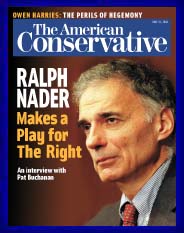
The cover of the 2004 campaign? Ralph Nader makes a play for conservatives.
Conservative commentator and former presidential candidate Pat Buchanan lobs a softball interview to Ralph Nader in the latest edition of The American Conservative Magazine: ["Ralph Nader: Conservatively Speaking"]. This is pretty amazing stuff and clearly proves the case Nader has been making: He can appeal to both conservatives pissed off at President George W. Bush and liberals who are just not going to vote for John Kerry. Combine this with the efforts of conservatives across the country to get Nader on the ballot in states and donate money to his campaign, and Nader's strategy seems to be working. With Kerry's current Electoral College lead over Bush in most surveys and we will have a new nation by November! Conservative-Naderites - a new political designation? Maybe after all.
U.S. Senator from N.H., hmm ...:
It really sucks to be Democrat N.H. state Sen. Burt Cohen right now.
For the last 18 months, Cohen has been gunning for Republican Sen. Judd Gregg. And why not? Sure, Gregg isn't as bad as most Republicans - but he is still pretty bad. With Kerry looking good here, maybe Cohen could pull off a miracle. Cohen had some pretty good radio ads but didn't seem to have as powerful a message as other Democrats. While he was quick to criticize Republicans, he was tentative on solutions to the issues - which was a problem. But somebody over at the campaign was pilfering campaign funds: ["Sources: Cohen Campaign Funds May Have Been Stolen"]. The fledging PoliticsNH site broke the story first: ["Cohen drops U.S. Senate bid one day before filing period ends"] while word spread around the Web about what was happening.
However, what a tempting situation. Apparently in N.H., registered party members don't have to collect signatures, all they have to do is sign up for the race and they are on the ballot. How easy is that? But just when all hope is lost, the Democrats have a true champion who signed up to run: Granny D!: ["Granny D and two others file for U.S. Senate"]. As the song goes, Go Granny go Granny go Granny go! You have my vote for sure.
In other political news ...:
U.S. Rep. Mike Capuano, D-MA-8, escaped a real close one after former Ambassador Charles Stith decided not to challenge him as an independent this fall: ["Stith decides against a run for Congress"]. And here is my old bud Paul Simmons - finally getting into the papers - by shooting his mouth off in the Boston Phoenix: ["STITH VERSUS CAPUANO"].
Ouch. While Simmons is probably correct - Stith would lose - he would hardly be road kill, one of Simmons' fave expressions. It would have been a difficult race. Stith was planning on running as an independent - a very difficult task, especially with the arrogant media, who would probably ignore his campaign. However, Stith could easily lay the ground work for 2006, when Capuano is most assuredly going to run for governor against Mitt Romney. And let's be honest: While there is all kinds of talk about "diversity" in Massachusetts, they always manage to find a way not to actually implement diversity. Twelve white males representing them in the Senate and Congress. What an example. There are more black Republicans in elected office in most states then there is in Massachusetts. While Capuano is an okay rep., a Stith campaign would have been a good thing for the state and the black community.
"You say times are tough ..."
Who says ex-rock and rollers can't run for public office? Here is one of my faves, Peter Garrett, running for a Labor Party seat in Australia: ["Ex-Midnight Oil Singer Runs for Office"]. There is hope in the world.
Sunday polls:
Illinois: Kerry 52, Bush 39 [Survey USA].
Michigan: Kerry 45, Bush 43, Nader 3 [EPIC/MRA].
Missouri: Bush 48, Kerry 37, Nader 5 [L.A. Times].
New Hampshire: Bush 46, Kerry 46, Nader 2 [American Research Group, without Nader both Bush and Kerry have 47].
Ohio: Kerry 45, Bush 42, Nader 4 [L.A. Times, without Nader it's Kerry 46, Bush 45. Nader takes more votes from Bush than Kerry].
Pennsylvania: Kerry 47, Bush 46 [Survey USA].
Wisconsin: Bush 44, Bush 42, Nader 4 [L.A. Times, without Nader Kerry and Bush are tied with 44].

The cover of the 2004 campaign? Ralph Nader makes a play for conservatives.
Conservative commentator and former presidential candidate Pat Buchanan lobs a softball interview to Ralph Nader in the latest edition of The American Conservative Magazine: ["Ralph Nader: Conservatively Speaking"]. This is pretty amazing stuff and clearly proves the case Nader has been making: He can appeal to both conservatives pissed off at President George W. Bush and liberals who are just not going to vote for John Kerry. Combine this with the efforts of conservatives across the country to get Nader on the ballot in states and donate money to his campaign, and Nader's strategy seems to be working. With Kerry's current Electoral College lead over Bush in most surveys and we will have a new nation by November! Conservative-Naderites - a new political designation? Maybe after all.
U.S. Senator from N.H., hmm ...:
It really sucks to be Democrat N.H. state Sen. Burt Cohen right now.
For the last 18 months, Cohen has been gunning for Republican Sen. Judd Gregg. And why not? Sure, Gregg isn't as bad as most Republicans - but he is still pretty bad. With Kerry looking good here, maybe Cohen could pull off a miracle. Cohen had some pretty good radio ads but didn't seem to have as powerful a message as other Democrats. While he was quick to criticize Republicans, he was tentative on solutions to the issues - which was a problem. But somebody over at the campaign was pilfering campaign funds: ["Sources: Cohen Campaign Funds May Have Been Stolen"]. The fledging PoliticsNH site broke the story first: ["Cohen drops U.S. Senate bid one day before filing period ends"] while word spread around the Web about what was happening.
However, what a tempting situation. Apparently in N.H., registered party members don't have to collect signatures, all they have to do is sign up for the race and they are on the ballot. How easy is that? But just when all hope is lost, the Democrats have a true champion who signed up to run: Granny D!: ["Granny D and two others file for U.S. Senate"]. As the song goes, Go Granny go Granny go Granny go! You have my vote for sure.
In other political news ...:
U.S. Rep. Mike Capuano, D-MA-8, escaped a real close one after former Ambassador Charles Stith decided not to challenge him as an independent this fall: ["Stith decides against a run for Congress"]. And here is my old bud Paul Simmons - finally getting into the papers - by shooting his mouth off in the Boston Phoenix: ["STITH VERSUS CAPUANO"].
"Stith would be road kill," Simmons says. "Capuano is arguably the best field politician currently in Massachusetts, as he proved in the 1998 race. I wonder if this isn’t some sort of trial balloon, because Charlie Stith never struck me as being politically stupid — and it would be stupid to the point of masochism for him to run."
Ouch. While Simmons is probably correct - Stith would lose - he would hardly be road kill, one of Simmons' fave expressions. It would have been a difficult race. Stith was planning on running as an independent - a very difficult task, especially with the arrogant media, who would probably ignore his campaign. However, Stith could easily lay the ground work for 2006, when Capuano is most assuredly going to run for governor against Mitt Romney. And let's be honest: While there is all kinds of talk about "diversity" in Massachusetts, they always manage to find a way not to actually implement diversity. Twelve white males representing them in the Senate and Congress. What an example. There are more black Republicans in elected office in most states then there is in Massachusetts. While Capuano is an okay rep., a Stith campaign would have been a good thing for the state and the black community.
"You say times are tough ..."
Who says ex-rock and rollers can't run for public office? Here is one of my faves, Peter Garrett, running for a Labor Party seat in Australia: ["Ex-Midnight Oil Singer Runs for Office"]. There is hope in the world.
Sunday polls:
Illinois: Kerry 52, Bush 39 [Survey USA].
Michigan: Kerry 45, Bush 43, Nader 3 [EPIC/MRA].
Missouri: Bush 48, Kerry 37, Nader 5 [L.A. Times].
New Hampshire: Bush 46, Kerry 46, Nader 2 [American Research Group, without Nader both Bush and Kerry have 47].
Ohio: Kerry 45, Bush 42, Nader 4 [L.A. Times, without Nader it's Kerry 46, Bush 45. Nader takes more votes from Bush than Kerry].
Pennsylvania: Kerry 47, Bush 46 [Survey USA].
Wisconsin: Bush 44, Bush 42, Nader 4 [L.A. Times, without Nader Kerry and Bush are tied with 44].
Wednesday, June 9, 2004
Montana primary:
Democrat:
Kerry - 58,973 - 67.9 percent - 14 delegates.
Kucinich - 9,109 - 10.5 percent.
Edwards - 8,059 - 9.3 percent.
No Preference - 6,172 - 7.1 percent.
Clark - 3,837 - 4.4 percent.
LaRouche - 740 - 0.9 percent.
Republican:
Bush - 93,502 - 95.2 percent.
No Preference - 4,707 - 4.8 percent.
New Jersey:
Democrat:
Kerry - 191,816 - 92.1 percent - 106 delegates.
Kucinich - 9,074 - 4.4 percent.
LaRouche - 4,528 - 2.2 percent.
George Ballard - 2,758 - 1.3 percent.
Republican:
Bush - 211,218 - 100 percent - 52 delegates.
Democrat:
Kerry - 58,973 - 67.9 percent - 14 delegates.
Kucinich - 9,109 - 10.5 percent.
Edwards - 8,059 - 9.3 percent.
No Preference - 6,172 - 7.1 percent.
Clark - 3,837 - 4.4 percent.
LaRouche - 740 - 0.9 percent.
Republican:
Bush - 93,502 - 95.2 percent.
No Preference - 4,707 - 4.8 percent.
New Jersey:
Democrat:
Kerry - 191,816 - 92.1 percent - 106 delegates.
Kucinich - 9,074 - 4.4 percent.
LaRouche - 4,528 - 2.2 percent.
George Ballard - 2,758 - 1.3 percent.
Republican:
Bush - 211,218 - 100 percent - 52 delegates.
Sunday, June 6, 2004
Sunday headlines ... and questions:
I am going to be busy today so instead of posting the usual weekend rant, here are some headlines for everyone to peruse:
What is going on in Bush's mind?: ["Bush's Erratic Behavior Worries White House Aides"]. Holy sh*t:
Very interesting. There is also this, a pretty good overview of Bush's flip-flops by consultant Dan Payne: ["'Steadfast' Bush's amazing flip-flops"].
Why are liberals worried about Kerry?: Here's why: ["Liberal activists lukewarm on Kerry"]. I meant to post this earlier in the week but I have been busy. Simply, the wrong Democrat is the nominee.
What's going on with Nader?: Nader's press coverage hasn't been bad considering this time four years ago there was practically nothing. Here is a pretty good piece by William Safire: ["Who's a 'spoiler,' and who's not?"]. Worrying about Kerry's energy policy is a legitimate issue these days, with gas prices where they are and no one calling Kerry on his positions: ["Nader skeptical about Kerry on energy"]. Though Nader doesn't mention it, people forget that Kerry was advocating new nuclear power plants in early 2001. But then, there is this: ["Candidates Risk 'Glum' Label for Criticism"]. Sure, this is a "news article" but is also soaked with opinion. The point shouldn't be lost however: Candidates opposing a popular incumbent need to get a bit more positive and allow the surrogates to be negative. Other articles include this one, about efforts to get Nader on the ballot in Mass.: ["Nader supporters crash graduations: Backers want enough signatures to put candidate on ballot"] and this one from New Jersey ["Nader's aim on a viable third party"].
Why isn't this guy mopping up floors somewhere?: ["Rome on $12,000 a Month: The Return of Cardinal Bernard Law"]. So, this is what the Pope thinks should be done to people who don't protect the most innocent among us? The holy father goes on and on about the unborn. Yet, when priests were raping boys, over and over again, for years and years, and Law did nothing but attack those who were being raped, the Pope rewards the man. This is a disgrace.
Sunday polls:
Alabama: Bush 57, Kerry 36, Other 4, Not sure 4 [Rasmussen].
California: Kerry 49, Bush 41, Other 5, Not sure 5 [Rasmussen].
Connecticut: Kerry 46, Bush 36, Nader 8 [Qunnipiac, Without Nader, Kerry gains 4 points, Bush gains 2 points].
Georgia: Bush 51, Kerry 39, Other 5, Not sure 5 [Rasmussen].
Georgia: Bush 49, Kerry 32 [Insider Advantage].
Illinois: Kerry 54, Bush 38, Other 2, Not sure 6 [Rasmussen].
Illinois: Kerry 53, Bush 37, Nader 4 [Market Shares Corp.].
Louisiana: Bush 48, Kerry 42 [Marketing Research Institute].
Maine: Kerry 54, Bush 35, Other 3, Not sure 7 [Rasmussen].
Michigan: Kerry 47, Bush 43 [Survey USA].
Minnesota: Kerry 48, Bush 43, Other 4, Not sure 5 [Rasmussen].
Missouri: Bush 44, Kerry 43, Other 5, Not sure 8 [Rasmussen].
New Jersey: Kerry 51, Bush 39, Other 4, Not sure 6 [Rasmussen].
New York: Kerry 57, Bush 34, Other 4, Not sure 5 [Rasmussen].
North Carolina: Bush 48, Kerry 44, Other 3, Not sure 5 [Rasmussen].
Ohio: Bush 46, Kerry 44, Other 5, Not sure 6 [Rasmussen].
Oregon: Bush 46, Kerry 45, Other 6, Not sure 3 [Rasmussen].
Pennsylvania: Bush 45, Kerry 44 [Rasmussen].
South Carolina: Bush 49, Kerry 39, Other 3, Not sure 8 [Rasmussen].
Texas: Bush 55, Kerry 38, Other 3, Not sure 4 [Rasmussen].
Virgina: Bush 47, Kerry 45, Other 3, Not sure 5 [Rasmussen].
Election Projection has the race Kerry 337, Bush 201: [http://www.electionprojection.com/elections2004.html].
Samboni now has it at Kerry 312, Bush 226: [http://www.geocities.com/samboni1342/state_polls.htm].
David Wissing has it at Bush 307, Kerry 231: [http://www.davidwissing.com/bushkerrystate2004.html].
MyDD Blog has it Kerry 316, Bush 222: [http://www.mydd.com/special/president].
Rasmussen comments on why they aren't including Nader in their polls here: ["Why We're Not Including Ralph Nader"]. Here is an interesting quote: "These polls have caused some to conclude that Nader will once again play the role of spoiler for the Democratic contender. We respectfully disagree."
I am going to be busy today so instead of posting the usual weekend rant, here are some headlines for everyone to peruse:
What is going on in Bush's mind?: ["Bush's Erratic Behavior Worries White House Aides"]. Holy sh*t:
"President George W. Bush's increasingly erratic behavior and wide mood swings has the halls of the West Wing buzzing lately as aides privately express growing concern over their leader's state of mind. In meetings with top aides and administration officials, the President goes from quoting the Bible in one breath to obscene tantrums against the media, Democrats and others that he classifies as 'enemies of the state.'"
Very interesting. There is also this, a pretty good overview of Bush's flip-flops by consultant Dan Payne: ["'Steadfast' Bush's amazing flip-flops"].
Why are liberals worried about Kerry?: Here's why: ["Liberal activists lukewarm on Kerry"]. I meant to post this earlier in the week but I have been busy. Simply, the wrong Democrat is the nominee.
What's going on with Nader?: Nader's press coverage hasn't been bad considering this time four years ago there was practically nothing. Here is a pretty good piece by William Safire: ["Who's a 'spoiler,' and who's not?"]. Worrying about Kerry's energy policy is a legitimate issue these days, with gas prices where they are and no one calling Kerry on his positions: ["Nader skeptical about Kerry on energy"]. Though Nader doesn't mention it, people forget that Kerry was advocating new nuclear power plants in early 2001. But then, there is this: ["Candidates Risk 'Glum' Label for Criticism"]. Sure, this is a "news article" but is also soaked with opinion. The point shouldn't be lost however: Candidates opposing a popular incumbent need to get a bit more positive and allow the surrogates to be negative. Other articles include this one, about efforts to get Nader on the ballot in Mass.: ["Nader supporters crash graduations: Backers want enough signatures to put candidate on ballot"] and this one from New Jersey ["Nader's aim on a viable third party"].
Why isn't this guy mopping up floors somewhere?: ["Rome on $12,000 a Month: The Return of Cardinal Bernard Law"]. So, this is what the Pope thinks should be done to people who don't protect the most innocent among us? The holy father goes on and on about the unborn. Yet, when priests were raping boys, over and over again, for years and years, and Law did nothing but attack those who were being raped, the Pope rewards the man. This is a disgrace.
Sunday polls:
Alabama: Bush 57, Kerry 36, Other 4, Not sure 4 [Rasmussen].
California: Kerry 49, Bush 41, Other 5, Not sure 5 [Rasmussen].
Connecticut: Kerry 46, Bush 36, Nader 8 [Qunnipiac, Without Nader, Kerry gains 4 points, Bush gains 2 points].
Georgia: Bush 51, Kerry 39, Other 5, Not sure 5 [Rasmussen].
Georgia: Bush 49, Kerry 32 [Insider Advantage].
Illinois: Kerry 54, Bush 38, Other 2, Not sure 6 [Rasmussen].
Illinois: Kerry 53, Bush 37, Nader 4 [Market Shares Corp.].
Louisiana: Bush 48, Kerry 42 [Marketing Research Institute].
Maine: Kerry 54, Bush 35, Other 3, Not sure 7 [Rasmussen].
Michigan: Kerry 47, Bush 43 [Survey USA].
Minnesota: Kerry 48, Bush 43, Other 4, Not sure 5 [Rasmussen].
Missouri: Bush 44, Kerry 43, Other 5, Not sure 8 [Rasmussen].
New Jersey: Kerry 51, Bush 39, Other 4, Not sure 6 [Rasmussen].
New York: Kerry 57, Bush 34, Other 4, Not sure 5 [Rasmussen].
North Carolina: Bush 48, Kerry 44, Other 3, Not sure 5 [Rasmussen].
Ohio: Bush 46, Kerry 44, Other 5, Not sure 6 [Rasmussen].
Oregon: Bush 46, Kerry 45, Other 6, Not sure 3 [Rasmussen].
Pennsylvania: Bush 45, Kerry 44 [Rasmussen].
South Carolina: Bush 49, Kerry 39, Other 3, Not sure 8 [Rasmussen].
Texas: Bush 55, Kerry 38, Other 3, Not sure 4 [Rasmussen].
Virgina: Bush 47, Kerry 45, Other 3, Not sure 5 [Rasmussen].
Election Projection has the race Kerry 337, Bush 201: [http://www.electionprojection.com/elections2004.html].
Samboni now has it at Kerry 312, Bush 226: [http://www.geocities.com/samboni1342/state_polls.htm].
David Wissing has it at Bush 307, Kerry 231: [http://www.davidwissing.com/bushkerrystate2004.html].
MyDD Blog has it Kerry 316, Bush 222: [http://www.mydd.com/special/president].
Rasmussen comments on why they aren't including Nader in their polls here: ["Why We're Not Including Ralph Nader"]. Here is an interesting quote: "These polls have caused some to conclude that Nader will once again play the role of spoiler for the Democratic contender. We respectfully disagree."
Saturday, June 5, 2004
Nearly half Nader voters would vote for Bush!
Thanks to Kevin for sending me some of the raw data from this ABC News/Washington Post Poll which shows almost half of Nader's support coming from Bush. I did a google and found the link: ["White House 2004: General Election"]. The poll talked to 1,005 adults over May 20-23.
When asked who they were supporting, the results were Bush 46, Kerry 46, Nader 4, None/Wouldn't vote 2, No Opinion 1.
However, when Nader and undecided voters were asked, "If Nader does not run or is not on the ballot, for whom would you vote: Bush or Kerry?" Bush got 47 percent to Kerry's 49 percent. In April, the results were Bush 49, Kerry 48.
So nearly half of Nader voters in May and over half of Nader voters in April planned to vote for Bush if Nader wasn't a choice. Again, more polling evidence that shows that Nader is hurting Bush just as much as Kerry and goes to the heart of what Nader has been saying about his 2004 campaign.
R.I.P. Reagan:
Ronald Reagan, the 40th president of the United States, died earlier this afternoon. Since I try to make a habit of not speaking ill of the dead, I won't say anything about his passing. I feel for his family and wish them condolences.
Thanks to Kevin for sending me some of the raw data from this ABC News/Washington Post Poll which shows almost half of Nader's support coming from Bush. I did a google and found the link: ["White House 2004: General Election"]. The poll talked to 1,005 adults over May 20-23.
When asked who they were supporting, the results were Bush 46, Kerry 46, Nader 4, None/Wouldn't vote 2, No Opinion 1.
However, when Nader and undecided voters were asked, "If Nader does not run or is not on the ballot, for whom would you vote: Bush or Kerry?" Bush got 47 percent to Kerry's 49 percent. In April, the results were Bush 49, Kerry 48.
So nearly half of Nader voters in May and over half of Nader voters in April planned to vote for Bush if Nader wasn't a choice. Again, more polling evidence that shows that Nader is hurting Bush just as much as Kerry and goes to the heart of what Nader has been saying about his 2004 campaign.
R.I.P. Reagan:
Ronald Reagan, the 40th president of the United States, died earlier this afternoon. Since I try to make a habit of not speaking ill of the dead, I won't say anything about his passing. I feel for his family and wish them condolences.
Friday, June 4, 2004
Alabama:
From June 1, Democrat:
Kerry - 162,958 - 75 percent - 44 delegates.
Uncommitted - 37,986 - 17.5 percent - 6 delegates.
Kucinich - 9,043 - 4.2 percent.
LaRouche - 7,241 - 3.3 percent.
Republican:
Bush - 186,926 - 93 percent - 45 delegates.
Uncommitted - 13,971 - 7 percent.
New Mexico:
Republican:
Bush - 47,341 - 21 percent.
South Dakota:
Kerry - 69,454 - 82.3 percent - 14 delegates.
Uncommitted - 5,104 - 6.0 percent - 6 delegates.
Dean - 4,837 - 5.7 percent.
LaRouche - 2,942 - 3.5 percent.
Kucinich - 2,043 - 2.4 percent.
From June 1, Democrat:
Kerry - 162,958 - 75 percent - 44 delegates.
Uncommitted - 37,986 - 17.5 percent - 6 delegates.
Kucinich - 9,043 - 4.2 percent.
LaRouche - 7,241 - 3.3 percent.
Republican:
Bush - 186,926 - 93 percent - 45 delegates.
Uncommitted - 13,971 - 7 percent.
New Mexico:
Republican:
Bush - 47,341 - 21 percent.
South Dakota:
Kerry - 69,454 - 82.3 percent - 14 delegates.
Uncommitted - 5,104 - 6.0 percent - 6 delegates.
Dean - 4,837 - 5.7 percent.
LaRouche - 2,942 - 3.5 percent.
Kucinich - 2,043 - 2.4 percent.
Monday, May 31, 2004
SPECIAL REPORT: Anti-Nader study falls flat
Deeper analysis shows registered Democrats voting for Bush a larger threat than Nader; massive Kerry lead
A press release sent out last week by DontVoteRalph.net claiming Ralph Nader’s independent candidacy is impacting John Kerry’s presidential campaign in a negative way is founded on flawed analysis of national preference polls. It also ignores the fact that Kerry’s inability to hold registered Democrats in certain swing states has a more detrimental effect on his campaign than Nader does. Studying individual state polls reveals that Nader has negative, neutral and positive impacts on the Kerry campaign, with Kerry currently beating Bush by anywhere from 136 to 116 Electoral College votes – the votes that actually determine who becomes the president.
In the study, located at http://www.dontvoteralph.net/pollwatch.htm, the group performed a Google.com news search on May 13 and consulted the PollingReport.com site, eventually finding 37 national polls taken since Nader announced his candidacy. In their news release of May 26, 32 of those polls showed "that Nader directly helps Bush." Four reportedly showed no impact and one by FoxNews showed a 1 percent tilt towards Kerry.
"This study shreds the assertion by the Nader campaign that they will help beat Bush," stated John Pearce, Executive Director of Progressive Unity, in the press release. "Facts are facts, and these findings are overwhelming: Nader is directly helping Bush."
But is Nader really helping Bush? Are these the "facts"?
Faulty use of national polls
The first flaw of DontVoteRalph.net’s analysis is the use of national preference polls to determine the outcome of the presidential election. National polls are meaningless in electing the president. The president is elected by prevailing in each individual state and winning every state’s Electoral College votes. Whether Nader is earning 1, 2, 5 or whatever percent of the support in a national preference poll is pointless because the result has no bearing on the individual state voting. Since DontVoteRalph.net didn't analyze state polling data thoroughly, there is not one shred of proof that Nader "costs" Kerry anything.
The second flaw in this analysis of the national preference poll is the perception that somehow every single voter supporting Nader would automatically go to Kerry if Nader were not running for president. This is a completely false assumption. In 2000 – when Nader garnered a large section of left-leaning voters – only 45 percent said they would have voted for the Democratic nominee Al Gore had Nader not been in the race, according to the Voter News Service, the most extensive national polling consortium. Twenty-seven percent of Nader voters would have gone to Republican George W. Bush and the rest said they would not have voted at all. So, if less than half of Nader voters in 2000 would vote for the Democrat, why would anyone assume that 100 percent would vote for Kerry four years later? DontVoteRalph.net foolishly forwards this assumption in its analysis. As we have all heard time and time again, most liberal, progressive, and Democrat voters are taking an "anybody but Bush" stance. Kerry has already gained tens of thousands of Nader's 2000 votes and is in a better position to beat Bush than Gore was. There are still stubborn Nader supporters out there and there are thousands of Green-Rainbow and Socialists party members who will probably support their nominees. These voters aren't planning to vote for Kerry under any circumstances. So the Nader candidacy doesn’t help Bush or "cost" Kerry anything.
Individual state polls
On their site, DontVoteRalph.net states they did look at some state polls and they claim "the results were even more striking … show[ing] Nader flipping New Jersey and Pennsylvania from Kerry to Bush, and causing an 8% surge for Bush among the large Arab-American vote in four critical swing states." But is it really "striking" or "helping Bush"? Maybe; maybe not. David Wissing of The Hedgehog Report [http://www.davidwissing.com/bushkerrystate2004.html] is one of a handful of netizens who has been tracking state polling data for over six months. Unlike other Web sites that track polls, Wissing posts the Nader numbers – and the outcome without Nader – when available. The site has 59 polls in which Nader was included from 30 different states. In over 50 of those polls, Nader had no influence on the outcome, with other polls showing negative, neutral, or positive results for the Kerry campaign.
Nader: Negative, neutral, positive
In analyzing all the individual state data, Nader’s campaign does have some bearing on Kerry’s position in a few states.
On the negative side, in at least three states that Gore won in 2000, Nader could potentially influence the outcome of the election.
In a Fairleigh Dickinson April 3-10 poll in New Jersey, the results were Bush 48, Kerry 44, and Nader 5. But without Nader, Kerry benefits with 48 percent and Bush gets 47. However, countering this are four other polls from New Jersey done after the Fairleigh Dickinson poll which show Kerry beating Bush with or without Nader on the ballot.
In Oregon, a state Gore barely won in 2000, two polls show Nader potentially influencing the outcome. In a May 3-5 American Research Group [ARG] poll, Bush and Kerry were tied at 45, with Nader clocking in with 5 percent. Without Nader, the result would be Kerry 48, Bush 46. A Rasmussen Reports poll released on April 25 showed Bush and Kerry tied with 43 and Nader receiving 8 percent. Without Nader, Kerry received 46 with Bush getting 45, and 6 percent said they would vote for "some other candidate." So even with only two choices, the bulk of Nader’s support inflexibly stayed with their candidate. This polling data shines light on the mistaken premise that Nader’s candidacy "costs" Kerry the election. Again, many of Nader's supporters are not going to vote for Kerry under any circumstances so he gains nothing from a two-candidate race. Like in New Jersey, three other polls from Oregon showed Kerry beating Bush even with Nader on the ballot. But two recent polls - one in March and one in May - showed Bush beating Kerry in Oregon with no Nader candidacy at all. Again, more evidence that shows a potential loss for Kerry, without Nader, in the state.
Lastly, in Pennsylvania, a March 9-15 Quinnipiac poll showed Bush with 44, Kerry at 40, and Nader with 7 percent. However, without Nader, Kerry takes the lead with 45 to Bush's 44 percent. In the polling data, Nader earned the support of 4 percent of registered Republicans and 6 percent registered Democrats. Democrats supporting Bush came in at 14 percent.
However, another Pennsylvania poll shows Nader taking more Republican than Democrat votes by a 4 to 3 margin. In an April 16-25 Pew Charitable Trusts poll, Bush and Kerry were tied with 42 percent. Nader received 5 percent. The poll did not ask voters how they would vote if Nader were not on the ballot. Yet in this poll, Bush received 12 percent of the vote from registered Democrats – four times as many Democratic votes as Nader received. Another 10 percent of Democrats were undecided or supporting other candidates. So a full 22 percent of Democrats in Pennsylvania were supporting Bush, another candidate other than Nader, or were undecided, while only 3 percent were supporting Nader. Again, the Democratic base voting for Bush or another candidate costs Kerry the state. Kerry and Bush have been in a tug-of-war for the lead in other Pennsylvania polls, with most recent ones showing Kerry leading even with Nader on the ballot.
On the neutral side, recent polls from Florida show a replay of 2000 with essentially a tied race. An ARG poll from May 15-17 shows Bush leading 47 to Kerry’s 46 and Nader with 3. Without Nader, the results are a tie: Bush 47, Kerry 47. So while Nader "costs" Kerry 1 percent of the vote in this poll, the addition of Nader doesn’t guarantee a Kerry win in the state. An ARG poll from April 18-20 showed similar results: Bush at 46, Kerry with 45, and Nader in at 3. But without Nader, the results are again a tie: Bush 47, Kerry 47. So there is still no Kerry win in the state without Nader but some affect. However, look at some of the data buried in the May poll: Nader received 3 percent of registered Democrats [1 percent of the Republican vote] while Bush gets 11 percent of registered Democrats. This is almost a repeat of 2000 when 1 percent of Democrats voted for Nader and 13 percent voted for Bush, swinging the election to Bush. Clearly, in Florida, the Democratic nominee’s inability to hold his own base is more of a detriment to his candidacy than Nader.
In New Mexico, another state Gore barely won in 2000, the Nader candidacy has mixed results. In a March 30-April 1 ARG poll, Bush had 46, Kerry had 45, and Nader came in with 3 percent. Without Nader, the results would again be a tie, with Bush and Kerry getting 47 percent. However, Nader took equally from both registered Republicans and Democrats, 2 percent, while Bush received a whopping 20 percent of registered Democrats in the state – a 10 to 1 margin over Nader. Again, in this poll, registered Democrats – not Nader – are keeping Kerry from winning in New Mexico by voting for Bush.
On the positive side, in at least one poll from Ohio, Nader takes enough Republican votes to help Kerry win the state. In a late-March poll from West Virginia, Nader takes more Democrat votes by a two-to-one margin but the results affect Bush’s position in the state, not Kerry's. In that poll, Bush received a massive 22 percent of the Democrat vote. In many other states, Nader takes almost equally from both major party candidates, without changing the state outcomes. In a New Hampshire poll released in March by ARG, Nader garnered the support of 9 percent of Republicans compared to 4 percent of Democrats, a two to one margin and virtual repeat of what occurred in 2000, with Bush leading in the state with or without Nader.
Kerry's Electoral College vote lead
Different Web sites tracking state by state polls and compiling possible Electoral College results show Kerry with huge leads over Bush even with Nader in the race. Election Projection [http://www.electionprojection.com/elections2004.html] has the race at Kerry 337, Bush 201. Samboni1342, another Web site posting numbers, now has it Kerry 327, Bush 211 [http://www.geocities.com/samboni1342/state_polls.htm]. On Saturday, May 29, Wissing posted Kerry 289, Bush 249 results on his site, listed above. However, on Sunday, his results had shifted to Bush 296, Kerry 248 with new polls showing Bush leads in Ohio and other states but no Nader effect.
Conclusion: The anti-Nader site analysis is flawed
After looking at all the polling analysis that is available to date, there is no definitive evidence that shows Nader harming Kerry in any way. There is the potential for Nader to harm Kerry if the Democrat follows a similar path that Gore followed in 2000 and loses his clear lead at this point in the election. As well, the selection of a conservative or free trade vice presidential candidate by Kerry could alienate potential support for his cause and shift votes to Nader, similar to the support which shifted from Gore after his selection of Sen. Joseph Lieberman for the VP spot. However, the deeper data in some of the state polls goes to the heart of what Nader has stated in his 2004 campaign – and goes against statements and analysis forwarded by DontVoteRalph.net. In some swing states, Nader is taking more votes from registered Republicans than Democrats. In many others, Kerry's inability to keep the Democratic base from casting votes for Bush will cost him the election just as these voters cost Gore the election in 2000. A Kerry loss would be more a result of failing to keep his base from fleeing to Bush than Nader.
In the future, anti-Nader sites like DontVoteRalph.net should ignore national preference polling and perform a more expansive and accurate analysis of state polls before coming to suspect conclusions like they did on May 26. They should also spend less time attempting to deny the Constitutional rights of Nader to run for office and those people who want a third choice in 2004.
Kerry supporters should also spend more time trying to get Kerry elected and encouraging the candidate to pick a populist, fair trader for the vice presidential nomination, in order to earn the votes of Nader supporters instead of trying to scare them with flawed, baseless analysis.
Deeper analysis shows registered Democrats voting for Bush a larger threat than Nader; massive Kerry lead
A press release sent out last week by DontVoteRalph.net claiming Ralph Nader’s independent candidacy is impacting John Kerry’s presidential campaign in a negative way is founded on flawed analysis of national preference polls. It also ignores the fact that Kerry’s inability to hold registered Democrats in certain swing states has a more detrimental effect on his campaign than Nader does. Studying individual state polls reveals that Nader has negative, neutral and positive impacts on the Kerry campaign, with Kerry currently beating Bush by anywhere from 136 to 116 Electoral College votes – the votes that actually determine who becomes the president.
In the study, located at http://www.dontvoteralph.net/pollwatch.htm, the group performed a Google.com news search on May 13 and consulted the PollingReport.com site, eventually finding 37 national polls taken since Nader announced his candidacy. In their news release of May 26, 32 of those polls showed "that Nader directly helps Bush." Four reportedly showed no impact and one by FoxNews showed a 1 percent tilt towards Kerry.
"This study shreds the assertion by the Nader campaign that they will help beat Bush," stated John Pearce, Executive Director of Progressive Unity, in the press release. "Facts are facts, and these findings are overwhelming: Nader is directly helping Bush."
But is Nader really helping Bush? Are these the "facts"?
Faulty use of national polls
The first flaw of DontVoteRalph.net’s analysis is the use of national preference polls to determine the outcome of the presidential election. National polls are meaningless in electing the president. The president is elected by prevailing in each individual state and winning every state’s Electoral College votes. Whether Nader is earning 1, 2, 5 or whatever percent of the support in a national preference poll is pointless because the result has no bearing on the individual state voting. Since DontVoteRalph.net didn't analyze state polling data thoroughly, there is not one shred of proof that Nader "costs" Kerry anything.
The second flaw in this analysis of the national preference poll is the perception that somehow every single voter supporting Nader would automatically go to Kerry if Nader were not running for president. This is a completely false assumption. In 2000 – when Nader garnered a large section of left-leaning voters – only 45 percent said they would have voted for the Democratic nominee Al Gore had Nader not been in the race, according to the Voter News Service, the most extensive national polling consortium. Twenty-seven percent of Nader voters would have gone to Republican George W. Bush and the rest said they would not have voted at all. So, if less than half of Nader voters in 2000 would vote for the Democrat, why would anyone assume that 100 percent would vote for Kerry four years later? DontVoteRalph.net foolishly forwards this assumption in its analysis. As we have all heard time and time again, most liberal, progressive, and Democrat voters are taking an "anybody but Bush" stance. Kerry has already gained tens of thousands of Nader's 2000 votes and is in a better position to beat Bush than Gore was. There are still stubborn Nader supporters out there and there are thousands of Green-Rainbow and Socialists party members who will probably support their nominees. These voters aren't planning to vote for Kerry under any circumstances. So the Nader candidacy doesn’t help Bush or "cost" Kerry anything.
Individual state polls
On their site, DontVoteRalph.net states they did look at some state polls and they claim "the results were even more striking … show[ing] Nader flipping New Jersey and Pennsylvania from Kerry to Bush, and causing an 8% surge for Bush among the large Arab-American vote in four critical swing states." But is it really "striking" or "helping Bush"? Maybe; maybe not. David Wissing of The Hedgehog Report [http://www.davidwissing.com/bushkerrystate2004.html] is one of a handful of netizens who has been tracking state polling data for over six months. Unlike other Web sites that track polls, Wissing posts the Nader numbers – and the outcome without Nader – when available. The site has 59 polls in which Nader was included from 30 different states. In over 50 of those polls, Nader had no influence on the outcome, with other polls showing negative, neutral, or positive results for the Kerry campaign.
Nader: Negative, neutral, positive
In analyzing all the individual state data, Nader’s campaign does have some bearing on Kerry’s position in a few states.
On the negative side, in at least three states that Gore won in 2000, Nader could potentially influence the outcome of the election.
In a Fairleigh Dickinson April 3-10 poll in New Jersey, the results were Bush 48, Kerry 44, and Nader 5. But without Nader, Kerry benefits with 48 percent and Bush gets 47. However, countering this are four other polls from New Jersey done after the Fairleigh Dickinson poll which show Kerry beating Bush with or without Nader on the ballot.
In Oregon, a state Gore barely won in 2000, two polls show Nader potentially influencing the outcome. In a May 3-5 American Research Group [ARG] poll, Bush and Kerry were tied at 45, with Nader clocking in with 5 percent. Without Nader, the result would be Kerry 48, Bush 46. A Rasmussen Reports poll released on April 25 showed Bush and Kerry tied with 43 and Nader receiving 8 percent. Without Nader, Kerry received 46 with Bush getting 45, and 6 percent said they would vote for "some other candidate." So even with only two choices, the bulk of Nader’s support inflexibly stayed with their candidate. This polling data shines light on the mistaken premise that Nader’s candidacy "costs" Kerry the election. Again, many of Nader's supporters are not going to vote for Kerry under any circumstances so he gains nothing from a two-candidate race. Like in New Jersey, three other polls from Oregon showed Kerry beating Bush even with Nader on the ballot. But two recent polls - one in March and one in May - showed Bush beating Kerry in Oregon with no Nader candidacy at all. Again, more evidence that shows a potential loss for Kerry, without Nader, in the state.
Lastly, in Pennsylvania, a March 9-15 Quinnipiac poll showed Bush with 44, Kerry at 40, and Nader with 7 percent. However, without Nader, Kerry takes the lead with 45 to Bush's 44 percent. In the polling data, Nader earned the support of 4 percent of registered Republicans and 6 percent registered Democrats. Democrats supporting Bush came in at 14 percent.
However, another Pennsylvania poll shows Nader taking more Republican than Democrat votes by a 4 to 3 margin. In an April 16-25 Pew Charitable Trusts poll, Bush and Kerry were tied with 42 percent. Nader received 5 percent. The poll did not ask voters how they would vote if Nader were not on the ballot. Yet in this poll, Bush received 12 percent of the vote from registered Democrats – four times as many Democratic votes as Nader received. Another 10 percent of Democrats were undecided or supporting other candidates. So a full 22 percent of Democrats in Pennsylvania were supporting Bush, another candidate other than Nader, or were undecided, while only 3 percent were supporting Nader. Again, the Democratic base voting for Bush or another candidate costs Kerry the state. Kerry and Bush have been in a tug-of-war for the lead in other Pennsylvania polls, with most recent ones showing Kerry leading even with Nader on the ballot.
On the neutral side, recent polls from Florida show a replay of 2000 with essentially a tied race. An ARG poll from May 15-17 shows Bush leading 47 to Kerry’s 46 and Nader with 3. Without Nader, the results are a tie: Bush 47, Kerry 47. So while Nader "costs" Kerry 1 percent of the vote in this poll, the addition of Nader doesn’t guarantee a Kerry win in the state. An ARG poll from April 18-20 showed similar results: Bush at 46, Kerry with 45, and Nader in at 3. But without Nader, the results are again a tie: Bush 47, Kerry 47. So there is still no Kerry win in the state without Nader but some affect. However, look at some of the data buried in the May poll: Nader received 3 percent of registered Democrats [1 percent of the Republican vote] while Bush gets 11 percent of registered Democrats. This is almost a repeat of 2000 when 1 percent of Democrats voted for Nader and 13 percent voted for Bush, swinging the election to Bush. Clearly, in Florida, the Democratic nominee’s inability to hold his own base is more of a detriment to his candidacy than Nader.
In New Mexico, another state Gore barely won in 2000, the Nader candidacy has mixed results. In a March 30-April 1 ARG poll, Bush had 46, Kerry had 45, and Nader came in with 3 percent. Without Nader, the results would again be a tie, with Bush and Kerry getting 47 percent. However, Nader took equally from both registered Republicans and Democrats, 2 percent, while Bush received a whopping 20 percent of registered Democrats in the state – a 10 to 1 margin over Nader. Again, in this poll, registered Democrats – not Nader – are keeping Kerry from winning in New Mexico by voting for Bush.
On the positive side, in at least one poll from Ohio, Nader takes enough Republican votes to help Kerry win the state. In a late-March poll from West Virginia, Nader takes more Democrat votes by a two-to-one margin but the results affect Bush’s position in the state, not Kerry's. In that poll, Bush received a massive 22 percent of the Democrat vote. In many other states, Nader takes almost equally from both major party candidates, without changing the state outcomes. In a New Hampshire poll released in March by ARG, Nader garnered the support of 9 percent of Republicans compared to 4 percent of Democrats, a two to one margin and virtual repeat of what occurred in 2000, with Bush leading in the state with or without Nader.
Kerry's Electoral College vote lead
Different Web sites tracking state by state polls and compiling possible Electoral College results show Kerry with huge leads over Bush even with Nader in the race. Election Projection [http://www.electionprojection.com/elections2004.html] has the race at Kerry 337, Bush 201. Samboni1342, another Web site posting numbers, now has it Kerry 327, Bush 211 [http://www.geocities.com/samboni1342/state_polls.htm]. On Saturday, May 29, Wissing posted Kerry 289, Bush 249 results on his site, listed above. However, on Sunday, his results had shifted to Bush 296, Kerry 248 with new polls showing Bush leads in Ohio and other states but no Nader effect.
Conclusion: The anti-Nader site analysis is flawed
After looking at all the polling analysis that is available to date, there is no definitive evidence that shows Nader harming Kerry in any way. There is the potential for Nader to harm Kerry if the Democrat follows a similar path that Gore followed in 2000 and loses his clear lead at this point in the election. As well, the selection of a conservative or free trade vice presidential candidate by Kerry could alienate potential support for his cause and shift votes to Nader, similar to the support which shifted from Gore after his selection of Sen. Joseph Lieberman for the VP spot. However, the deeper data in some of the state polls goes to the heart of what Nader has stated in his 2004 campaign – and goes against statements and analysis forwarded by DontVoteRalph.net. In some swing states, Nader is taking more votes from registered Republicans than Democrats. In many others, Kerry's inability to keep the Democratic base from casting votes for Bush will cost him the election just as these voters cost Gore the election in 2000. A Kerry loss would be more a result of failing to keep his base from fleeing to Bush than Nader.
In the future, anti-Nader sites like DontVoteRalph.net should ignore national preference polling and perform a more expansive and accurate analysis of state polls before coming to suspect conclusions like they did on May 26. They should also spend less time attempting to deny the Constitutional rights of Nader to run for office and those people who want a third choice in 2004.
Kerry supporters should also spend more time trying to get Kerry elected and encouraging the candidate to pick a populist, fair trader for the vice presidential nomination, in order to earn the votes of Nader supporters instead of trying to scare them with flawed, baseless analysis.
Sunday, May 30, 2004
Sunday polls - Kerry's big lead:
The problems in Iraq and the sputtering economy are clearly damaging Bush's reelection campaign.
Alabama: Bush 54, Kerry 32, Nader 3 [Capital Survey Research Center].
Arizona: Bush 43, Kerry 38, Nader 2, Undecided 17 [Arizona State/KAET-TV].
Arkansa: Bush 49, Kerry 45, Nader 0 [Zogby].
California: Kerry 51, Bush 39, Nader 6 [Field Poll].
Florida: Kerry 49, Bush 48, Nader 1 [Zogby].
Indiana: Bush 54, Kerry 38, Nader 8 [Indianapolis Star/WTHR].
Iowa: Kerry 46, Bush 43, Nader 2 [Research 2000].
Iowa: Kerry 48, Bush 45, Nader/Undecided 8 [Survey USA].
Kentucky: Bush 49, Kerry 43 [Garin-Hart-Yank Research Group].
Louisiana: Bush 48, Kerry 29, Nader 0 [Multi-Quest].
Michigan: Kerry 50, Bush 41, Nader 0 [Zogby].
Minnesota: Kerry 51, Bush 42, Nader [Zogby].
Missouri: Kerry 47, Bush 44, Nader 0 [Zogby].
Montana: Bush 53, Kerry 33, Nader 8 [Mason-Dixon].
Nevada: Kerry 47, Bush 43, Nader 0 [Zogby].
Ohio: Bush 47, Kerry 41, Nader 3, Undecided 9 [Mason-Dixon]
Ohio: Kerry 49, Bush 45, Nader 0 [Zogby].
Pennsylvania: Kerry 44, Bush 41, Nader 6 [Quinnipiac].
Washington: Kerry 53, Bush 44, Nader 0 [Zogby].
West Virginia: Bush 48, Kerry 46, Nader 0 [Zogby].
Wisconsin: Kerry 52, Bush 43, Nader 0 [Zogby].
Election Projection has the race Kerry 337, Bush 201. Last week, they had Kerry 327, Bush 211: ["Election Projection"].
Samboni now has it at Kerry 307, Bush 231. Last week it was: Kerry 289, Bush 243, Undecided 6. Two weeks ago he had Bush 266, Kerry 258, Undecided 54: http://www.geocities.com/samboni1342/state_polls.htm.
David Wissing has it at Bush 296, Kerry 248. On Saturday he had it: Kerry 289, Bush 249. Last week he had it: Bush 276, Kerry 262. Two weeks ago he had Bush 280, Kerry 256: http://www.davidwissing.com/bushkerrystate2004.html.
The problems in Iraq and the sputtering economy are clearly damaging Bush's reelection campaign.
Alabama: Bush 54, Kerry 32, Nader 3 [Capital Survey Research Center].
Arizona: Bush 43, Kerry 38, Nader 2, Undecided 17 [Arizona State/KAET-TV].
Arkansa: Bush 49, Kerry 45, Nader 0 [Zogby].
California: Kerry 51, Bush 39, Nader 6 [Field Poll].
Florida: Kerry 49, Bush 48, Nader 1 [Zogby].
Indiana: Bush 54, Kerry 38, Nader 8 [Indianapolis Star/WTHR].
Iowa: Kerry 46, Bush 43, Nader 2 [Research 2000].
Iowa: Kerry 48, Bush 45, Nader/Undecided 8 [Survey USA].
Kentucky: Bush 49, Kerry 43 [Garin-Hart-Yank Research Group].
Louisiana: Bush 48, Kerry 29, Nader 0 [Multi-Quest].
Michigan: Kerry 50, Bush 41, Nader 0 [Zogby].
Minnesota: Kerry 51, Bush 42, Nader [Zogby].
Missouri: Kerry 47, Bush 44, Nader 0 [Zogby].
Montana: Bush 53, Kerry 33, Nader 8 [Mason-Dixon].
Nevada: Kerry 47, Bush 43, Nader 0 [Zogby].
Ohio: Bush 47, Kerry 41, Nader 3, Undecided 9 [Mason-Dixon]
Ohio: Kerry 49, Bush 45, Nader 0 [Zogby].
Pennsylvania: Kerry 44, Bush 41, Nader 6 [Quinnipiac].
Washington: Kerry 53, Bush 44, Nader 0 [Zogby].
West Virginia: Bush 48, Kerry 46, Nader 0 [Zogby].
Wisconsin: Kerry 52, Bush 43, Nader 0 [Zogby].
Election Projection has the race Kerry 337, Bush 201. Last week, they had Kerry 327, Bush 211: ["Election Projection"].
Samboni now has it at Kerry 307, Bush 231. Last week it was: Kerry 289, Bush 243, Undecided 6. Two weeks ago he had Bush 266, Kerry 258, Undecided 54: http://www.geocities.com/samboni1342/state_polls.htm.
David Wissing has it at Bush 296, Kerry 248. On Saturday he had it: Kerry 289, Bush 249. Last week he had it: Bush 276, Kerry 262. Two weeks ago he had Bush 280, Kerry 256: http://www.davidwissing.com/bushkerrystate2004.html.
Subscribe to:
Posts (Atom)