Saturday, September 23, 2006

Christy Mihos' TV ad

I just saw Christy Mihos' 30-second spot on Channel 7 ... and it is totally hilarious: It starts with a cartoon of Mihos standing outside the State House with "The Big Dig, Explained" above the character in big letters. Mihos then asks a Bechtel contractor, "How did the Big Dig get $12 billion over-budget?" The contractor - another cartoon character - said, "Well, you see ..." and then sticks his head up his ass and starts walking around!
At this point, I took my headphones off and said, "What the hell is this?"
Mihos, then turns to some men and women, including one blonde woman who looks like "Muffy" Healey and asks the same question. "Massachusetts Politicians," as they are labeled, stick their heads up their asses and start walking around mumbling!
Then, about 10 minutes later, it played again: A double dose in the news. Nice job.

Why Mihos needs the ads: Take a look at this poll: ["Mass. Gov."]. First, I seriously doubt this poll. Patrick at 64 percent? No way. Healey could probably be that low. The same with Mihos and Ross. But who are the Other who are getting 3 percent? There are no other candidates. Mickey Mouse? Donald Duck? The margin of error is 4 percent.

Calling Roy Morrison: Roy Morrison, a Warner poet, environmentalist and columnist who sends me stuff sometimes, gave Al Gore his recent book called "Taxing Pollution, Not Income," and it seems as though Gore likes the idea: ["Gore says tax pollution, not payrolls"]. Wow. I will be interviewing Roy about this and other things when his new book comes out in October.

Post-NAB roundup: Because the NAB Education Foundation was able to line up a table at a Job Fair for me, I ended up missing the last two Friday events at NAB, including the one with Ariana Huffington. But, I don't think I was alone in missing the events.
After setting up for the Job Fair, I went looking for a cup of coffee and took one more pass through the NAB Bookstore to order the entire NAB event on CDR. Shockingly, the exhibit hall was closed and exhibitors were breaking down all their gear. This was surprisingly because last year in Philadelphia, the booths were still up on Friday morning and there was some last minute trading going on between customers and vendors. But not here: The Hilton was barren.
I grabbed a cup of coffee from the SESAC refreshment area and headed back to the Job Fair, almost running into Sean Hannity, blurry-eyed, heading towards the NAB area.
At the Job Fair, I met a bunch of interesting candidates and, as I have said before, I continue to be surprised by all the interesting people, with their diverse backgrounds, looking to get into the radio business. During one of the side conversations between a woman visiting with me and the guy in the booth next to me, she mentioned that attendance was down almost 20 percent from last year, allegedly, even though there were 3,100 people in attendance. This doesn't surprise me at all since it seemed empty. But what do I know?

Friday, September 22, 2006

Dallas morning sunrises ...
It is a bit cloudy today but I'm sorry I failed to mention the morning sunrises here. They are very pretty although not spectacular and because everything is so flat, it makes for a very bright morning indeed. It is also strange to wake up at 6 a.m. and have it be dark when in my neck of the woods, the sun is up at 5 a.m. most of the time.
Another odd thing about staying here has been the one hour difference in time from eastern to central. My laptop has the eastern time but my phone automatically changed to central time when I got to Chicago. The television is off by an hour. All the normal 8 p.m. shows in New Hampshire were airing here at 7 p.m. This caught me totally offguard because if I sat down at a certain time for one show, another one came on. Very weird. But, I'm so out of touch with TV these days and the new fall season, it will probably be a similar feeling when I get home.
This is the last day of the 2006 NAB Radio Show. Thanks to everyone who has been reading. I will have a Friday report sometime on Saturday morning ... Eastern Daylight Time. :-)

Bumpin' and grindin': Kids will be kids, as they say, but our local high schoolers make the Drudge Report:
["Grinding to a halt"].

Thursday, September 21, 2006

The NAB Radio Show, Day 2.5


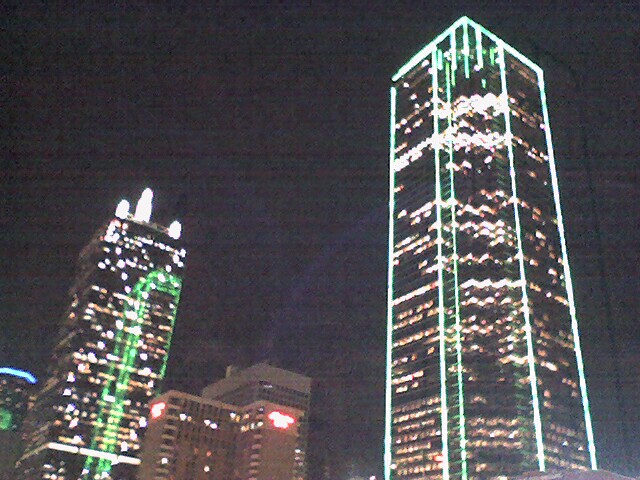
The view outside the fab YO Texas Steakhouse in Dallas. The building on the right is the Bank of America bulding. I thought I would post this so everyone with Bank of America cards can see what their interest payments built. Note how cool the green neon looks in the opposite building. Again, taken with the spotty camera on the Treo 650.

Between airliners roaring over my head – it must have been last night’s wind affecting flight patterns – and people getting out of their rooms early and draggin’ their luggage over the cement hallway [clunk, clunk, clunk …], I didn’t get enough sleep last night and woke a little later than I wanted to.
I had hoped to get to the NAB FCC Breakfast by 7:30 a.m. Instead, I arrived a little after 8 a.m. to a bunch of folks standing at the entrance, eating their breakfasts or just drinking coffee, because there were not enough chairs. So, when in Rome …
It was an interesting conversation between Commissioners Jonathan Adelstein and Robert McDowell with host Bruce Reese [sp], talking about everything from indecency laws, regulation, or actually lack of it, the roll out of digital radio, low-powered licenses, and FM translators for AM stations who go dark or power down in the evening.
Interestingly, they both kinda agreed that the indecency fines may have gone too far the other way and may be stifling free speech. There was some talk about how the digital radio format was an experimental thing and that was why the FCC was taking so long to make the digital arrangements permanent. They also stated that they were waiting to see if broadcasters were taking advantage of the multicasts to become more local.
Sidebar: As most of us know, broadcasters haven’t been doing that. They have been doing the opposite – throwing syndicated or satellite stuff on the air with little or no local content, according to some of the trades. Broadcasters seem more concerned with using the new multicast signals as ways of raising new revenue and not necessarily concerned with content or localism, despite all the NAB rah-rahing about the subject.
Reece was also affable and humorous and the breakfast of standard buffet fare was pretty good.

After the breakfast, I attended the first session of the morning, Small Market Operators, Big Market Thinkers, featuring a pretty good give and take from three Midwest owner/operators of clusters of small market stations.
The moderator, Chuck DuCoty, of NRG Media in Iowa, did a really good job of moving the conversation around and allowing people in the audience to chime in with questions about what operators were doing. This keeps the thing a bit less top-down more than other sessions, which isn’t an easy thing to do without passing a mic around.
Joe Schwartz, the president and CEO of Cherry Creek Radio in Colorado, called it an exciting time to be in radio despite all the “gloom and doom” from the big owners and their shareholders. He also said that he didn’t think the HD Radio, PPM – a new electronic metering system expected to be unveiled by Arbitrons in 2010 – or Wall Street meant anything to the small market broadcaster.
Sue Goldstein, who handles the marketing/sales for Jackson Radio Works of Michigan, a company she owns with her husband, agreed with much of what Schwartz said. She noted that her company worked with customers one-on-one to help them solve problems and find solutions.
“We don’t worry about the ratings,” she said, but added that they embrace new technologies as much as they can without spending big bucks. “It’s all what we make it.”
Gary Buchanan, the president and COO of Three Eagles Broadcasting, which owns 47 stations in the Midwest, noted that small market radio “can still have fun … We don’t try to save our way to prosperity” taking a jab at some of the big boys who are complaining about profit pressures.
They all agreed about the importance of retaining and recruiting people locally on a regular basis and making sure that sales people were trained properly. There was some discussion about inventory and what to do about filling it or keeping it under control and also about cost per point and pricing.
Schwartz said his station didn’t look at the pricing structure at other radio stations.
“Giving away spots is not the business you want,” he said.
Rather, radio stations should go after newspaper ads where “the real money” is. He noted that newspapers raise their prices every single year, sometimes twice a year, and radio does a far better job getting the price the client deserves.
Goldstein also said it was important to look at the market as a whole. While her company owns the only commercial station in her town, it gets bombed by other radio stations outside of the market. However, it doesn’t affect them. She said they worry about cable ads, although the high costs of television production keep things inline.
Buchanan said it was important to pay close attention to local advertisers, noting that one of his sales managers refused ads from a large big-box store which is opening up stores everywhere across the nation and putting locals out of business [He was probably talking about Wal-Mart but didn’t mention the company by name]. He said those companies will press radio stations to give them rates of 10 cents on the dollar. He said their company also does calendar promotions and other things with packaging and promotions.
They all talked about car giveaway promotions and other things stations have seen that have worked. Schwartz said the station puts together an agriculture event which raises $200,000 each year in revenue. He also stressed selling long-term contracts because radio repetition and the frequency of ad runs were the way to success in radio. He said most companies should consider 28 spots per week over 52-weeks and the advertiser will get results.

The keynote speech by David Rehr, president and CEO of NAB, and Ken Schmidt, a former spokesman and marketing man for Harley-Davidson, was surprisingly sparsely attended It was interesting to say the least though.
Rehr went on this near rant about forcing the FCC to take on the satellite companies for their illegal signal transponders in cars and their push to offer services to terrestrial radio. He noted that radio’s demise had been predicted before with the invention of the LP, 8-track, cassette, TV, and CDs, and yet, radio was still around.
Rehr also went off with a laundry list of things which the NAB was doing to assist broadcasters. He emphasized “localism” a number of times, noting that radio is a person’s most immediate resource. He stated that it was important for radio to embrace technology and stop the RIAA, the recording industry’s lobbying arm, from passing a performance broadcast tax on radio stations. One got the feeling that it was a fire and brimstone speech and not really one on “the state of the industry” as it was promoted to be. He said that NAB would be “going on the offensive” and would be transferred into an aggressive advocate for radio.
“The future goes to those who take risks,” he said. “The others, will be left behind.”
Schmidt was a pretty cool guy but he knew it was a rough crowd when his jokes starting falling flat right out of the box.
“There are a lot of suits out there,” he cracked.
By the third joke, he threw up his hands and gave up and started to talk about how he helped turn Harley-Davidson around by creating brand loyalty, offering customization, and getting out into the hustings to see what motorcycle enthusiasts wanted in a Harley. It wasn’t an easy task. But the company kept trying and trying until the company reached the position it is in today.
He said the company worked to find the emotional, human side in its customers and ignored catch phrases like “quality” and “customer satisfaction.”
“People are tuning it out,” he said. “[We have to] stop doing business the way we’re expected.”
He also said it was important to listen to your customers and adjust accordingly since a company really isn’t who it says it is; a company is what the market says it is. He also said it was important to show passion in what you do.

I then attended a session called “Radio and The Consumer’s Mind: How Radio Works” which was headed up by Mary Bennett of RAB and James Peacock, a consultant helping RAB put together these studies about how effective radio advertising are and some other things which are being gathered up through extensive polling. The whole discussion was pretty fascinating with a lot of data about how effective certain types of advertising is and whether or not people tune out to certain types of ads.
The studies will take things from four different angles: Relevance and emotion, Internet synergy, Creating images, Engagement, and then they will figure out ways of utilizing all the information to make radio work better for clients.
Most of the information is clearly geared to big ad agencies who will advertise with big radio companies and those same big radio companies are footing the bill for the study. But there should be some trickling down of the information for mom and pop shops trying to get more business.
The study will be unveiled next week in NYC and when it is, I may come back and do a more thorough write-up about it because I’m intrigued by these things.
They did, however, release a sneak peak at some results. They found that: Radio is more personally and emotionally connected to consumers than TV, Internet, or newspapers; Radio ads remain more personally relevant to consumers, who expect radio ads to be “speaking to them”; Radio ads are better tolerated than ads on TV or the Internet; Advertising on the Internet has very high negatives; All of which suggests that radio listeners are especially receptive to advertising.
Pretty interesting to say the least.

The State of Talk Radio was another session I attended but it wasn’t much different than previous ones I have attended or seen on C-Span. Note to Michael Harrison: Will you please pipe down and let your panelists speak a bit? Jeesh.

I also attended a short meeting of the Small Market Broadcasters Caucus and listened to a presentation about HD Radio and an update about AM stations getting FM transponders.

I skipped the Marconi Awards dinner this year and saved the $100 ticket. After seeing all the big corporate radio stations nominated for awards, another silly morning zoo host lined up as the emcee, and a house band made up of radio executives who could play instruments, I decided to pass. I don’t think I missed anything but I will find out tomorrow.
Rumor around the convention in mild chit-chat before most of the sessions was that ticket sales for the event were really bad and that was why NAB introducers kept pimping the fact that there were still dinner tickets available before each session on Thursday. I don’t know if this is true or not, just guessing.
Instead, I enjoyed a huge New York ribeye steak at the YO Texas Steakhouse downtown and took a stroll over to Deep Elum, where I once played some shows while in a rock band back in the late 1980s. It is all developed and yuppified now but still a nice place to look around.

NAB Radio Show, Day 1


Here is the foyer inside of the Hilton Anatole Hotel in Dallas.

Well, technically, it is Day 1.5 since the event opened last night for a few hours but since those were only social hours, I guess they dont really count. The National Association of Broadcasters hosts two annual conventions during the year: Its regular convention in the spring which is held in Las Vegas and its fall Radio Show, which is held at various places around the country. Last year it was in Philadelphia. This year, it is in Dallas. The Vegas show is a massive event and one of the great things about the radio convention is that it really does concentrate on radio. The Vegas convention covers TV and film along with radio and also is co-hosted by the Radio Television News Directors Association. It does have a lot more features and a lot of cool gadgets. But, in some ways, it is too big.
I got up early and headed over to the convention center for the first round of sessions. During the first time attending NAB, I pretty much stuck with sessions that dealt with news content, programming, or other things of that nature. For the second one, I attended a mix of sessions about programming, news, sales, and marketing, with the intent of getting as much information as I could. During the third one, I attended a mix but admittedly was distracted by a lot of work stuff that I really didn’t get the full potential of the event. However during this one, I have mainly concentrated on leadership, management, and sales sessions, with the hope that I could learn even more about being a station manager.
What I found was that I already knew quite a bit about what some of the lecturers were saying. But, that is a good thing.
Instead of attending the more “fun” sessions like the future of radio or the talk about getting results for clients via more creative commercial writing, I attended the stress management talk. Now, someone who does the job of three or four people can expect a bit of stress in their lives. But at the same time, you want to figure out ways to get your job done faster and be able to manage your employees without having them all quit on you. I expected this talk to be pretty boring but it actually wasn’t. It was pretty interesting. The consultant, Debbie Waggoner, of Nodus, Inc., did a really good job in explaining how to limit your work stress by planning out your week, every week, and manage people better but at the same time, controlling the whine factor.
She used a creative example by have a huge vase full of sand at the bottom and small rocks up to the top and then asked a volunteer to put another half vase worth of big rocks into the already full vase. Of course, it was extremely difficult and the big rocks were barely piled on at the top and eventually, a couple fell out.
In the next example, she dumped out the sand gravel and asked the volunteer to fill the vase with the big rocks first and then the pebbles and then the sand, which filtered around all of the rocks. Almost everything fit into the vase.
But that was the point: Most people don’t make time for “the big rocks” first because they are bogged down with the sand and pebbles. The reverse should be true and it was a really good point.
Some other points included: Retaining key personnel is critical and making sure you spend time with them is a good thing and wards off career changes. Set aside time at the end of the week or on the Sunday before work to set up a weekly plan for the week. It’s important to be able to tell the difference between important things and urgent things, and to act accordingly.
I felt bad for Debbie because she did a great job but as I peered around the room, I saw a lot of sleepy and lost faces in the ground. Not too many people stressed although they looked tired.
Next, instead of attending talks about Podcasting, HD Radio, and how to not sound like an idiot, I went to the talk on how to make and manage your million dollar media rep.
This session, hosted by Michael Guld, had a lot of great tips on how to keep people motivated. The best thing to do though is to start out by hiring the best people in the first place. The wrong hire can be a disaster, he said. Hire the smile and then train the skill and then he went through a bunch of strengths and weaknesses a company must look at when hiring people for sales.
After lunch, which featured former Dallas Cowboys’ quarterback Troy Aiken, I went to a talk about how to find new employees in a small market job pool and then later, how to develop a good farm team. Both sessions had very good material in them and I learned a lot from them.

Tomorrow will feature the FCC Breakfast talk early and then I think I will attend the small market operators, big market thinkers talk and probably attend the keynote session featuring the president of NAB and some guy from Harley-Davidson. After that, there will be a talk on radio and the consumer’s mind, another talk about retaining team members, and then a meeting of the Small Market Operators Caucus, a new group which has formed to network small market radio owners together, something that is badly needed within this organization.

Although the sessions were pretty stellar one thing that was really a let down is the exhibit hall. Almost all the stuff was both big money things – like Google and Arbitrons – or lots of technical things like transmitters and things geared towards engineers. In addition, there were almost no vendors attending who hadn’t attended previous NAB events. Meaning that the exhibition booths – a major part of the process for going to one of these events – weren’t as impressive as the past. Oh well.

One of the other things I enjoy about coming to these conventions is all the free stuff. I got a bag full of free crap when I registered. None of it was really that impressive – lots of magazines, CDRs with material on it, note pads and pens – but sometimes, you get some cool things. This year, besides the other stuff mentioned, I got a sunglass holder which clips onto your car visor, which is cool. I also entered into some contests for free iPods and a free Apple laptop.

After the sessions, I decided to head back to the hotel room. Instead of getting food delivered or going out to a fancy meal somewhere, I went over to this hole-in-the-wall place called Buck’s Prime, which featured mesquite-grilled burgers and cold beer and soda in a cafeteria-like atmosphere. I had a messy chili-cheeseburger, which was really tasty, along with a couple of beers and skimmed through most of the Dallas Observer, a free local weekly tab ala the Village Voice, which had just hit newsstands.
Frankly, I was enthralled by the lead story, “The Reverend Freak,” about this black pastor who allegedly raped and assaulted women in his parish ["The Reverend Freak"]. The sidebar to the story – about the two female reporters not being allowed to leave the sanctuary after scoping the place out – was a good read too.

I headed back out into the Dallas night after eating and a light breeze blew hot air all around me as I tried to cross the boulevard. It was an eerie feeling – being completely covered in this warm breeze – but it is good to get the sense of other climates and places. I looked at the skyline for a few minutes and then went into my room to do some reading and work.

Wednesday, September 20, 2006

Let's see what's going on in radio


The night skyline in Dallas from the crappy camera on my Treo phone from the balcony of my inexpensive motel down the street from the ritzy Hilton where the 2006 NAB Radio Show is being held. Obviously, the view is not as impressive as Vegas.

Ah, Dallas.
I've been to Dallas a number of times now over the past 15-plus years - while touring with a small indie band in the late 1980s to a sales seminar and now, the 2006 NAB Radio Show.
Last year, the theme was "Radio revitalized." There was a lot of talk about the Hurricane Katrina situation and how radio, including the two big corporations which own most of the stations there, stepped up to serve their communities for once.
This year, it is "Redefining radio: The Talent to Lead; the Technology to succeed," like radio really needs to be redefined. I would assume that is trying to figure out other ways of relating to radio instead of just turning on the set. I'll find out tomorrow.
This year, NAB is also teaming up with Radio & Records Magazine to do a dual convention with both orgs so there are a lot of people here. I looked over the R&R agenda but it is mostly music stuff so I will probably be sitting out a lot of their seminars.
I really do like coming to these things because I really get a lot out of them. The seminars and training are very informative and you can find out the latest things in the radio industry in a two or three day spend. If it weren't so expensive, I assume more people would come. But I think it is worth the money. Unlike the annual NAB show in Vegas - which is truly overwhelming, addressing TV, radio, and film - this is geared towards radio only. So there is a concentration.
Getting here wasn't easy: I was up at 4 a.m. on the plane out of Manch at 6:45 a.m. with a stop in Philly and Chicago, which had a two hour layover - three if you count the time change - and then into Dallas landing just before 3 p.m. CDT - or 4 p.m. EDT. So, it was a 12-hour day before getting off the plane. A traffic tie-up on the Interstate and a packed shuttle meant it took an hour to go about 20 miles to get to the hotel.

Sidebar: I overheard this on the shuttle: A major radio personality, who is also a TV personality, is thinking about making the jump from regular radio to a satellite radio. A female exec for one of the companies was talking to another passenger on the shuttle and was trying very hard to not let anyone else hear her ... so I didn't get all the details. I sensed that this woman was talking about Sean Hannity because she said something about "Sean's itinerary," but I don't know for sure. No announcement will be made at the convention, she said, but it sounded as if it were something major. The company doesn't like the contract stipulations and the "No out" clause. Hmmm.
There was a report in the New York Post yesterday that Howard Stern may be leaving satellite to go back to regular radio. But both he and Sirius deny it: ["Sirius: Stern not going anywhere"]. Michael Harrison of Talkers Magazine was on "Countdown" on MSNBC and said he thought it would happen since Sirius has to figure out a way to make its $500 million back from Stern.

I came a day early in order to get a full start first thing tomorrow morning. If I left a day later, I would have missed an entire day of stuff or almost half the events. What is the point of that? Some of things tomorrow include a radio sales breakfast presentation, a talk on radio's future, stress free time management techniques, writing commercials which get results, two HD radio talks, important techniques for talk hosts and producers, a talk on podcasting, and managing the million dollar media rep ... and this is all before lunch! Obviously, one person can't go to all of them but at least you have some interesting choices. In other words, it is well worth the trouble and effort to get to this thing.

After settling into my inexpensive motel - I'm pleased to say I'll save more than $300 staying just a couple of blocks from the Hilton Anatole - I went over to the convention to register and check things out. None of the booths were open but I got a traditional convention bag full of crap and then got a beer [$6.75 for an Ultra - Yikes!] and kinda stood around listening to all the executive mucky mucks have their cocktail party.
Note to self: There needs to be a "small broadcasters association" of some sort either within or around NAB so us regular folks in radio can interact with each other and not have to talk about their stock portfolios or clusters of stations.
I then decided to check out the local food fare and after seeing some of the prices, decided to have some pizza and a salad delivered. I don't always do everything on the cheap but a $30 steak and a $20 cab ride to get to the steak is a tad much.

More on the 2006 NAB Radio Show tomorrow.

Four Red States in eight months: While sitting in the plane for hour after hour after hour, a few things struck me.
The first was how beautiful the damn country is. Cut away patches of light and dark greens and browns, hues of sienna and even some pretty filthy looking rivers and streams although the lakes and ponds seem to look pretty clean from the air.
The second was the fact that some of the tunes I picked for my mp3 player to listen to on the plane fit the mood of the flight ... the lofty "Soon" by My Bloody Valentine and "Untitled" by Interpol while flying through some whispy clouds; "This could be anywhere; this could be everywhere," an anti-suburb rant by the Dead Kennedys while flying over the sprawl of suburbia in Philly, Chicago, and Texas.
The third was how many porn shops are in the Dallas area. This is the heart of Red State country and there they all are. I thought it was only the evil liberals who condoned this stuff. Magazine porn shop, Christian church, strip club, church, etc. I noticed the same thing in Florida, South Carolina, Dallas on the last trip, and, well, Vegas, but there aren't any churches. I wonder if there is a theme there.

Texas politics: Not unlike a lot of states, Texas has a nasty governor's race going on.
Republican Rick "Good Hair" - as one Unversity of Texas columnist has nicknamed him - Perry is running for reelection against two indies and a Dem.
Right now, polls have him in the lead with about 35 percent, but that isn't a lot in a four-way race, according to the 11 p.m. news tonight [I didn't catch the channel I was watching].
Author and satirist Kinky Friedman is running as an indie and shockingly has about 25 percent of the state's support ["60 Minutes" did a profile on him a few months back which was hilarious]. Another indie, Carole Keeton Strayhorn, the tough, fighting grandma, has about 13 percent but between 10 and 12:30 p.m. tonight, I saw three of her TV ads, which were actually pretty good. Chris Bell, the Dem, has 23 too.
The channel is sponsoring a debate on Oct. 6 and it is pretty amazing that they are including all four of these candidates. Huh, Texas media, more open than Massachusetts or Maryland. Who woulda thunk it?

"For it all" Deval wins primary: In Mass., Deval Patrick routs Chris Gabrieli and Tom Reilly to become the first black to head up a statewide Democratic ticket in the state. Tim Murray, the Mayor of Worcester, won the lieutenant governor's slot against two businesswomen - Deb Goldberg and Andrea Silbert - who both seemed more qualified. Patrick will now face Lt. Gov. Kerry Murphy Healey, millionaire businessman Christy Mihos, and Green-Rainbow candidate Grace Ross, who is actually getting covered in the Boston Globe. Shocker.
If signs at gas stations count for anything, Mihos will win ... hahhaha ... that was a joke ... But, signs don't vote so ...
Another interesting point: While vacationing on the Cape recently, I didn't see one Murphy Healey sign anywhere. The Cape is the heart of GOP country in Massachusetts and not a sign to be seen. Yikes!

Tuesday, September 19, 2006

NAB Radioshow 2006
Stay tuned because I will be blogging from the National Association of Broadcasters' 2006 radio show convention in Dallas this week.

Monday, September 11, 2006

Headline Roundup
Yeah, it's been awhile and I have been busy, on vacation, but at the same time, saving up a slew of links to share. So, as Casey Kasem would say, On with the countdown.

Usama bin Ladin protected by Pakistan?
A couple of days ago, there was a story posted by Brian Ross, an investigative reporter with ABC News, which stated that Pakinstan had reached a no capture deal with bin Ladin. It was posted on Ross' Web site at ABC News called The Blotter. Here is the link which no longer works: ["Bin Laden gets ..."]. It looks like they have pulled the story. Nothing on Google News leads to anything about this report. There is a lot about bin Ladin being elusive and the trail being cold but not a lot about the Ross report. Update: I was able to find this by Googling, a mea culpa of sorts from the Pakistani government. Boy, that was fast!: ["Pakistan Denies Bin Laden Gets a Pass"].

The Londonderry gas price war
WMUR-TV Channel 9 reported Sunday night that a gas station in Londonderry off I-93 Exit 4 dropped its price to $2.25 and a price war ensued! Three other gas stations have dropped their price. At one station, the Mobil, the station ran out of gas. I noticed a price drop over the course of the week and mentioned to my wife that it was nice to be paying $2.55 a gallon even though that is way too high. Does anyone else wonder if this has anything to do with the fact that there is a mid-term election about to happen?

Recession coming?
I thought we were already in one: ["Recession will be nasty and deep, economist says"]. Housing sales drop; foreclosures rise; gas prices are squeezing every spare dime from your pocket; jobs aren't paying enough and Americans don't actually make anything anymore. Gee, do you think a recession is coming?

Reclassifying everything
What is this government so afraid of? Are they really afraid of John Lennon - 26 years after his death? Or, is this just a standard the government plans on making all the time and Hey, what the heck, let's go way, way back ... Wow, indeed: ["John Lennon - Still a Security Threat"].

This is interesting

["Al Gore Says He Hasn't Ruled Out 2nd Run"]. It should be third run, since he was also a candidate in 1988, but, what do they know, they are foreigners. The key quote is this though:

"I haven't completely ruled out running for president again in the future but I don't expect to."

Eh, so is that he hasn't completely ruled out running or that he doesn't expect to rule out a run? I'm confused.

All kidding aside, I will say that the Al Gore of 2006 isn't the Al Gore who was VP or the candidate in 2000. He is either different or it is a good ruse. A lot of Dems seem to be going through this lately. And the fact that he calls Ralph Nader "my friend" while signing his new book [Gore signs book] while Democrats are still seething about Nader and his current/former supporters is a testament of its own.

This is what they call journalists these days? Yikes!
["10 Miami journalists take U.S. pay"]. It kinda makes you wonder what all these people would do if they had to get real jobs somewhere else, doing something else. And I can think of a ton of things which our government could do with the $37 million going to this program.

What your money in Iraq is building

Protecting Sara Lee indeed: ["Bush 'Palace' Shielded from Iraqi Storm"].

More candidates being kept out of debates

Check this one out - I actually saw a clip of one of the candidates getting dragged away in cuffs on FoxNews: ["Candidate Arrested After Protesting Exclusion from Debate"].
Eighteen candidates in a primary is a lot. But if you don't get the coverage, you don't get the donations, and you don't get the polling position, which means you don't get the support, which means you don't get the coverage. It is a big circle. Why not do two debates, each an hour long, with nine candidates? Or, do a two hour debate with all the candidates? If they are on the ballot, they should be given equal access and time to television and radio. That is the responsibility of those companies who have the broadcast licenses. It is interesting that the FCC cares about every little thing a radio station does but they don't give a damn about this stuff at all.

R.I.P.: Bruce Gary
Who is Bruce Gary you might ask? Well, he is the original drummer for the band The Knack. He died of cancer last month I found out quite by accident after downloading "Live from the Rock 'n' Roll Funhouse" a live album on emusic.com. The concert, from 2001, is actually pretty good and shows that the material the band put out between 1979 and 1981, really holds up and stands the test of time. There are a few more songs here from later released which really didn't catch on like "My Sharona" and "Good Girls Don't," but they do sound good and it does take you back to yesterday. The band set up a tribute site for Bruce here: ["Bruce Gary Tribute"].
Hilarious!

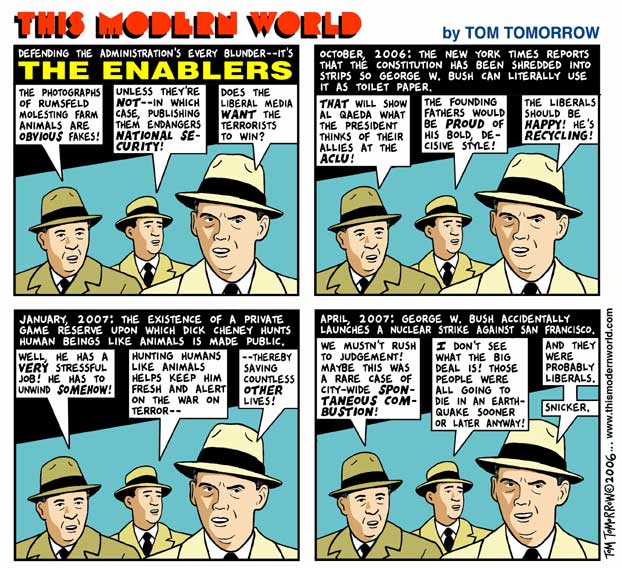
This Tom Tomorrow cartoon appeared late last month. It is truly hilarious.

Sunday, September 10, 2006

Tune out tomorrow
I'm going to do everything I can to keep the television turned off tomorrow. I suggest that everyone else try and do the same thing. Shut the TV off. Don't bother. Don't get sucked in. It is going to be difficult, I know. I'm a 24-hour news person. I have to keep the thing on. But I'm going to try not to.

I personally find this entire 5 year anniversary stuff cryptic and manipulative. It is whipping up fear in the hearts of men and it is unnecessary because there probably aren't going to be any more terror attacks on the level which we saw on Sept. 11 no matter who is in power and no matter what they do policy-wise. I could be wrong, but I doubt it. And that is how I feel about it. I will, however, apologize ahead of time to anyone who may lose their lives in future terrorist attacks in the United States because there could be smaller terrorist attacks like those which have occured in Europe and Asia all the time. It should be noted that Asia and Europe don't have the freedoms we have and yet, even with all their security, they still have terror attacks and probably always will.

I will leave readers with these thoughts when thinking about the 5 year anniversary: Benjamin Franklin once said, "They that can give up essential liberty to obtain a little temporary safety deserve neither liberty nor safety." Eisenhower once said, "We will bankrupt ourselves in the vain search for absolute security." He also said this: "If you want total security, go to prison. There you're fed, clothed, given medical care and so on. The only thing lacking ... is freedom."

Think about that for a bit. I will have a headline roundup tomorrow.

Saturday, September 9, 2006

Mass. Dem Debate
Crossposted at Talking Politics Blog
I too watched the debate and actually thought all three did pretty well considering the situation - a dead-heat, three-way primary, a couple of weeks from Election Day, with millions flying around and accusations flying every which way. However, I also think we can all agree that any one of them would be better than Mitt "Guy Smiley" Romney.

I don't know about Kerry Murphy Healey yet. I know she is very smart and actually quite charming when you meet her in person. But I don't know how she would actually govern. Having seen some of her moves over at the MassGOP, there is reason to wonder how she would run the state. Although, again, anything would be better than Romney right now.

I liked Mihos and his message. Being an “unbought and unbossed” indie myself, I was really intrigued by his run. However, he lost any and all credibility with me when he picked John Sullivan, the town moderator of Winchester, as his running mate. Since I used to be the editor of The Winchester Star, I know Sullivan all too well and believe me, the man is unqualified to be the second in command. While I couldn’t prove the guy was dirty, it sure felt like he was.

Anyhow, I listened to both WRKO talkers John DiPetro and Howie Carr the day after the debate – hey, I was on the Cape and nothing else was on the radio except classical music, which I also enjoyed over the past few days. DiPetro had Andy Hiller on and I only caught a bit of it before getting out of the car. Hiller talked about nailing Reilly with a Big Dig question – and nail him he did. Reilly has been asleep at the wheel on that although he was correct to point out that this project has been run – and overseen – by Republicans. But Reilly hasn’t done enough as AG to look at this thing or prosecute the criminals. And that is because the Dems and the unions have had their fingers in the batter the entire time Bechtel and Republican governors have been driving it into the ground.

I also agree with Carr’s points about Reilly: Reilly came out swinging and needed to. While it may have seemed like bitching to some, as Carr noted, that is what politics is about. It is about hardball. It is about nailing the other guy if you can with whatever you have. Especially if you are losing, like Reilly seems to be. And, Reilly needed to do something and that is kinda all he had. 'I've been with the regular folks ...' and you know, he has for the most part. Working folks in Meffa, Revere, Dot, and all those other towns – folks who actually vote not pseudo progressives who talk and don't act – know this and will be out for him. His ads also work as do Gabrieli's, IMHO. While some will be upset with the Conte thing, it won't be enough for him to lose. I still think he could win, despite what polls say. There is a silent majority out there that pollsters never talk to.

Also, an interesting point was made by one of Carr’s callers: Reilly kept saying ‘The voters know where I stand’ and the caller stated that Louise Day Hicks was the last pol to use that slogan [“You know where I stand …”] as a veiled message asking white voters to support her in her mayoral races from the late 1960s and early 1970s. Hicks was an anti-busing School Committee member from Southie who was elected to the U.S. Congress for one term. Joe Moakley, who bypassed the primary and ran as an independent, later ousted her in a brutal election in 1972. She later became the first woman president on the Boston City Council. Hmm.

Gabrieli was on his game, directly making his succinct points, over and over again. He was also towering over the other two. Having debated with him before, back in 1998, I found him to be a very easy-going and likable guy. But, he is a towering figure. And watching him the other night and realizing how he stood over the other two had to have a mental presence on voters.

I think the Ameriquest thing – as well as Killer Coke – hurts "For it all" Deval. All the inspirational speeches in the world don't make up for the fact that a person has been in the tank with the corporate whores for years and years. Gabrieli can point to hundreds – if not thousands – of jobs he has created. His plan will clearly create more. Reilly can point to other things he has done. What has Patrick actually done? He also didn't look well on TV. While Gabrieli and Reilly looked cool and calm, Deval was sweatin' up a storm.

Having hung around with a slew of progressives over the years, I don't get the obsession with Deval Patrick. So he is black. Big deal. If he wasn't, none of these 20,000 people would be backing him.
For example, let’s say Deval Patrick wasn’t black and was named, Daveo Patricino or David McPatrick, would they be goo-goo over him? No, of course not. Say he was from the North End or Southie instead of the South Side, and worked his way through Harvard, they would look at Ameriquest and Killer Coke and run away in droves.

Update:
Dan Kennedy has a round up on some of the media coverage: ["It's Almost Unanimous"].

Update 2:
It's 12:57 a.m. and I have just seen a second Deval Patrick political ad, right at the end of SNL. Is he trying to appeal to the insomniac crowd? Ads at this hour are a waste of money ... unless TV ads are a lot cheaper than they were in 1998, when spots in the 6 and 11 p.m. news hours were going for thousands.

Saturday, September 2, 2006

Friday, September 1, 2006

More signs of the [war]times
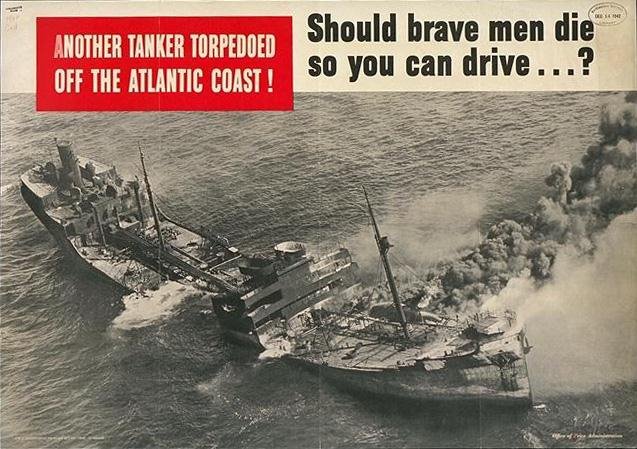
In a post earlier this week, I talked about wartime sacrifices of the past and the lack of them today. Here are a few more for your viewing pleasure with a few notes from me. I'm pretty astonished that these were done and that people followed them:

This sign looks more like an energy crisis poster than a war poster. But the advice is pretty much commonsense ... and interesting that this one is probably from a landlord somewhere. Close your windows, don't waste hot water, don't demand heat 24 hours a day, etc. Well, duh. These are all relatively simple and minor things you can do to preserve energy during the winter months.


Again, another one: Grow your own; Can your own, a part of the national victory garden movement of the time period. Some victory gardens still exist like the huge one in the Fenway neighborhood of Boston. Nation [or in this case, individual] self-sufficiency has been something I have written about and championed for a long time, especially when it comes to globalism and [supposed] free trade. Each and every day, I drive past a little farm this old Republican guy has in his front yard [I only know he is a Republican because over the years, he has had signs for President Bush and U.S. Rep. Charlie Bass in his yard although it is interesting to note that it is campaign season and there is no Bass sign up yet]. I get so jealous driving by this guy's house, thinking about all the fresh veggies he has in the fall - corn, beans, pumpkin, tomatoes and squash - mmmmm. Oh course, he is retired, so he has time to garden. But, I'm still jealous.


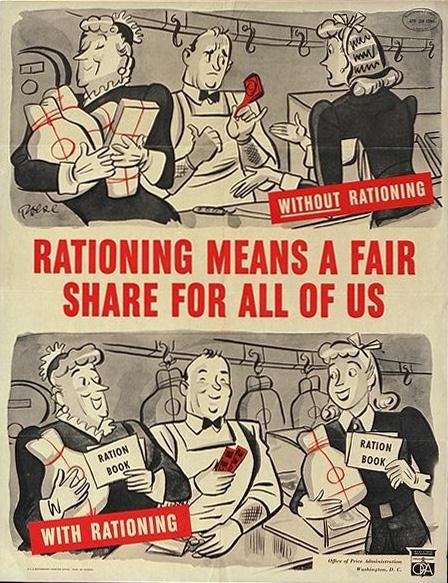
This is another interesting sign and it has class-conscious connotations. The older woman hogging all the food is drawn as if she is kinda from the upper crust side of the street. Note the frilly hat and blouse, and the pearl earrings. A very Barbara Bush, old Yankee kinda look. And look at the way the artist has her turning away, chin in the air, with faint disgust, at the more working class momish female who pleads for more than one chicken leg to feed herself and/or her family. Can you even imagine the words "fair share" being uttered in post-Sept. 11 America by the Defense Dept. or anyone in the government? It's so ... so ... Socialist!


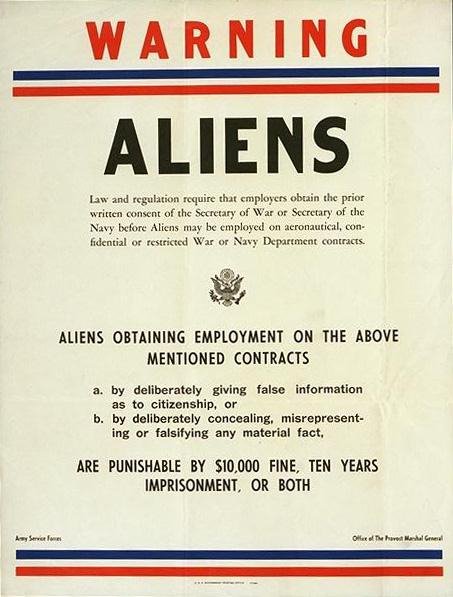
Now we come to this little ditty. It speaks for itself. Although, the government was probably more worried about trade secrets at weapons manufacturers being lost to the enemy than depressed American wages due to cheap labor.

Tuesday, August 29, 2006

Where are the wartime sacrifices now?


Posters like these from World War II seem almost laughable now.

I wasn't around during WWII, obviously, and was only a wee bitty of thing during 'Nam. Desert Shield/Storm wasn't really a war in my mind - it was a total slaughter covered by the media. And none of the military conflicts or covert ops our government is involved in around the world all during the last two decades were official wars.

But, we are, unfortunately, involved in one now. And from the looks of it - even with a regime change from this one to one controlled by the Democrats - it will probably be an unending war for awhile.

I got to thinking about that last week a bit when I had a free minute to think. I was wondering about past wars and how it would be interesting to go back in time and be a fly on the wall during WWII. It would have been interesting to hear the kitchen conversations of the time period. The reason I've been thinking about how normal folks worked, lived, and acted during the last big and real war, was that I saw this Northwest University site: ["World War 2 Poster Collection"] which had an archive of all these old signs from the 1940s asking people to sacrifice for the war effort. Give up a little for our boys so they don't have to. Horde and recycle - before recycling - rags, rubber, animal fat and fuel. I mean, after all, they were fighting the dark menace of the Nazis and Hitler. Never mind that Standard Oil and IBM were helping the Nazis while our boys were dying and all.

But, the propaganda posters were used to make the American people think that they were a part of this world war, that the sacrifice of American boys and citizens mattered, and that we were all in it together, in a way. And that war did matter despite the isolationist tendencies of the time period and the rumor/fact that FDR knew that Pearl Harbor was going to be attacked and let it happen - hint, hint, sound familiar? - in order to drag the American people kicking and screaming into the war against the Axis powers.

But doesn't it make you think about where is the wartime sacrifice now?

Sure, war is a racket, but there are numerous support the troop rallies and drives to come up with materials our soldiers need in Iraq and Afghanistan, like Chapstick and talc, while they are guarding trucks with cheesecake on it, while Haliburton gets billions, and while billions more are lost and unaccounted for. Imagine that.

Imagine a public service or government-sponsored ad program suggesting that Americans in 2006 save their rubber for the war effort! Imaging saving your leftover dinner fat to the local butcher to be used in explosives. Imagine even carpooling?! Imagine growing hemp for the war effort. They did that too.

More posters later ... but it is all something to think about in this day and age.

Monday, August 28, 2006

Gore today; Gore yesterday, Part Whatever ...

On telecommunications consolidation, from the article ["Gore Lashes Out at Media Consolidation"], published on Monday, Aug. 28, 2006:

Former Vice President Al Gore said Sunday ever-tighter political and economic control of the media is a major threat to democracy. Gore said the goal behind his year-old "interactive" television channel Current TV was to encourage the kind of democratic dialogue that thrives online but is increasingly rare on TV. "Democracy is under attack," Gore told an audience at the Edinburgh International Television Festival. "Democracy as a system for self-governance is facing more serious challenges now than it has faced for a long time.
"Democracy is a conversation, and the most important role of the media is to facilitate that conversation of democracy. Now the conversation is more controlled, it is more centralized."
He said that in many countries, media control was being consolidated in the hands of a few businesspeople or politicians.

And then, back in Jan. 11, 1994, when he was vice president, could really do something about it, and issued the first white paper which later became the 1996 Telecom Bill:

As I announced last month, we will soon introduce a legislative package that aggressively confronts the most pressing telecommunications issues, and is based on five principles. This Administration will: Encourage Private Investment; Provide and Protect Competition; Provide Open Access to the Network; Take Action To Avoid Creating a Society of Information "Haves" and "Have Nots"; Encourage Flexible and Responsive Governmental Action.
Many of you have our White Paper today, outlining the bill in detail. If you didn't get your copy, it's available on the Internet, right now. Let me run through the highlights with you -- and talk about how they grow out of our five principles.
We begin with two of our basic principles -- the need for private investment and fair competition. The nation needs private investment to complete the construction of the National Information Infrastructure. And competition is the single most critical means of encouraging that private investment. ...
Today, we must choose competition again and protect it against both suffocating regulation on the one hand and unfettered monopolies on the other.

Gee, wonder what he thinks now.

And here is Ralph Nader, who got it right at the time and on Aug. 23, 2000, when this text was read:

There is indeed another major area that the two major candidates won’t touch and that is the big media. It is the mass media concentrated in six media conglomerates: Disney, General Electric, Time-Warner, the Murdock chain, etc., which Professor Ben Bagdikian, over there at Berkeley, says now control the bulk of the audiences and the circulation of newspapers, magazines, radio stations, and TV. Well, it was William Jefferson Clinton who signed the Telecommunications Act of 1996, which allowed corporations to buy up more and more TV and radio stations.
Before 1996, no company could own more than 12 radio stations. Now, one company owns 800 radio stations. They are laying off reporters. They are not covering local news. They’re giving you homogenized syndicated pap like Dr. Laura and Rush Limbaugh. Indeed, Gore and Bush will never raise this in the campaign. They are afraid of the big media. They are afraid that they might unleash a storm of challenge among the American people who would become aware that they, as a commonwealth legal right, own the public airwaves. They are the landlords!
It’s not Bush and Gore who are going to say to the American people that if they become President, they will make sure that some of those public airwaves will be transformed into your own TV and radio stations and cable channels, funded by a fee imposed on the broadcasters who for 65 years have gotten our property, free of charge, without paying any rent to we, the people, who are the landlords.

We've all seen the ill-effects of this bill but it is important to remember some of them. It deregulated most cable TV rates - and we are now all paying huge bills ... it eliminated the rule barring a single company from owning more than 12 TV stations - and now these same stations bar anti-war ads they don't like from the airwaves ... $70 billion in digital spectrum given away for free ... it also allowed radio stations to be consolidated into a few corporate hands and many other deregulations which have led to the pathetic state of media these days.

It is also important to remember that it sailed through the Senate [91-5] and the Congress [414-16] meaning that it was a bipartisan mistake - like most - and all those Democrats now who bitch about it and continue to reelect their corrupt representatives are a bunch of hypocrites.

Sunday, August 27, 2006

Buchanan right on immigration

No pun intended. I haven't read Patrick J. Buchanan's new book, "State of Emergency," but if it is anything like his previous books "The Great Betrayal," "The Death of the West," or "A Republic, Not an Empire," he won't have any trouble convincing me of his theory that illegal immigration has reached the emergency point in this nation.
This may upset my more liberal friends and readers, but the simple fact is that Pat Buchanan, no matter what we may think about him, is correct on many issues, like international trade, the invasion of Iraq, gun ownership, and immigration.
In the past, Buchanan has talked about the issue of illegal immigration from the standpoint of depressed wages and culture.
Frankly, I don't get into the concept that illegals are lazy and collecting welfare and crap like that, some of the ideals espoused by Howie Carr and others. Sure, that might be true in some cases. But, in most cases, it is a rarity. Many illegals are breaking their backs to build our country. The problem is that they are often working for less than the minimum or prevailing wage which then depresses wages for everyone else, especially those folks who were born here, pay taxes here, and have no other choice but to live here.
What they should be doing is breaking their backs to build their country. And, if we didn't have a corrupt foreign policy, our nation would be trying to bring their standard up - and not dragging it down via NAFTA and other policies - which only encourages them to come the United States to work. But, that wouldn't make cheap goods for consumer markets here, now would it?
Illegals are also sending their money back to Mexico by the billions and billions - essentially taking huge swathes of cash out of our economy and putting it into their home economy. This money, had it been earned by native born and legals, would be spent here, boosting our economy, and not that of Mexico and other countries, whether from the south, north, east or west of the border.
Just as an aside, here in the state of New Hampshire, prison costs for illegals costs millions of dollars, with more than 15 percent of prisoners being illegal immigrants; money that is otherwise not being spent on other things, like roads, bridges, and health care for poor kids; cells which would otherwise be filled by other criminals who should probably be in jail too.
This doesn't even get to the issue of future potential terrorism issues and the fact that while our borders are not secure, we are more in danger of attack than anything going on with Iran or North Korea.